
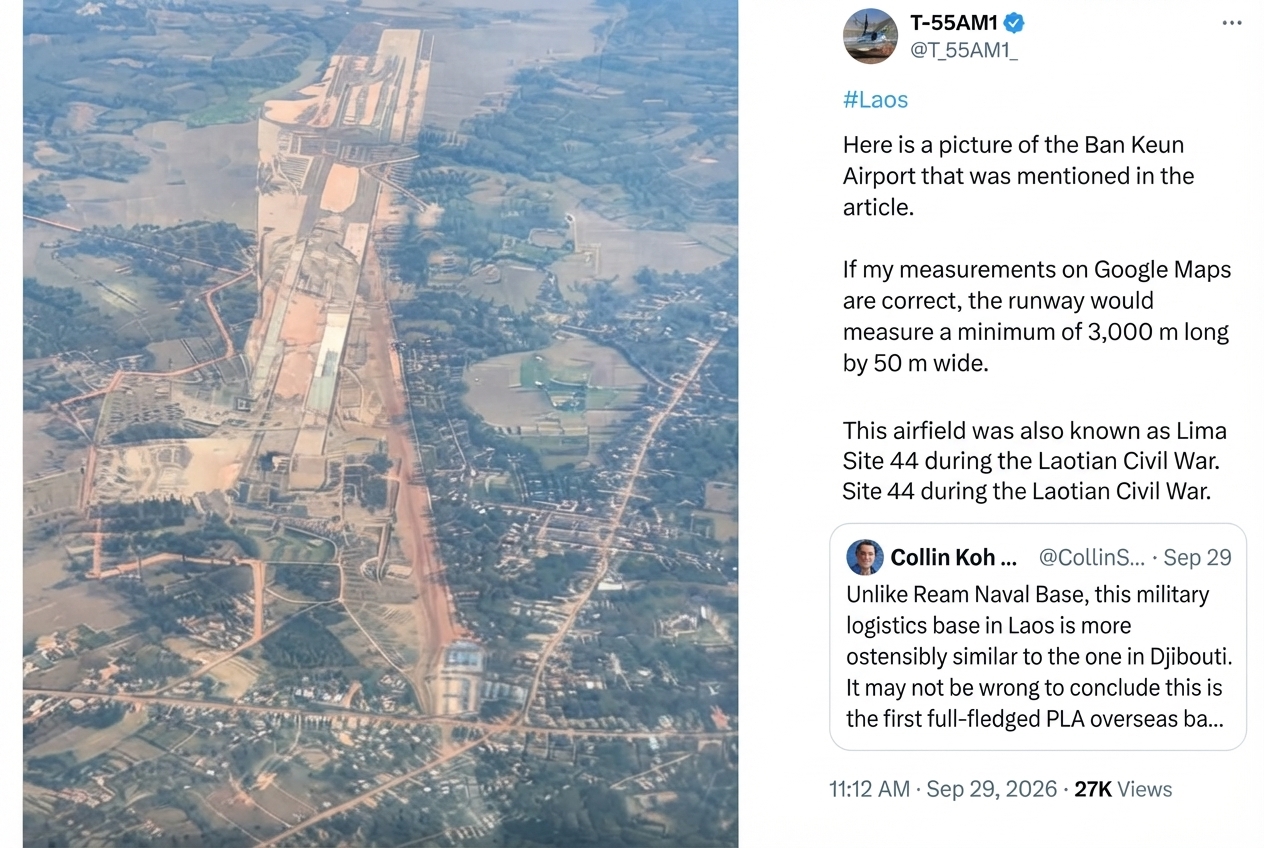
Recent satellite images indicate that light attack aircraft and military vehicles have appeared in a joint training facility newly established by the Chinese Communist Party in Laos. As construction continues at the facility, diplomats and analysts are closely monitoring whether it will expand beyond training to include broader military purposes.
According to images obtained by Reuters from the commercial satellite company Vantor, on September 30th, approximately 8 aircraft suspected to be K-8 planes and over 20 support vehicles were seen on a runway that is still under construction in Ban Keun, located about 50 kilometers north of the capital city of Vientiane in Xiengkhouang Province, Laos. The images also show ongoing extensive construction around the runway.
The Chinese Ministry of National Defense announced the establishment of this joint training facility on September 29th, stating that it aims to assist Laos in enhancing the training of its air force pilots and is not targeted at any third party. However, analysts speculate that this facility could potentially become China’s first full-fledged overseas military base in Southeast Asia.
Rachel Vandenbrink, a senior analyst at the Australian Strategic Policy Institute, mentioned that the choice of Ban Keun for setting up a facility for the Chinese military indicates a pursuit of opportunities rather than solely meeting apparent operational needs.
Vandenbrink noted that Laos shares a border with China and has infrastructure connections, including railways, making it a convenient foothold for entering the mainland of Southeast Asia, thereby possessing a certain level of geostrategic value.
Security analysts and experts from Vantor have identified the aircraft in the images as Hongdu JL-8 planes, also known as K-8; both the Chinese and Laotian air forces use this type of aircraft.
As construction progresses, diplomats and analysts are observing whether there are indications of the presence of air defense systems, ammunition and fuel storage facilities, as well as surveillance or reconnaissance facilities at the site; these signs may suggest that the facility will undertake broader military functions beyond training.
Alexander Neill, a researcher at the Hawaii-based Pacific Forum, mentioned that although the current runway at the airport is relatively short, it may potentially be used by larger aircraft in the future, including signal intelligence and electronic reconnaissance planes. He added that the airport’s engineering design seems to have accommodated the possibility of extending the runway.