
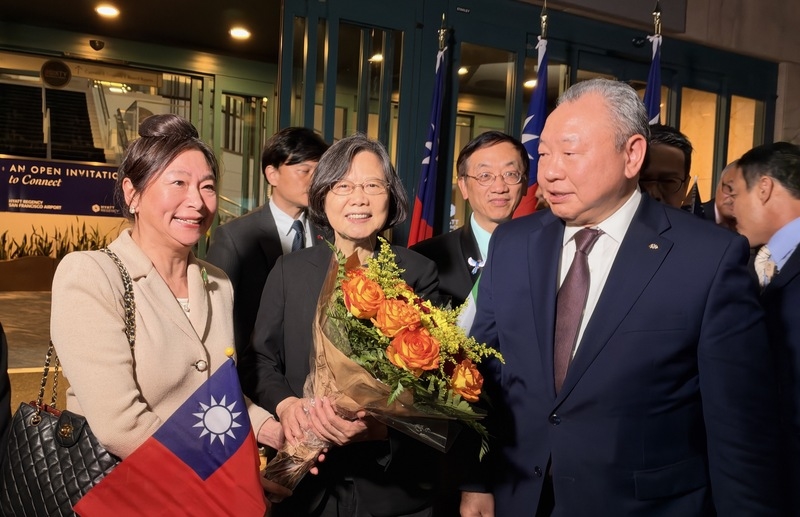
Former President of the Republic of China, Tsai Ing-wen, is set to attend the “2026 Technology and National Security Conference” at Stanford DEFCON at Stanford University in the United States on October 7. Experts familiar with international affairs pointed out on the 6th that this highlights Taiwan’s irreplaceable strategic position in global critical technology, semiconductor supply chain security, and Taiwan-US defense security cooperation.
Tsai Ing-wen arrived in San Francisco on the evening of the 5th local time and will embark on a week-long exchange visit. This is her first visit to the United States since stepping down from office. Tsai Ing-wen is expected to deliver the opening keynote speech at the “2026 Technology and National Security Conference” at Stanford DEFCON on the 7th.
Experts noted that Tsai Ing-wen’s invitation as the keynote speaker of this year’s conference is not only her first visit to the United States after stepping down but also marks the first time a former leader of Taiwan has participated in this prestigious defense forum.
Against the backdrop of escalating tension in global geopolitics due to the continued expansion of authoritarian states, the security and efficiency of defense supply chains have become a top priority for countries worldwide. The organizers inviting Tsai Ing-wen to deliver the opening speech not only highly commend Taiwan’s democratic resilience but also underscore Taiwan’s irreplaceable strategic position in global critical technology, semiconductor supply chain security, and Taiwan-US defense security cooperation.
Experts say that this event brings together top Silicon Valley venture capitalists, emerging defense unicorns, senior Pentagon officials, decision-makers, and international dignitaries, establishing Stanford DEFCON as one of the most iconic strategic dialogue platforms in the global defense technology field.
The conference in 2024 focused on the “Interweaving of Commercial Technology and National Security,” while 2025 emphasized “Leading Future Defense and Technology Leaders,” focusing on leveraging large language models (LLMs) and commercial satellites for defense advantage in the era of strategic competition. This year’s 4th annual meeting centers on “Innovation and Defense Industrialization of Allies under Geopolitical Competition,” with a strong emphasis on battlefield AI autonomy, asymmetric warfare, and how allied countries can reshape secure defense supply chains.
With such a high-profile strategic positioning, reflected in the expanding roster of attendees year after year, Taiwan’s role as a global leader in efficient and capable high-tech manufacturing is particularly significant with Tsai Ing-wen’s presence, holding special strategic significance for US-Taiwan defense innovation cooperation.
Experts analyze that from Tsai Ing-wen’s invitation to the involvement of Taiwan’s young startups, it showcases Taiwan’s strength as a “Tech Island” at the intersection of global technology and democratic resilience. Just as the organizers point out, Taiwan’s experience is at the crossroads of technology, economic security, and strategic competition.
Taiwan not only holds crucial capabilities in global semiconductor and key supply chain but also demonstrates resilience in the face of complex geopolitical environments and various new types of threats. This resilience has become an indispensable partner for the United States and allied countries in enhancing security resilience and defense supply chain security.
As Stanford DEFCON plays an increasingly important role as a defense venture capital accelerator, Taiwan’s advantages in hardware manufacturing, chip design, and agile software development are accelerating the establishment of more resilient and substantial defense collaborative research and supply chain mechanisms globally in the next generation of defense innovations such as unmanned vehicles and battlefield low-orbit satellite communications through connections with Silicon Valley defense venture capital, alignment with the defense needs of the United States and international allied countries.
(Source: Central News Agency)