
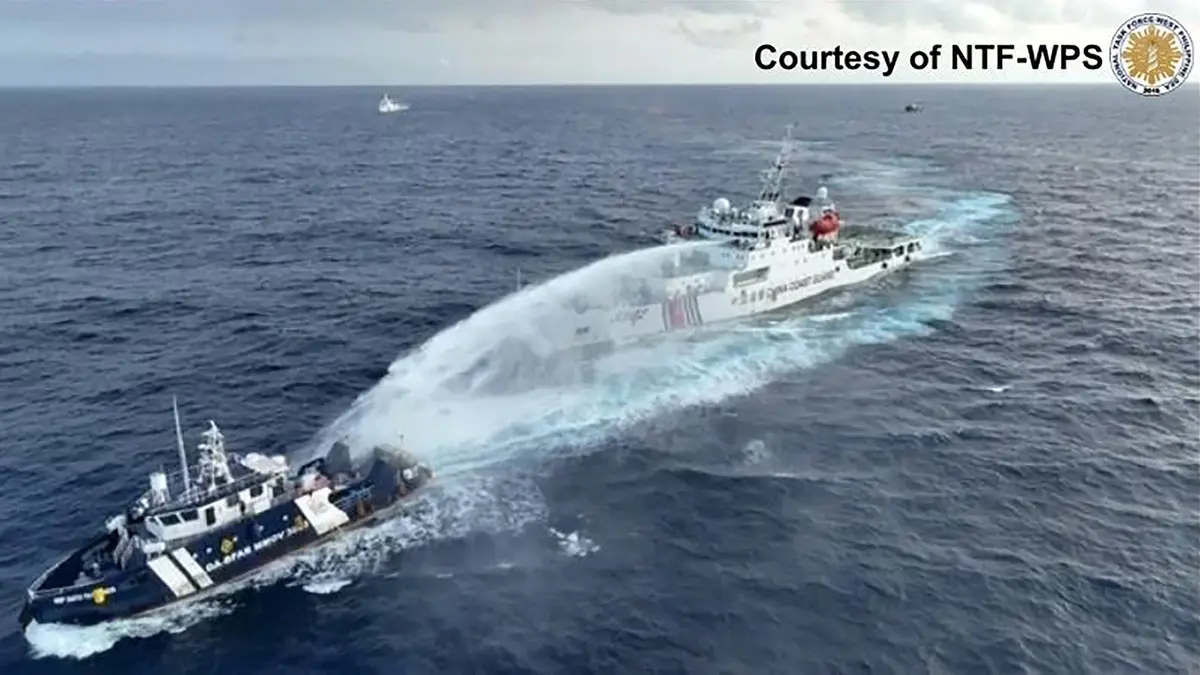
In recent years, the Chinese Communist Party (CCP) has been consistently strengthening its military, law enforcement, and infrastructure activities in the South China Sea. From island reclamation, coast guard patrols, to joint sea and air operations, and the expansion of its shipbuilding industry, these activities demonstrate that its marine strategy is gradually evolving from just modernizing its navy to establishing itself as a maritime power.
Observing the CCP’s maritime strategy requires looking beyond just the number of warships and aircraft. It is crucial to also focus on how it integrates capabilities such as coast guard, navy, air force, unmanned systems, ports, shipbuilding industry, and maritime transportation. Therefore, the South China Sea is not just a region of sovereignty and maritime rights disputes, but it has become a vital strategic space for the CCP to exert its maritime strategy. It is noteworthy that while the CCP is promoting maritime strategy (holistic strategic layout), the U.S. emphasizes building a maritime alliance.
Of recent concern is the progress of the CCP’s construction of a large airstrip on the Fiery Cross Reef in the Spratly Islands. According to a report by Reuters on October 2, satellite images indicate that construction on the Fiery Cross Reef is accelerating, including the construction of the airstrip, land reclamation, and other infrastructure. At the current pace, the airstrip may be capable of accommodating aircraft takeoffs and landings as early as around mid-2027.
The strategic significance of these developments lies not only in adding an airstrip but potentially establishing a fixed base that can sustain long-term maritime and aerial activities. If further enhancements are made in radar, communication, logistics, and maintenance facilities, its role could transcend being merely an aircraft base and become a crucial strategic support point for the CCP to maintain its maritime and aerial strength in the South China Sea.
From a maritime strategy perspective, the value of fixed facilities lies in transforming what was once a temporary military presence relying on ships or aircraft into the ability for long-term deployment. This trend of “normalization” may be more significant than individual military actions themselves.
Additionally, activities around the Scarborough Shoal are increasing. At the end of September, the CCP conducted joint air and sea patrols and readiness activities around the Scarborough Shoal involving various forces such as warships, supply ships, drones, early warning aircraft, fighter jets, and bombers. From a strategic standpoint, such activities, along with infrastructure development on reefs and islands, demonstrate a certain continuity.
When warships occasionally enter a particular sea area, it constitutes a one-time military presence. However, when warships, aviation forces, unmanned systems, and supply forces gradually establish a fixed operational pattern, it may lead to different strategic effects.
Nevertheless, this does not imply that the CCP has gained comprehensive legal control, but rather reflects its efforts to increase its presence.
An important feature of maritime strategy is that “presence itself has meaning.” If the CCP’s law enforcement, military patrols, and aviation activities become routine, over time, the strategic environment in the relevant maritime areas will continue to evolve, a phenomenon referred to as “normalization.”
The issue of the South China Sea involves both international law and actual maritime power. According to the United Nations Convention on the Law of the Sea, coastal states are entitled to a territorial sea of up to 12 nautical miles, with a contiguous zone extending up to 24 nautical miles. However, different maritime areas have distinct legal regimes, and a 24-nautical-mile zone does not automatically grant a country full military control beyond its borders.
Therefore, when analyzing China’s South China Sea strategy, it is necessary to distinguish between “sovereignty claims,” “legal rights,” and “actual control capabilities.”
Legal claims represent one aspect, while maritime power and daily presence constitute another dimension.
When coast guards, navies, aviation forces, and unmanned systems operate long-term in specific maritime areas, the strategic presence established differs from the effects of occasional patrols.
This aspect is an important facet to observe in the current situation in the South China Sea – how China gradually transforms its existing maritime assertions into a more sustainable and concrete maritime presence.
The significance of the South China Sea as a critical maritime area in the CCP’s maritime strategy is tied to its unique maritime geographical conditions. Depending on various research and statistical sources, the South China Sea covers an area of approximately 3.3 to 3.5 million square kilometers, with an average depth exceeding 1,000 meters. Some areas in the central deep basin have depths exceeding 5,000 meters. In contrast, the Bohai Sea is relatively shallow, much of the Yellow Sea constitutes continental shelf waters, while the western part of the East China Sea features extensive continental shelves with deeper waters concentrated in the east and the Okinawa Trough.
Thus, from a purely maritime geographic perspective, the South China Sea is a deep blue area, which is crucial for submarine and other naval forces.
The CCP’s military possesses important naval facilities such as Yulin on Hainan Island, and the South China Sea to the south of Hainan boasts vast areas of deep waters that provide different conditions for maneuverability and concealment for underwater military forces compared to nearshore shallow seas.
However, deep waters do not equate to absolute safety. Modern anti-submarine warfare involves satellite, sonar, anti-submarine aircraft, unmanned systems, and various maritime and aerial surveillance means. Nevertheless, deep-sea environments indeed offer unique operational spaces.
Geographically, compared to the East China Sea, the South China Sea provides another significant strategic space for the CCP to extend its reach towards the Western Pacific. The East China Sea directly faces the southwestern Japanese islands, Taiwan, and other pivotal points of the first island chain, where naval and aerial surveillance and military deployment density are notably high. In contrast, the South China Sea offers a broader maritime depth.
The Chinese navy can extend southward from Hainan through the nearby Bashi Channel and Balintang Channel into the Western Pacific. Nonetheless, the geographical advantage of the South China Sea does not automatically translate to an easy breakthrough of the first island chain.
The first island chain is not a simple line on a map; rather, it forms a network comprising islands, harbors, airports, radars, communication facilities, and military bases.
Therefore, for the CCP to convert its geographic advantage in the South China Sea into long-term military capabilities towards the Western Pacific, it requires coordination across multiple capabilities such as reconnaissance, command, communication, logistics, anti-submarine warfare, and joint operations. From this perspective, “breaking through the first island chain” is more suitable as a facet to observe in analyzing China’s maritime strategy rather than the whole picture.
Another focal point to note in China’s maritime strategy is its vast maritime industrial system.
A column from Reuters Breakingviews on September 21 cited data from Clarksons Research, stating that Chinese shipyards accounted for approximately 74% of global new ship orders in the first seven months of 2026. This figure does not directly equate to China’s naval power nor simplistically imply that China possesses 74% of global military shipbuilding capacity. However, it reflects China’s establishment of a significant shipbuilding and maritime industry foundation, involving multiple industries such as steel, machinery, electronics, ports, shipping, energy, and maintenance.
From a long-term maritime strategy perspective, these capabilities not only support commercial shipping but also serve as a crucial industrial backbone for sustaining the country’s maritime power. Especially in the rapid advancement of systems like drones and unmanned vessels, industrial scale remains imperative.
While the cost of individual unmanned platforms may be lower than traditional large weapon systems, widespread deployment signifies substantial production, maintenance, replenishment, and replacement demands.
Thus, future maritime competition encompasses not only competition between a few high-performance platforms but also potentially competition encompassing entire industrial systems.
From a broader strategic perspective, China is currently attempting to realize the modernization of its navy. This entails not only possessing warships but also having capabilities in shipbuilding, ports, merchant ships, maritime energy transportation, coast guard law enforcement, aviation strength, satellite communication, and maintenance and replenishment logistics.
However, if China’s direction is gradually transitioning towards becoming a maritime power, the United States presents a different maritime strategy model – building a maritime alliance.
America’s strength stems not only from its naval power but also from the network of allies and partners it has long established.
Countries like Japan, the Philippines, and Australia possess diverse geographical locations and military capabilities, while the U.S. provides essential capabilities such as intelligence surveillance, long-range strikes, aircraft carriers, nuclear deterrence, command communications, and logistics.
Hence, the disparity between China and the U.S. in maritime strategy extends beyond a mere comparison of military scale to include two distinct organizational models.
The CCP emphasizes integrating its own maritime capabilities, whereas the U.S. excels at linking the maritime capabilities of different countries into an alliance network.
As these two frameworks gradually converge in the Western Pacific, a structural competition has already taken shape.
China’s strategy is evolving from a “country with a navy” to transforming into a nation with more comprehensive maritime capabilities.
Therefore, when observing China’s South China Sea strategy in the future, it is essential not just to focus on the number of warships, island airstrips, or individual military exercises but also to monitor whether its navy, coast guard, merchant ships, shipbuilding industry, ports, aviation force, and unmanned systems can gradually form a maritime system capable of long-term operation.
What truly warrants long-term observation is whether China can transform its substantial industrial and military capabilities into sustained maritime strategy. Perhaps, this aspect is more reflective of the core of the strategic competition in the South China Sea and the Western Pacific than merely discussing who can or cannot “break through the first island chain.”