
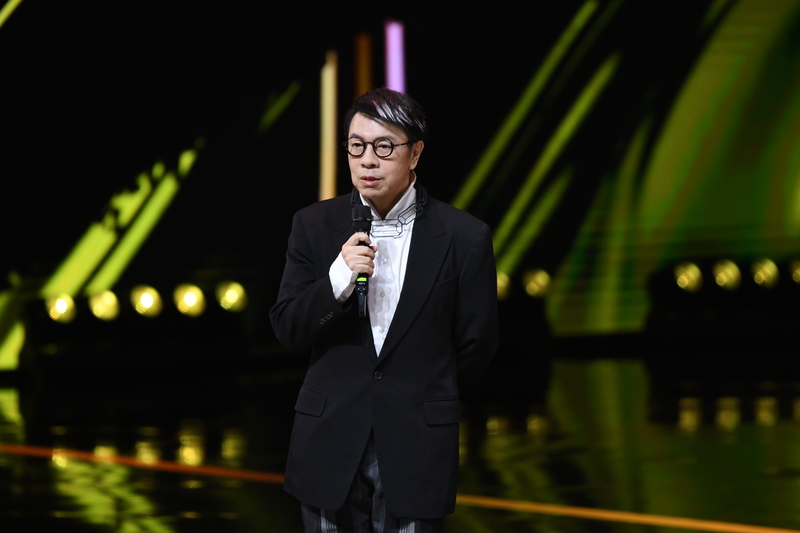
Renowned Taiwanese host Kang-Yung Tsai appeared low-key at the establishment ceremony of the campaign headquarters for Shen Boyang, the Democratic Progressive Party candidate for Taipei mayor. In a short period of time, Kang-Yung Tsai came under attack on Chinese social media, with some commercial partners beginning to distance themselves.
Japanese senior media personality and executive director of the Indo-Pacific Strategic Think Tank, Akihio Yaita, stated that this incident has taught all Taiwanese people who engage with the CCP a “very important lesson.”
On October 4th, Shen Boyang held a campaign headquarters establishment ceremony, where Kang-Yung Tsai was spotted wearing a hat and a face mask, sitting discreetly in the VIP section, holding campaign banners and cheering sticks.
Kang-Yung Tsai’s agent stated that he was there to understand the election activities and might interview the Taipei mayoral candidate in the future. Kang-Yung Tsai also mentioned that he was just there to “have a look” and hoped to hear opinions from all sides.
Since Shen Boyang had previously been labeled by the Taiwan Affairs Office of the CCP as a so-called “stubborn advocate of Taiwan independence,” Kang-Yung Tsai’s appearance at the campaign event quickly stirred up controversy on Chinese social media. A large number of online users targeted him, while at the same time, Chinese companies that collaborated with Kang-Yung Tsai began to distance themselves.
Last month, the China-based electric car brand “Leapmotor,” which had invited Kang-Yung Tsai for a collaboration, released a statement on the 4th, stating that Kang-Yung Tsai was only a participating artist in past collaboration content, not a spokesperson. They have since taken down all related content and reserved the right to pursue legal responsibilities. Meanwhile, “Fashion Bazaar” also removed promotional materials related to Kang-Yung Tsai on their September issue cover.
During the escalation of the incident, Kang-Yung Tsai’s Weibo account with 36 million followers was found to have no public posts visible, and the followings list had been cleared. Whether this action is directly related to the incident has sparked high attention.
On October 5th, topics labeled “Kang-Yung Tsai appearing at the independence advocate campaign event” and “Kang-Yung Tsai’s account cleared, unfollowed” shot up on the hot search lists.
On the same day, Akihio Yaita posted on the social platform X, stating that Kang-Yung Tsai merely sat quietly in the audience to watch the event, did not speak on stage, and did not publicly express support, yet he instantly faced a backlash in China, with collaborating brands quickly distancing themselves. He believes that this incident shows that the idea that “more interactions can defuse hostility” may not always hold true.
Akihio Yaita cautioned Taiwanese artists from three perspectives regarding the difficulties they may face when cooperating with China.
Firstly, the belief that “more interactions can defuse hostility” is probably wishful thinking.
Kang-Yung Tsai is a Taiwanese artist who has deep interactions with China. “Kangxi Coming” had significant influence across the strait, and he has long worked and hosted programs in China. However, years of interactions and accumulation can be instantly erased simply by appearing at a campaign event for Taiwan’s democratic elections. This demonstrates that when political loyalty overrides everything else, no amount of interaction can bring basic respect.
Secondly, as long as one heavily relies on the Chinese market economically, they may gradually lose their own freedom.
The Kang-Yung Tsai incident indicates that when making money in China, one not only needs to be careful about what they say but also about what they haven’t said, where they’ve been, and who they’ve been with. Eventually, what may be lost is not only freedom of speech but even the “freedom of silence.”
Thirdly, and most frighteningly, the red lines in China (CCP) are “constantly shifting.” Previously, it was thought that holding the flag of the Republic of China was a red line, then supporting DPP candidates became a red line. Now, even sitting silently in the audience at a campaign event could cross a red line and prompt a boycott.
Akihio Yaita likened making money in China to “receiving pocket money from the devil”: the money is real, but the rules are not in one’s own hands, and the other party could change the rules at any time.
He believes that the Kang-Yung Tsai incident is a wake-up call for Taiwanese artists to reconsider how much they may have to sacrifice when their work and income are heavily tied to the Chinese market, and how much freedom they can still retain.