
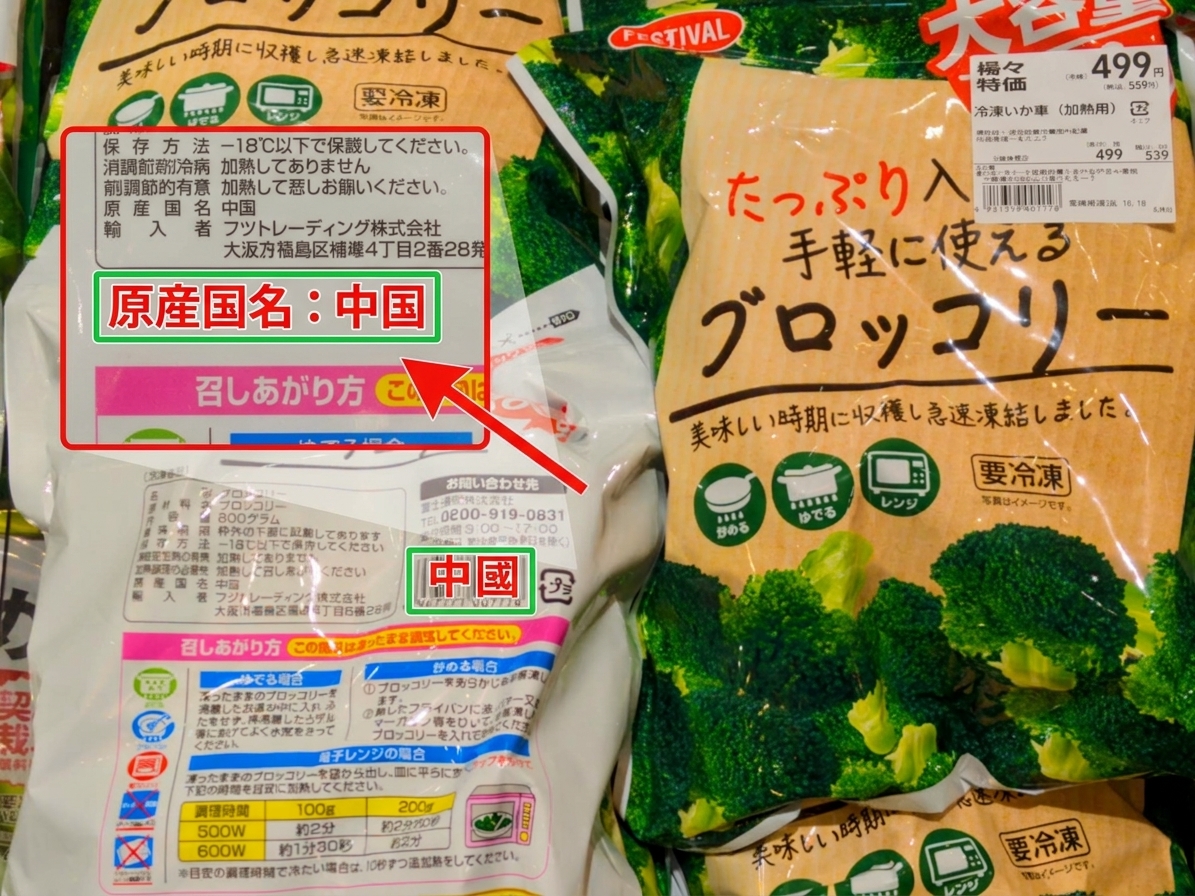
Recently, China has been hit by a series of food safety issues, sparking concerns in Japan about Chinese food products. Japanese media have published three investigative reports consecutively, pointing out various Chinese food products found to be non-compliant and already on shelves in Japanese supermarkets and restaurants. Experts have noted that some issues arise even before the freezing process, making it difficult to eliminate pesticide residues and bacterial contamination during subsequent freezing treatment.
In a recent incident, China once again faced food safety problems, including soaking cabbage in the carcinogen formaldehyde and treating bamboo shoots with sulfur dioxide, triggering attention in Japanese society regarding the safety of Chinese food products.
The Japanese weekly magazine “Weekly POST” published three consecutive investigative reports on September 25, October 2, and October 9, uncovering safety concerns in a variety of foods from vegetables to frozen seafood.
Media figure Masayuki Ogura, familiar with food safety issues, pointed out that in public data on food hygiene violations in Japan, there have been 11 cases of frozen flounder detected with coliform bacteria and 10 cases of frozen clams found with paralytic shellfish toxin. Violations involving coliform bacteria have also been reported in products such as crabs, squid, eel, conch, shrimp, scallops, and Arctic clams.
Furthermore, crabs and shrimp from China were found to exceed the standard for sulfur dioxide. Sulfur dioxide is an irritant that may cause adverse reactions in individuals with sensitive respiratory systems.
Chinese food products have already made their way into Japanese supermarkets and restaurants. Takaya Kakiya, a representative of the Japan Consumer Problem Research Institute and a food issue commentator, pointed out that these Chinese seafood products mainly enter supermarket frozen food sections, as well as izakayas, family restaurants, and in recent years, there has been a significant demand for such ingredients in chain sushi restaurants.
Investigations into the origin of ingredients from various chain sushi restaurant websites revealed that squid, clams, eel, and other ingredients are labeled as being from China.
Kakiya mentioned that due to China’s large agricultural and seafood output and its proximity to Japan, the import volume from China is naturally high. The freezing process extends the shelf life of products, and with larger shipping volumes, the unit cost decreases, leading to a massive influx of Chinese food products into the Japanese market.
Many of the food safety issues in China are considered to be societal problems before processing. Kakiya emphasized that the safety concerns do not disappear just because the food undergoes freezing. The focus should be on pesticide use, hygiene management, and processing before freezing.
“The problem does not lie in China’s freezing technology itself. The key issue is not during processing but in the contamination of food with pesticides or poisonous bacteria before freezing. If the food is contaminated before freezing, even after the process, pesticide residues persist, and the toxicity of the poisonous bacteria remains unchanged.”
He explained that although coliform bacteria are not heat-resistant, they cannot be completely eradicated even in a freezing environment at -20°C. This means that if the food is contaminated before freezing, subsequent freezing treatment cannot fundamentally eliminate concerns.
Kakiya further pointed out that in China, there is a large number of small-scale farmers and small aquatic businesses, combined with the vast geographical area, making it difficult for official and administrative authorities to provide comprehensive oversight.
“With many local small-scale farmers and small aquatic businesses, coupled with the vast expanse, it is practically impossible for official and administrative authorities to cover everything comprehensively. Not only in frozen foods, even though Japanese importers may conduct random inspections locally, achieving total supervision is near impossible given the current situation,” Kakiya said.
His statements indicate that even with Japanese importers sending personnel for sampling inspections, it is challenging to oversee all aspects of Chinese food from agriculture, production, processing to pre-freezing. For food already contaminated at the source, subsequent freezing and transportation processes will struggle to eliminate existing risks.