
【Epoch Times News, October 4, 2026】Pacific Airshow, a signature event in Southern California since its establishment in 2016, kicked off in Huntington Beach, Southern California on October 2nd for a three-day extravaganza of awe-inspiring aerial displays and on-ground carnival activities.
The chief operating officer of the airshow, Sam Pearce, mentioned, “Our primary goal is to inspire the next generation’s interest and passion for the aviation industry.” The beach area usually sees between 500,000 to 800,000 visitors over the weekend, but the airshow attracts even larger crowds. The event features various STEM interactive activities, displays by sponsors, and top-flight performance by global aerobatic teams. Attendees can enjoy thrilling aerobatic displays, beachside entertainment, meet-and-greets with favorite pilots, indulge in beach cuisine, bars, live music performances, and more family-friendly entertainment.
The airshow has been honored multiple times, listed as one of the “Top Three Best Airshows” by USA Today in both 2021 and 2024. The U.S. Air Force Thunderbirds also named it the “Best Civil Airshow Venue of 2022.” Pearce expressed gratitude for the support from the local government and various stakeholders, mentioning, “We are from Code Four Company, based in Huntington Beach, the organizers of the Pacific Airshow; we also host similar events on Australia’s Gold Coast.”
Over the past decade, the airshow has faced various unexpected events, such as a maritime oil spill leading to its cancellation. Last year’s airshow was affected by the federal government shutdown, causing all military flight teams to withdraw. However, Pearce stated, “This year will witness the strongest lineup of jet fighters, with not only the familiar Thunderbirds but also appearances by F-22, F-35, and NASA’s F/A-18 at the airshow, making it an exhilarating weekend.”
In addition to local residents, the airshow attracts RV enthusiasts who camp in beachside parking lots. One gentleman commented, “We love the airshow and Huntington Beach; these three days are a chance for friends to gather, watch the displays and enjoy the beach. During the aerobatic displays, visitors are only allowed to stay in the shallow water, with water levels below hip height. The weather is great, making it a very family-friendly activity.”
Lauren Diaz, a member of the U.S. Air Force F-22 Raptor fighter jet team, shared, “We bring the top-notch fifth-generation fighter jets, known for their stealth capabilities, supersonic cruising, and advanced avionics systems.”
Typically, conventional jet aircraft have ground crews consisting of several hundred people, but Diaz noted, “Our team comprises only 10 members, responsible for ensuring the planes take off smoothly and each performance runs seamlessly. We tour for about 290 days a year, with the next show scheduled in San Francisco.”
Diaz, handling external communications, community outreach, and photography, mentioned the team’s anticipation for this year’s airshow after missing out on the previous year. She said, “Not being able to perform last year, we have been eagerly looking forward to this year. The entire team is loyal fans of the Pacific Airshow, enjoying the event just like the regular attendees.”
At the F-35C Lightning II fighter jet booth, three instructors, with the alias “Cupid,” Lieutenant Hunter Cultus, said, “We’re here to showcase the F-35C fighter jet – fast, loud, and visibly large, you can’t miss it.”
“The Marine Corps uses the F-35B, slightly smaller in size and capable of vertical take-off and landing, suitable for smaller vessels; on the other hand, the F-35C lacks vertical landing ability but features larger wings, designed for carrier landings, with a tailhook installed,” Cultus explained. “The F-35 excels in stealth capabilities, evading radar detection, much like the F-22.”
As the fighter jets roar past the audience at high speed, the deafening noise emphasizes the impact, prompting viewers to remember their earplugs. The booth showcases Air Force insignias and stickers for sale, as Cultus mentioned, “These items are sold to raise funds for more airshow participation and aerial performances.”
During the performances, the entire audience gazes upward. Enthusiastic and informative commentary provides the airshow with a distinct charm and appeal.
Introducing a team from the Royal Air Force Falcons parachuting squadron from the UK, flying the Side Eye Parrots twin-engine aircraft, skydiving from 10,000 feet. Spectators only spot them as they descend closer, with pink smoke canisters tied to their legs.
The team initially forms a “snake” formation, transitions to a “heart” formation, followed by a “helix split,” where even-numbered members veer right while odd-numbered ones veer left, creating two separate snake formations. The high level of coordination among team members is crucial for the visual effect, as the commentator explained.
Subsequent maneuvers include a “cross” where team members turn towards each other from both sides, crossing at over 45 miles per hour with just a few feet of clearance; then a dynamic and traditional “carousel” formation – a team favorite that tests speed, focus, and trust among members. The finale is a “saber chase,” with the team once again adjusting the snake formation before descending amidst the pink smoke.
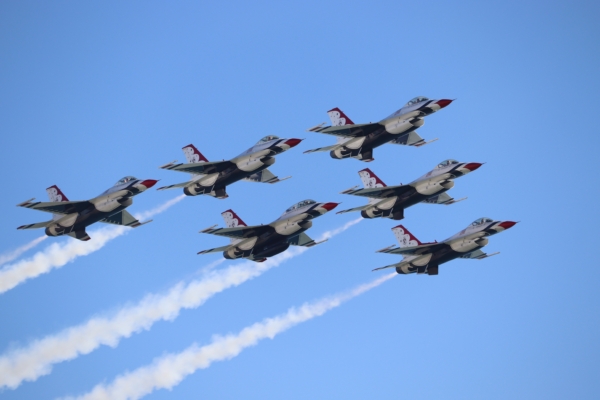
The Thunderbirds are the showstoppers. Described as the leading flight performance team of the U.S. Air Force, the Thunderbirds from Nevada comprise 130 elite personnel. Piloting F-16 Fighting Falcon jets, achieving elevations of up to 50,000 feet, climbing at a rate of 30,000 feet per minute, speeds reaching up to 2 Mach (approximately 1,500 miles per hour), and sustaining up to 9G of acceleration.
During the performance, the commentator explained the Thunderbirds maneuvering in diamond formation, with wingtip spacing of just 12 inches, maintaining the formation even during rolls; simultaneously, another aircraft performed a knife-edge pass. Solo displays included low-level repeated 4-point rolls and inverted flight; dual-plane performances featured high-speed crisscrossing, mirror flight, and four-plane crosses from four directions, thrilling and exhilarating.
Since their establishment in 1953, the Thunderbirds have inspired countless spectators, showcasing unparalleled precision, speed experiences, and astonishing power, demonstrating the might, discipline, and undisputed air dominance of the U.S. Air Force. The Thunderbirds are committed to recruiting, retaining, and inspiring Air Force personnel on a global scale. ◇