
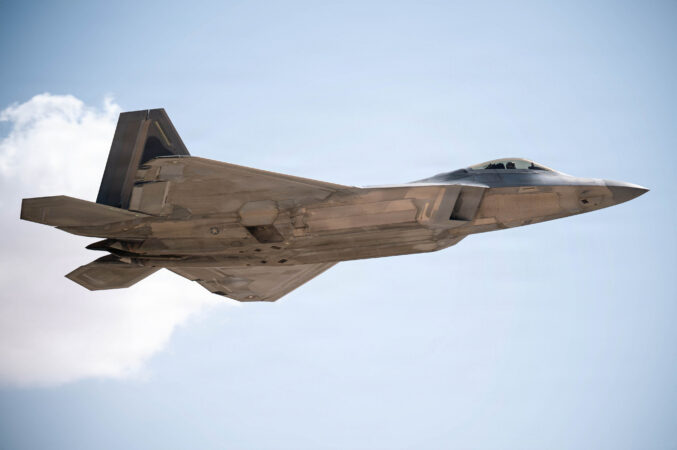
Seven F-22 “Raptor” fighter pilots were honored with one of the highest accolades by the U.S. military for their outstanding performance in escorting B-2 stealth bombers during the “Midnight Hammer” operation.
According to a press release from the U.S. Air Force on September 30, during a ceremony held in Essen, Germany, on September 22, a U.S. Air Force pilot was awarded the Distinguished Flying Cross for his performance while deployed in the U.S. Central Command’s area of responsibility.
Air Force Lieutenant General Jason T. Hinds, the U.S. Air Forces in Europe and Africa commander, presented the medal to recognize the pilot’s combat leadership, flying skills, and steadfast commitment to protecting joint forces during missions in the Central Command’s area of responsibility.
The pilot not only led the formation but also assisted in safeguarding a mission group crucial to the operation’s success. “This responsibility requires exceptional judgment, courage, and trust in the team,” Hinds said.
The pilot led a squadron of U.S. Air Force F-22 “Raptor” fighters tasked with protecting a strike group navigating through enemy-threatened airspace.
This F-22 pilot is the seventh to receive the Distinguished Flying Cross for participation in operations in the Middle East. On August 31, General Adrian L. Spain, commander of Air Combat Command, presented six other medals during a ceremony at a base in Virginia.
According to military officials cited by Air & Space Forces Magazine, these pilots were awarded for their roles in the “Midnight Hammer” strike operation against Iranian nuclear facilities in June 2025.
The pilots were responsible for escorting B-2 “Spirit” stealth bombers targeting the Fordow and Natanz nuclear facilities in Iran. In addition to the F-16 “Fighting Falcon” and F-35 “Lightning II” fighters involved in the strike group, personnel from multiple units, including air refueling crews supporting the mission, have received this honor. Personal awards for the B-2 crew members involved in the “Midnight Hammer” operation have not been announced yet.
The Distinguished Flying Cross is intended to recognize courageous acts or extraordinary achievements in the air and ranks as the fourth highest valor decoration in the U.S. military.
“For over an hour, the pilot remained focused on protecting his teammates,” Hinds stated during the medal presentation. “His actions secured the time and space needed to accomplish the mission for the strike group.”
The Air Force press release mentioned that despite facing severe challenges, including enemy threats, the pilot commanded the fleet to make critical decisions in a high-pressure, low-error environment.
“The Airman understood the risks and took decisive action to protect a larger force, ensuring the safe return of the formation,” Hinds added.
“The significance of this medal exceeds a successful mission,” Hinds stated. “It recognizes the pilot’s exceptional skill and extraordinary courage under extreme conditions, bringing significant and direct impact to the entire unit.”
The F-22 fighters stationed in Virginia were part of the escort formation responsible for escorting seven B-2 bombers. The B-2 bombers dropped 14 GBU-57 “Massive Ordnance Penetrator” bombs weighing 30,000 pounds at the Iranian nuclear facilities. This mission involved approximately 125 U.S. military aircraft of various types and was conducted after Israel’s air strikes against Iran for nearly two weeks. The stealth F-22 fighters are the main air-to-air combat aircraft of the U.S. Air Force, capable of penetrating defended airspaces with their superior performance.
According to a statement from the 1st Fighter Wing, Spain stated, “Their mission is to gain and maintain air superiority. Bomber groups and other support formations rely on these ‘Raptor’ fighter pilots to clear the airspace, counter ground threats, and ensure safe routes in contested skies.”
For operational security reasons, officials from Air Combat Command (ACC), U.S. Air Forces in Europe (USAFE), and the 1st Fighter Wing declined to disclose more details about the mission (the basis for awarding pilots with medals or decorations) or reveal the pilots’ identities.
“In the past few decades, we have awarded such medals sparingly because they are meant to recognize true heroism and extreme flying achievements; this means they should be rare, and indeed they are,” Spain remarked.