
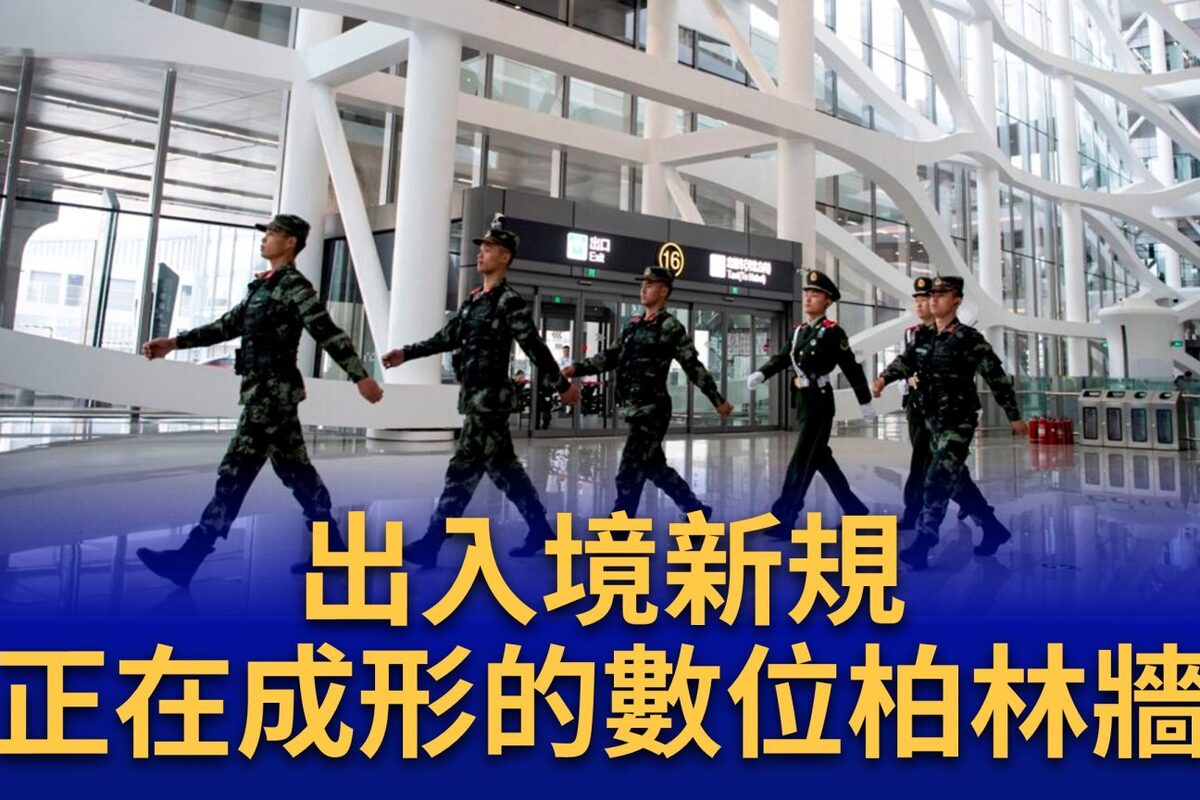
On the early morning of August 13, 1961, the East German government erected a concrete wall overnight in the center of Berlin, splitting the entire city in half. The official purpose of the wall was claimed to be “defending socialism,” but in reality, its sole function was to prevent East Germans from voting with their feet and escaping to the free world. The moment the Berlin Wall went up, the whole world understood one thing: a regime that needed a wall to keep its people in was no longer a trustworthy regime.
65 years later, although China has not built a concrete wall, it has erected an invisible digital iron curtain using big data, facial recognition, and AI risk assessment to replace guard posts and searchlights.
On September 15, 2026, the “Regulations on Entry and Exit Administration” issued by the State Council officially took effect. This new regulation appeared to be an administrative procedural adjustment on the surface, but in essence, it rewove every Chinese citizen, every Taiwan resident holding a Taiwan Compatriot Permit, and even every Chinese person holding a U.S. passport into a net that could be tightened at any time.
If the devil truly rules some corner of the world, its most skilled method is not blatant slaughter, but turning the most basic freedom of movement into a gift that must be exchanged for through obedience.
Article four of the new entry and exit regulations clearly states that personnel involved in export control, technology import and export, or may endanger industrial security and technological security, may be prohibited from exiting the country; article six further stipulates that in cases involving national security or criminal investigations, authorities may not explain the specific circumstances to the individual.
Together, these two articles amount to giving the power to decide “whether you can leave this country” entirely to a black box that does not need to explain the reasons to you. While the law should be used to restrict government power and leave inviolable boundaries for individuals, businesses, and society, in this case, it has become a universal key that the government can use at any time to deal with anyone.
Even before the new regulations were officially announced, this system of restricting exit had already been implemented in individual cases. In March of this year, the UK Financial Times reported that the two founders of the Chinese AI startup Manus were restricted from leaving the country, unable to depart from China, precisely coinciding with Meta’s announcement of its intention to acquire Manus. The general interpretation was that the authorities were concerned about core technology and talent flowing overseas through the acquisition.
Taiwanese commentator Wu Jingyi described this as engineers being viewed by the authorities as “human chips,” where individuals with technology and knowledge that could impact the country’s technological competitiveness became strategic assets that needed to be controlled. The previous mindset of “focus on technology, not politics” is no longer sufficient to deal with this level of control.
Prior to the official implementation of the new regulations, Radio Free Asia obtained two leaked internal screenshots on September 2, a “Letter of Agreement to Apply for Entry and Exit Documents” requiring personnel within the system to obtain approval before exiting, and another conversation showing that a bank internally stipulated that employees can only leave the country twice a year at most and must hand in their passports to the branch within three days of returning.
An insider within the Chinese system told Radio Free Asia that these regulations had already been implemented internally for many years, and this new regulation simply formalized the previously clandestine operations into official legal text, adding additional restrictions on financial, scientific research personnel, and university students, citing that in the past year, the continuous outflow of AI talent and technological data had actually affected China’s own technological development progress.
In addition to the Manus case, a series of departures by corporate executives also illustrate that the entrepreneur group is reevaluating risks. Xu Yang, former CEO of Anta brand, resigned on July 15 citing “family reasons,” openly announcing on August 18 that he would move to Los Angeles, while his flight had actually taken off from Hong Kong approximately an hour before the announcement, meaning he was safely out of the country before speaking up.
Zhang Yiming, founder of ByteDance who has settled abroad for a long time, has also been discussed as a case example by netizens, indicating that what Chinese people are truly worried about is no longer whether they can leave the country, but if they can leave again once they return.
This collective cautiousness is in itself a real-time poll of public trust in the regime. When an entire stratum of successful individuals subconsciously chooses to “leave first and then speak,” it indicates that everyone understands that this border can be unilaterally closed at any moment.
Even everyday family outings are not spared. In August, an insider took their child to Hong Kong Disneyland, applied a month in advance, but only received approval for a four-day holiday. The once free movement was now divided into scarce quotas that required layer upon layer of approval, portraying the true reflection of daily life after the new regulations took effect.
Vice Chairman of the Mainland Affairs Council of Taiwan, Liang Wenjie, explicitly pointed out that Beijing has always practiced “selective law enforcement.” Although none of the 19 regulations explicitly state that “holders of Taiwan Compatriot Permits are considered Chinese citizens,” as long as it benefits China, this system of restricting exit can be applied to Taiwan individuals at any time.
Taiwan’s official list identified seven types of Taiwanese individuals easily targeted or checked: political figures, public officials, retired military, judicial officials, teachers, social opinion leaders, and those who participated in the “Bluebird Action”; additionally, the Council specified five high-risk groups: Taiwanese business people, executives of Taiwanese companies, semiconductor and technology talent, grassroots public officials, and religious figures.
Responding for the Mainland Affairs Office of China, spokesperson Zhu Fenglian denied the claims, stating it was “alarmist,” and that there is no need to worry about travel for tourism or family visits. However, there have been precedents where Taiwanese individuals in China were restricted from exiting or even sentenced, and when handling cases, China does not care whether you hold People’s Republic of China nationality but whether you are considered “Chinese” by them.
In June of this year, an American scholar born in Burma who had held U.S. citizenship was invited to Kunming for a conference, but upon arrival at the Yunnan airport, he was taken away and later charged with “endangering national security.” The U.S. State Department officially deemed it a “wrongful detention” in August.
Furthermore, there is a circulated petition mentioning a Chinese merchant who obtained Japanese citizenship for 13 years, brought his entire family back to China for a visit but was stopped at the airport on their return to Japan, where the family of five was interrogated for seven days. The individual was forced to give up Japanese citizenship, regain Chinese citizenship, and was restricted from leaving until 2036.
Due to such incidents, the U.S. State Department updated its travel advisory on September 4, categorizing mainland China as a level two “exercise increased caution,” explicitly pointing out that Chinese authorities can “arbitrarily enforce local laws,” implement exit bans without fair and transparent procedures, and even pose risks of mistaken arrests or detentions.
The advisory emphasized that even U.S. citizens born in America without dual nationality issues may face challenges in China, where Chinese authorities have refused to acknowledge their U.S. citizenship and imposed exit restrictions. This highlights the most dangerous aspect of the Chinese regime – that laws, instead of limiting power, are tools readily available for use when needed.
The practice of keeping people within national borders is not a new invention by the Chinese Communist Party but a shared instinct of communist totalitarian regimes. Back in 1958, the CCP issued the “Household Registration Regulations,” firmly establishing the entire population within the urban-rural dual household registration system. Without approval, farmers were not allowed to enter cities, setting the stage for tens of millions of abnormal deaths during the “Great Leap Forward” due to the denial of the right to escape famine and survive.
During the Cultural Revolution, the “Sent Down Movement” forcibly relocated millions of young urban residents to rural areas, turning the freedom of movement into a sacrifice under a political slogan. Before the era of reform and opening up, leaving China for its citizens was a near impossibility, as passports were a privilege held by very few.
During the same era, East Germany encircled West Berlin with the Berlin Wall and electric fences. Between 1961 and 1989, at least over a hundred people lost their lives trying to escape over the wall. On the night of November 9, 1989, when the Berlin Wall fell, East Germans flocked to the border posts, breaking down the wall that stood for twenty-eight years with their own hands. This scene shook the world because it proved that any rule upheld by a wall will eventually crumble under the people’s yearning for freedom.
Looking at the world today, the few regimes that still use freedom of movement as a tool for governance are sparse, with North Korea being the most extreme example. Ordinary citizens hardly have approval to leave without permission, and once North Korean defectors are caught, the consequences range from forced labor to execution, showcasing the oppression of fundamental human rights by imprisoning people within national borders.
Over the past few decades, China has gradually moved away from the era of scarce passports through reform and opening up. Yet, it is now quietly leaning towards a border control logic reminiscent of North Korea with new administrative regulations and technological means, portraying not an alarmist picture but a reality that can be verified with specific articles and real-life examples.
Various human rights organizations and scholars have publicly pointed out that China is turning border control into a “normalized governance tool,” where the Chinese border has effectively become a massive prison affecting millions of people, highlighting a harsh sound but precise description of the system’s true operational logic.
Today’s China may not have a concrete wall, but with AI big data, facial recognition, and entry and exit blacklists, it has built a more precise, invisible, and unbreakable digital Berlin Wall.
From 2000 to the present, China estimates a net migration loss of up to 10 million people, mainly young, high-income, and high-knowledge individuals. Meanwhile, China has around 8 million births per year but nearly 10 million deaths, resulting in a net annual decrease of 2 million people, combined with hundreds of thousands voluntarily choosing to emigrate annually, suggesting a demographic structure worsening at a much faster pace than imagined.
Behind these dynamics lies two layers of fear: the shrinking mobilization capacity during wartime and the escalating tensions across the Taiwan Strait amid U.S.-China rivalry, where a massive outflow of the working-age population directly weakens the country’s human resources for mobilization, while the financial and social security systems face increasing pressure. As high-income groups depart, the tax and social security base becomes narrower, burdening those remaining within the system even more.
Hence, this new regulation may appear to manage entry and exit order, but its underlying strategy is a long-term interception strategy against population outflow, not by enhancing attractiveness but by raising the cost of departure.
Confucius made it clear in the Analects, “If people from afar do not submit, show them excellent governance to attract them, not by force to make them obey.” This classic philosophy suggests that attracting people through virtues is more effective than using coercion to retain them.
Confucius also straightforwardly stated, “An oppressive government is more dreadful than a tiger,” from the Book of Rites, recounting an encounter beneath Mount Tai where a woman would rather see her family perish in the jaws of a tiger than leave the land due to the oppressive taxes and tyranny elsewhere. This ancient story reminds us that despotic rule is something to be avoided at all costs.
In the Book of Documents, there is a similar admonishment from Duke of Zhou advising King Li of Zhou: “Prevent the mouths of the people from starvation more than you prevent the rivers from flooding,” indicating that if a ruler only blocks the people’s speech and movement without addressing the root cause of grievances, it will lead to a more intense overflow when the dam finally breaks. Laozi in the Tao Te Ching also left a stark reminder, “If the people don’t fear death, what can you use to terrify them?” suggesting that when people are no longer afraid of the worst outcome, using intimidation to threaten them becomes futile.
This wisdom from over two millennia ago, when applied to today’s entry and exit regulations, surprisingly proves true. By raising the threshold for entry and exit, scrutinizing even the most minute details, individuals are prevented from leaving by the fear of what might happen upon exits.
Mencius also offers an applicable insight: “Those who obtain the Way have many aids, those who lose the Way have few aids.” If a regime loses the hearts of the people, reliance on coercive methods for governance becomes increasingly ineffective and isolated, as evidenced by ancient Chinese political philosophy’s most stark and profound cautions left for posterity.
This is not the first time Beijing has used exit and entry controls as a political tool. After the 1989 Tiananmen Square protests, the CCP significantly tightened exit approvals, leading to many intellectuals and students who participated in pro-democracy movements facing delays or indefinite restrictions on passports, sometimes not being able to leave for years, or even permanently unable to travel overseas.
Following the Anti-Rightist Campaign of 1957, numerous labeled “rightists” faced political rights deprivation and close monitoring of their movement, travel, and communication liberties, showcasing the Party’s history of punishing dissidents through administrative means written into the CCP’s governing DNA.
Today’s new entry and exit regulations elevate the “passport control” and “stamp approval” practices from 37 years ago into an upgraded system of AI risk scoring and big data surveillance, where the tools have changed but the core logic remains unchanged.
The alarmingly notable aspect is that the current control instruments are more precise than any previous control mechanisms. In the past, individuals were restricted using manual approvals and stamped documents, with efficiency limits and gaps prone to errors.
Today’s system relies on facial recognition, mobile positioning, consumption records, social relationship networks, and even access to marriage and employment details of relatives, allowing access to real-time verification and checking.
There have been cases of Chinese individuals residing in the U.S. long-term being required to video call and real-time share locations, with local public security directly contacting their parents in China to verify marriage and exit details, showcasing that today’s system is not traditional border control but a comprehensive cross-border surveillance system extending to spaces beyond the border. When technology transcends human decency, the form of the wall changes from concrete to code, but the essence of confinement remains unchanged.
Political philosopher Hannah Arendt, in studying Nazi and Stalinist totalitarian rule, offered a critical insight: totalitarianism’s ultimate goal is not to enslave people but to render them “superfluous,” stripping individuals of autonomy to decide their own fate, movement, voice, turning living beings into easily numbered, reviewed, passed, or intercepted files.
Arendt pointed out that the most terrifying aspect of totalitarian regimes lies not in specific atrocities but in establishing a system where ordinary officials only need to “act within the law” or “approve according to regulations” to participate in the chain of restricting others’ freedom without feeling any moral guilt, thus epitomizing what she called “the banality of evil.”
Today, a county-level public security officer can decide whether an individual can see their parents overseas throughout their lifetime just by pressing an approval button in the system, illustrating Arendt’s theory accurately reflected in the 21st century – where machinery and bureaucratic systems have replaced personal moral judgment, making evil more efficient and mundane.
If we honestly confront the situation, we find that the fundamental nature of this border control, the involuntary exit restriction of Manus founders, the possibility of Taiwanese individuals being “selectively identified” as Chinese citizens at any time, Americans being unjustly detained at Chinese airports – all present different forms but ultimately reflect the same logic.
At its core, this logic is not about protecting national security but ensuring that every individual within the system always lives in the fear of their freedom being revoked at any time. Only through fear can the population comply, dare not resist, and even serve the regime by persecuting those around them.
From the Berlin Wall to the digital iron curtain, from the household registration system of 1958 to the entry and exit blacklist of 2026, the CCP’s ruling system spans nearly 70 years, changing forms but never altering its core logic, turning the people’s freedom into a revocable privilege, making everyone question before stepping across the border whether they can come back; whether they return, can they ever leave again.
When a regime must rely on such questions to maintain surface stability, it has already admitted that its legitimacy cannot endure the people’s judgment by walking away. Before the fall of the Berlin Wall, the Stasi secret police of East Germany established the world’s highest density of informants, where on average, one in every 6.5 citizens provided information for the regime. The system ultimately collapsed overnight in 1989 because the weight of people’s hearts is something no surveillance system can suppress permanently.
Today’s Chinese entry and exit regulations, big data surveillance, AI risk assessment are a digital upgrade of the Stasi informant system, implying a more efficient but equally futile attempt to compress the people’s yearning for freedom. History repeatedly proves that any rule requiring fear and restriction to maintain will ultimately encounter the day when the wall it built will be toppled by the people’s hands.
Taking a broader perspective, beyond the immediate instances like restriction on Manus founders, selective identification of Taiwanese individuals, or unjust detention of Americans, the prevalent use of fear and control mechanisms in the Chinese system constitutes an integrated tool for governance, reinforcing the regime’s reliance on apprehension rather than goodwill.
The transformation from the Berlin Wall to the digital iron curtain, from the household registration to contemporary data monitoring, epitomizes the CCP’s ruling methods for nearly seven decades, demonstrating various forms but a consistency in essence: transforming people’s freedom into a temporary privilege, that individuals must question their mobility: whether they can leave this time, whether they can return, will they become “excessive,” stripped of their agency, destined to be just a mere file susceptible to numbering and control.
Hannah Arendt’s insights into totalitarianism apply remarkably well to the present situation, where the intricacies of the system demote individual moral judgment, enhancing efficiency at the cost of ethical considerations, shaping a reality where even a county official’s approval can define the course of an individual’s life and ability to navigate freedom.
As people are increasingly caught in the grip of exit restrictions, the core of this policy is not to safeguard national security but to enforce a perpetual sense of fear within the population, ensuring compliance through the uncertainty of individual liberty – a reflection of the CCP’s method to maintain control by fanning the flames of apprehension.
The Chinese regime’s relentless grip over people’s movements, continual monitoring, and digital control are symptoms of an authoritarian system that fears the people’s aspirations for freedom. From antiquity to the present, the narrative remains consistent – oppressive rulers rely on silencing dissent and restricting departure rather than addressing root grievances, standing as a chilling reminder of the dangers posed by unchecked power.
Thereupon, it seems imperative for Beijing to introspect and question: not how to hinder people from leaving, but why an increasing number are willing to take risks to depart. As events from millennia past exemplify, citizens under oppressive regimes will resist the shackles of authoritarian control, demonstrating a longing for liberty that no iron curtain can contain forever.
From the Berlin Wall to the digital age, from the 1958 household registration to the 2026 entry and exit controls, the CCP’s ruling tactics have evolved over nearly 70 years, altering forms but not the intrinsic logic: confining people’s freedom to be revoc