
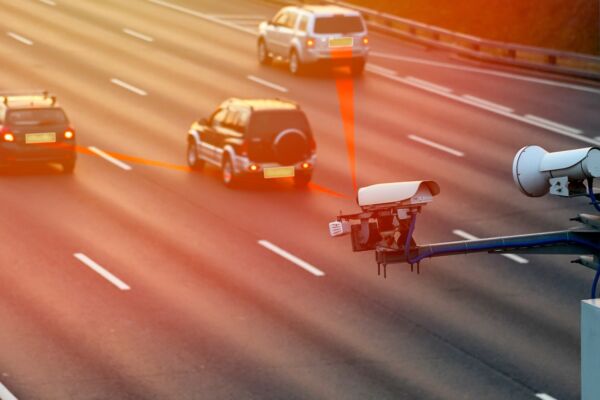
Los Angeles is set to activate the first batch of brand new speed cameras on October 26, with a total of 125 cameras throughout the city expected to be operational by the end of the year. The city government announced on Thursday (October 1) that this initiative is driven by the state law AB645, which came into effect in 2024, aimed at curbing speeding drivers and enhancing road safety.
According to the city news agency, the placement of the cameras has been carefully selected based on factors such as accident history, speeding data, proximity to vulnerable groups, covering areas around schools, senior centers, and high-accident road segments. The system will capture the license plates of any vehicles exceeding the speed limit by 11 miles per hour or more.
Information related to the violations will be securely transmitted to the Los Angeles Department of Transportation (LADOT) parking enforcement and traffic control division for verification of infractions. If a violation is confirmed, a civil speeding citation will be mailed to the registered vehicle owner. By state law, the information of the vehicle owner can only be used for processing citations and cannot be shared with local, state, or federal law enforcement agencies without a court subpoena.
During the first 60 days of camera activation, only written warnings will be issued. Following this warning period, first-time violations of 11-15 miles per hour over the speed limit will still receive warnings. Subsequent violations will result in civil speeding citations starting at $50 and increasing with the extent of the speeding. Vehicles exceeding 16 miles per hour or more over the speed limit will receive citations immediately, starting at $100. Full citation details can be found on the LAspeedsafety.org website.
“We are continuously working to create safer streets for all Los Angeles residents. LADOT remains dedicated to applying all available innovative, data-driven solutions to address the traffic safety crisis,” said Laura Rubio-Cornejo, General Manager of the LADOT, in a statement. “The speed safety system has proven to be one of the most effective tools in reducing dangerous speeding, preventing accidents, and saving lives.”
The revenue generated by this program will be directly invested in LADOT’s traffic safety efforts across Los Angeles.
In October 2023, Governor Newsom signed the AB645 bill proposed by Democratic Burbank State Assemblywoman Laura Friedman, set to take effect on January 1, 2024.
The new law authorizes Los Angeles, Long Beach, and Glendale, as well as San Jose, Oakland, and San Francisco cities and counties, to operate speed safety system pilot programs until January 1, 2032, unless extended through future legislation. The bill requires submission of a final evaluation report by March 1 of the pilot program’s ending year.
Earlier this year, the Los Angeles City Council approved the installation of 125 sets of speed safety systems in all 15 city council districts. The delay in implementing the program in some areas of Los Angeles was due to the need for community engagement processes to formulate usage policies and the time required for purchasing speed cameras. Most districts in Los Angeles will have 8 cameras installed, while districts 4, 6, 8, 9, and 10 will have 9 cameras each.
LADOT stated that automated speed safety systems have been proven to reduce risky driving behaviors. San Francisco observed a reduction of over 70% in speeding behavior after activating the speed camera system, while cities like New York witnessed a 75% decrease in speeding citations after implementing related measures.
According to the latest data from the Los Angeles Police Department, 290 people died in traffic accidents in the city in 2025, surpassing the number of deaths due to homicides.
Damian Kevitt, Executive Director of Streets Are for Everyone, welcomed LADOT’s announcement. “We all know how serious the issue of speeding has become, and unfortunately, it remains one of the biggest factors behind the increase in severe injuries and deaths in Los Angeles,” he said. Implementing speed safety systems may be the most effective single tool in reducing the number of deaths on Los Angeles roads since the introduction of seat belts, he added. “We have seen speeding behavior drop by 78% in San Francisco, and traffic deaths decreased by 42% in 2025. I look forward to seeing a similar reduction in speeding behavior in Los Angeles and understanding how many lives these speed safety systems can save in 2027 and beyond.”