
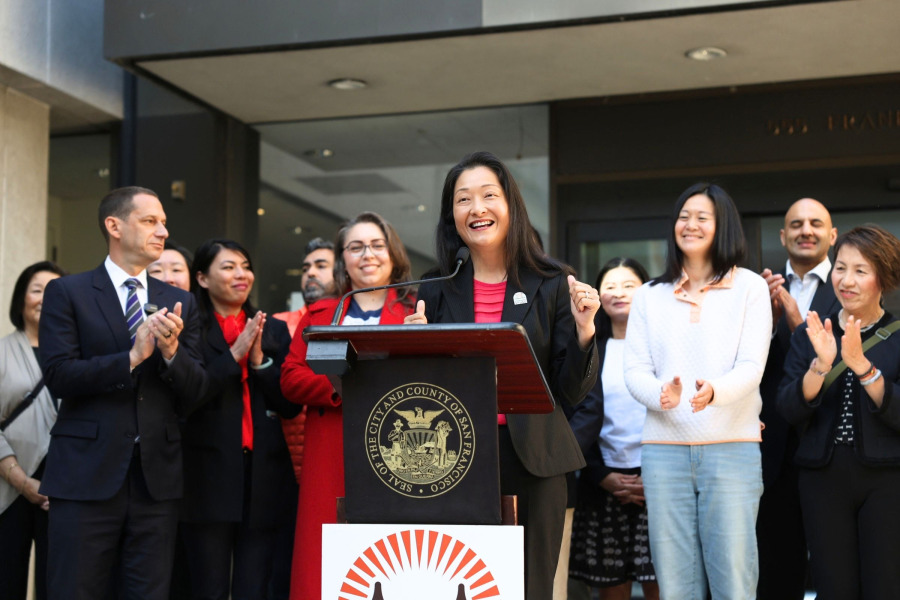
The San Francisco Unified School District (SFUSD) announced on September 24 that it will open the city’s first public Mandarin immersion TK-8 school in the fall of 2027. Currently, the district only has 66 spots for Mandarin immersion education at the kindergarten level each year, while hundreds of families apply for them. With the establishment of the new school, the number of spots will double.
At the initial stage, the school will be located at the Mission Education Center on 1670 Noe St. in Noe Valley. The existing programs and enrollment plans at the center will not be affected.
In its first year, the school will offer a transitional kindergarten (TK) and three kindergarten classes, each with 22 students. Subsequently, a new grade will be added each year, ultimately developing into a complete TK-8 Mandarin immersion school.
Liana Szeto has been appointed as a consultant for the new school. She founded the first Chinese immersion school in the United States in 1995, the Alice Fong Yu Alternative School.
Szeto stated in a district press release, “Establishing a campus that fully implements Mandarin immersion education from transitional kindergarten through 8th grade is a historic milestone for our district.”
According to the initial district plans, once the school’s construction is completed, it will have approximately 24 classrooms and can accommodate up to 600 students. The inaugural class is expected to reach 8th grade by 2035. The permanent location of the school will be determined in January 2027, with a planned move in for the fall of 2028.
SFUSD Superintendent Sue Chang said at the press conference that the establishment of the school today is “a true reflection of parent power.”
She recalled that after taking on the role of superintendent two years ago, she repeatedly heard the same plea from parents: “San Francisco Unified School District needs a public Mandarin immersion school.”
“We have reached this point because of families and partners like all of you, who believed in this school, steadfastly believed in it, and even had unwavering faith in it before it was established,” she said.
Abby Chao, a parent in the SFUSD with three children under the age of 3, said at the press conference, “For my family, this offers a great opportunity for our children to connect with their cultural roots and stay connected with Chinese-speaking relatives.”
“For all families, this is another reason to choose the San Francisco Unified School District,” Chao added. She emphasized that the establishment of the school is just the beginning, and collaboration among the city government, community, and education sector is still needed, including finding a permanent location and recruiting teachers.
Parent Zhang Zhiqi said, “Today represents many Asian parents like us, witnessing this milestone, which is a historic moment.”
Zhang has three children aged 13, 9, and 7, whom she has provided with bilingual education in English and Cantonese starting from kindergarten.
She noted the strong demand for Chinese education in San Francisco and stated that the establishment of the Mandarin immersion school is the result of parents’ demands, further collaboration between the community and the school district.
She expressed, “The district listened to parents’ demands and put them into action, which is really encouraging!” She hopes to see more fruits of collaboration between districts and parents in the future.
According to data from the U.S. Census Bureau, approximately 21.1% of San Francisco’s residents are Chinese.
Sarah Shang, a founding member of the Chinese Parent Advisory Committee (CPAC), stated that the demographic of Chinese residents in San Francisco is changing significantly, with an increasing number of Mandarin-speaking Chinese and more Westerners interested in learning Mandarin.
She hoped that the district would take more actions to improve the current situation and make public schools more appealing to families.
Zha Xia, one of the founders of the Asian Parent Advisory Committee, said, “We are very happy that the Mandarin immersion school is successful this time. This is a new breakthrough, a new way of doing things. We have combined parents’ needs with practical implementation.”
She mentioned that Chinese parents have always anticipated Chinese immersion education, but in the past, the district lacked sufficient conditions or mechanisms to meet this demand. Zha Xia stated that the establishment of the Mandarin immersion school has formed a new cooperation model among parents, teacher unions, and district management. The Asian Parent Advisory Committee can gather parents’ needs, communicate with the district and unions, and the unions can provide advice on teacher and school personnel allocation. Only when all three parties reach a consensus, the project becomes more feasible.
At the press conference, Luo Wei said, “Only when families take root here will our city become stronger.”
He emphasized that new development opportunities are emerging in San Francisco, but the city’s future development requires people who already live here to continue to live and work comfortably. This necessitates affordable rent, reliable childcare services, public transportation, and “excellent public schools.”
“As generations of students learn, shaping the language and culture of San Francisco and mastering bilingual and biliterate skills, many families also hope to secure this opportunity for their children,” Luo Wei said.
For many years, families throughout San Francisco have been asking public schools to provide more Chinese immersion education. “I look forward to the day when students walk through the school gates on the first day of school in 2027,” he concluded.