
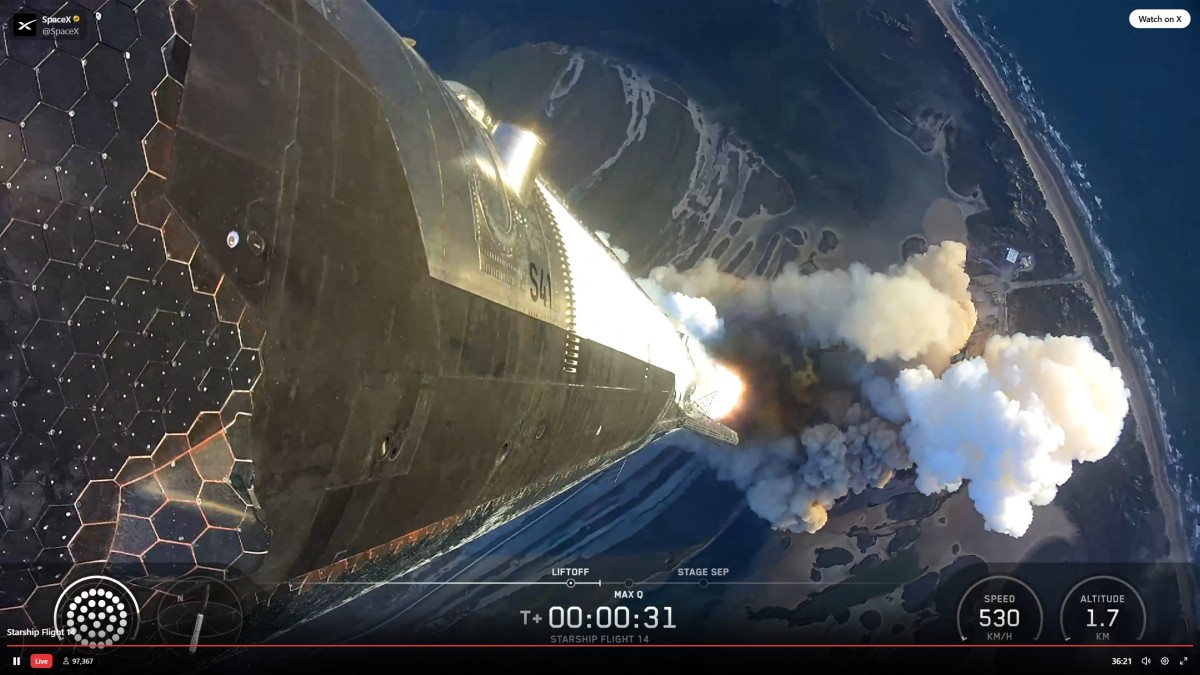
On Monday, September 28th, SpaceX, the American space exploration technology company, achieved a milestone with its most powerful giant rocket to date, the “Starship”, successfully entering orbit for the first time.
This marks a significant advancement for the Starship, which has transitioned from simple developmental testing to a new phase of commercial and scientific applications in the three years since its debut.
The colossal rocket, the largest and most powerful in human history, took off from the “Starbase” in Boca Chica, Texas, for the highly anticipated 14th comprehensive test flight.
In the previous 13 test flights, the Starship’s trajectory was intentionally limited to suborbital ranges, with the furthest extending only halfway across the Earth to the Indian Ocean as a safety precaution to avoid potential threats to land in case of loss of control.
However, the core objective of Flight 14 was to break this limitation. The mission planned for the Starship to enter orbit at an altitude of approximately 170 miles (275 kilometers) and orbit the Earth six times over a period of about 10 hours before a controlled splashdown in the Pacific Ocean near Chile.
Entering orbit signifies that the Starship now possesses the necessary velocity and precise trajectory for long-term space stays, large-scale satellite deployments, and future deep space transfers.
The ascent process was visually stunning with the Super Heavy first-stage booster, consisting of 33 Raptor engines, propelling the giant rocket, standing at 407 feet (124 meters), into the sky.
After passing through the Max-Q region and completing the main engine cutoff (MECO), the Starship demonstrated its unique and intense hot-staging separation technique: the upper Starship spacecraft directly ignited its engines, using powerful thrust to forcefully detach from the Super Heavy booster.
Following separation, the Super Heavy booster executed a boost-back burn for reentry. Despite some engines encountering minor ice obstruction and anomalous shutdown during ignition, the booster successfully completed the splashdown sequence, landing near the Gulf of Mexico close to the Starbase.
During the ascent of the upper Starship, the control center detected an unexpected shutdown in one of the three vacuum Raptor engines. Due to the high safety and technical requirements, there was consideration given to abort the orbital insertion. However, after data analysis confirmed that the three sea-level version Raptor engines, used for atmospheric and orbital maneuvers, were operating normally, ensuring a successful orbital insertion burn and deorbit burn at the end of the mission.
Ultimately, the mission control personnel gave the crucial “GO” signal, allowing the Starship to ignite successfully and enter orbit.
Upon entering orbit, the Starship promptly opened its space cargo bay. In a departure from past missions carrying only model satellites, this test flight marked the first execution of real commercial tasks: deploying 26 new generation “Starlink V3” satellites into the designated orbit using a slot-like arrangement similar to high-tech Pez candy boxes. SpaceX later confirmed successful contact with the initially deployed V3 satellites.
According to SpaceX’s Chief Propulsion Engineer, Jake Berkowitz, compared to the second-generation satellites, the new satellites in this batch have seen a tenfold increase in downlink capacity and a 22-fold increase in uplink capacity, significantly optimizing global high-speed satellite internet services.
SpaceX’s rigorous testing of the Starship is closely tied to NASA’s Artemis moon program. With the validation of orbital deployment and atmospheric reentry technologies completed, SpaceX is gradually paving the way for future crucial missions.
Artemis III is scheduled for next year to conduct an orbital triple docking exercise, where the Starship will rendezvous and dock in orbit with the crew-carrying Orion spacecraft and Jeff Bezos’ Blue Moon lunar lander.
Artemis IV is slated for as early as 2028, with astronauts boarding the Starship or Blue Moon for a lunar mission marking a human return to the moon after many years.
Founder Elon Musk has always seen the Starship as the ultimate tool for traveling to Mars. With the successful entry into orbit and initiation of the orbital mission during Flight 14, SpaceX has taken a crucial step towards proving the Starship’s capability to carry out complex orbital tasks. In the future, the Starship will not only gradually replace the company’s older Falcon 9 rocket but also pave the way for humanity’s journey to the moon and Mars.
(This article draws references from reports by CNN and the Associated Press)