
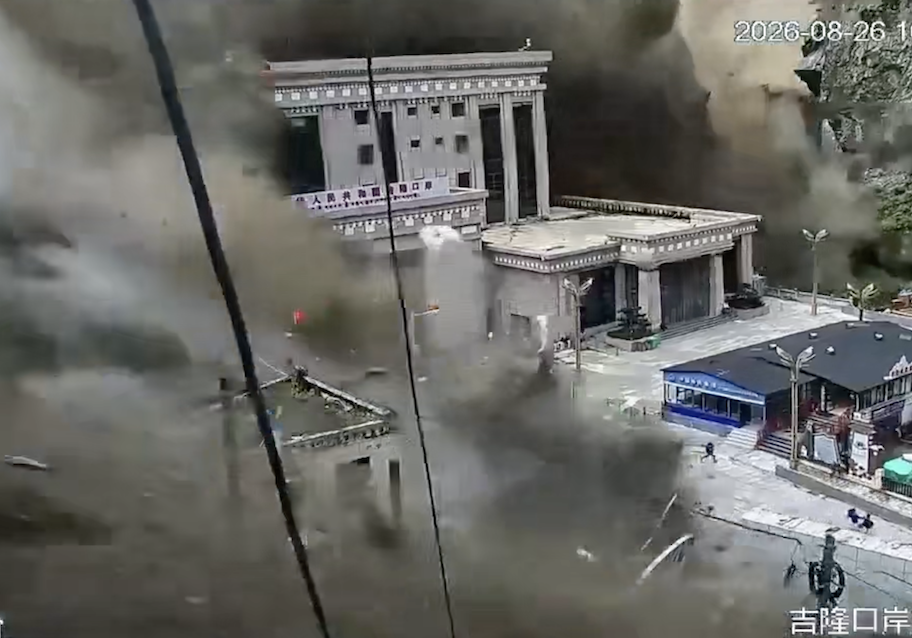
After the mudslide at the Gyirong Port in Tibet occurred, nine days later, the Chinese official media reported that on one side of Tibet, 31 people had died and 531 were missing. Legal expert in Australia, Yuan Hongbing, in an interview with Epoch Times, stated that the Chinese Communist Party (CCP) has long been exploiting Tibet’s natural resources in a plunderous way. He mentioned that after the disaster, the CCP’s priority was to protect its political control and interests, while concealing the losses of individuals and property.
The disaster took place on the morning of August 26. According to the CCP’s official statement, a massive ice and rock collapse occurred in high-altitude areas in Nepal, leading to rapid discharge along the valley that eventually turned into a mudslide, hitting the Gyirong Port in Tibet.
As of September 4, the Chinese state media Xinhua reported that the death toll on one side of Tibet had risen to 31 individuals, with the number of missing persons decreasing to 531. The authorities have not yet disclosed a complete list of the deceased and missing individuals.
Reports from the Associated Press revealed that, except for a few CCP journalists, other reporters were prohibited from entering the disaster-stricken area in Tibet for coverage. The official media mainly focused on leadership instructions and rescue deployments, with little emphasis on the personal experiences of the victims and their families.
In contrast, Nepal continued to update the lists of deceased and missing individuals and allowed media access to the disaster area for coverage. According to official Nepalese data, the death toll had risen to 1294, with 5053 missing individuals and 13,095 people rescued.
Yuan Hongbing emphasized that the CCP, in handling major disasters, prioritizes the interests of political control rather than prioritizing saving lives and properties, leading to the inevitable concealment of casualty figures and property losses.
Regarding the exploitative attitude of the CCP towards natural resources in Tibet, Yuan Hongbing pointed out that the Party is more concerned with short-term economic gains and political objectives rather than the long-term development and ecological preservation of the Tibetan region.
He mentioned that since Xi Jinping came to power, the CCP has attempted to turn Tibet’s water resources into a strategic tool to exert pressure on India and Bangladesh, advocating large-scale dam construction on rivers like the Yarlung Tsangpo flowing towards South Asia.
Yuan Hongbing criticized the CCP for its exploitation of water resources in Tibet, highlighting that it is driven by political and geopolitical strategies rather than focusing on sustainable development in the region and environmental protection.
He further expressed concerns about the large-scale water projects and other resource developments in Tibet that are endangering the region’s original ecological environment. Additionally, factors like climate change, glacier melting, and shifting snowlines are exacerbating ecological and geological risks in the plateau region.
Before 1985, Tibet had minimal large-scale reservoir development projects. Wang Weiluo, a hydraulic expert residing in Germany, recently stated on the YouTube channel “Fangfei Time” that the CCP used the 20th anniversary of the Tibet Autonomous Region as a pretext to promote the Zangmu Hydropower Station, despite objections from the 10th Panchen Lama. With the 10th Panchen Lama’s passing, the project continued.
Wang Weiluo indicated that Tibet now has approximately 150 reservoirs, some of which are used for agricultural irrigation besides hydroelectric power generation. He noted that promoting agricultural irrigation aims to settle the Tibetan nomads to facilitate administrative and population management by the authorities.
Given Tibet’s high altitude, steep terrain, seismic activity, and the conversion of natural glacial lakes into reservoirs, Wang Weiluo warned that the plateau environment poses significant challenges to the safety of hydraulic facilities, requiring extensive repairs and reinforcements to prevent potential disasters like flash floods and mudslides resulting from reservoir breaches.
Looking at the broader perspective, Wang Weiluo pointed out that while disasters like these are triggered by natural factors such as heavy rainfall or ice collapses, the forced implementation of large-scale construction in geologically high-risk areas and the establishment of ports and facilities in high-risk river channels ignore natural laws, resulting in excessive human interference and development.
He therefore believed that such disasters, though appearing natural on the surface, actually carry elements of man-made factors.
Regarding the CCP’s push for reservoir construction in Tibet in the 1980s, Yuan Hongbing highlighted the strong opposition from the 10th Panchen Lama.
Yuan Hongbing explained that the 10th Panchen Lama, based on Tibetan Buddhist beliefs, saw the construction of reservoirs as a threat to the religious harmony and tranquility between sacred mountains and lakes. He also expressed concerns that reservoir construction would harm Tibet’s natural environment.
The sudden demise of the 10th Panchen Lama on January 28, 1989, in Shigatse was officially claimed by the CCP to be due to a sudden heart attack caused by overwork and fatigue.
Yuan Hongbing raised skepticism about this claim, stating in his book “Killing the Buddha – The Truth behind the Persecution of the 10th Panchen Lama” that the 10th Panchen Lama did not die naturally but was a victim of political assassination.
He argued that the CCP took action against the 10th Panchen Lama not because of his opposition to reservoir construction but because of his aspirations for the return of the Dalai Lama to Tibet and the joint promotion of religious development in Tibet, a political stance not tolerated by the then Deng Xiaoping regime.
Furthermore, Yuan Hongbing implicated top CCP leaders like Deng Xiaoping, Chen Yun, as well as Hu Jintao (who was the Secretary of the Tibet Autonomous Region Communist Party Committee), in the decision to “eliminate” the 10th Panchen Lama for political reasons. However, these allegations have not been independently confirmed with concrete evidence.
A few days before his death, the 10th Panchen Lama publicly criticized CCP policies in Tibet. According to Radio Free Asia citing official CCP reports from that time, the 10th Panchen Lama remarked that in the 30 years of CCP rule in Tibet, the costs outweighed the benefits brought by development.
Gyirong Port’s river valley has experienced severe disasters before. In July 2025, a glacier lake outburst triggered a flood that destroyed the China-Nepal Friendship Bridge, leading to several individuals going missing, along with disruptions in port traffic and cargo transport that were only restored in January of this year.
Subsequent remote sensing analyses by researchers at Chengdu University of Technology identified 55 glacier lakes in the upstream basin of the Friendship Bridge with a total area of approximately 3.39 square kilometers. The researchers had cautioned about the possibility of recurring glacier lake outburst floods, emphasizing the need for enhanced upstream flood warnings and comprehensive risk assessments of glacier lakes within the basin.
Yuan Hongbing criticized the bureaucratic inefficiencies of the CCP, whereby even though research institutions had highlighted the associated risks in their reports, the slow bureaucratic processes and fragmented governance within the Communist regime had led to a lack of timely actions based on existing risk data.
In his view, Xi Jinping’s demand for absolute loyalty from officials, coupled with his initiatives for “purges and clean-ups,” had resulted in a culture of complacency, inefficiency, and neglect within the CCP apparatus. Faced with crises like those in Nepal and elsewhere, officials exhibited an attitude of “ignoring problems wherever possible,” turning a blind eye to critical issues.
Yuan Hongbing concluded that the CCP lacks genuine humanitarian concern and awareness of human rights, focusing solely on preserving the political interests of the one-party dictatorship.
He likened the CCP to a “political mafia,” stating, “In any major disaster or crisis, the CCP dictatorship’s first priority is to conceal its evils by fabricating national lies to pretend peace.”