
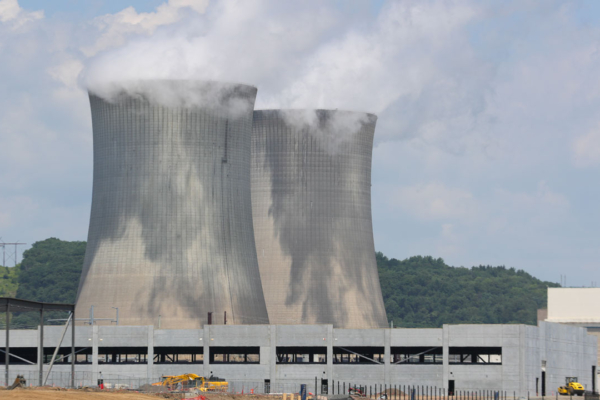
Technology giants that have long been champions of wind and solar energy are now embarking on the construction of large natural gas and nuclear power plants to provide stable and reliable electricity 24/7, 365 days a year for the rapidly developing artificial intelligence data centers.
For years, the largest tech companies in the United States have been strong advocates for wind and solar energy.
Microsoft had pledged to power all its energy consumption with renewable sources and aims to achieve “negative carbon” emissions by 2030. Meta (formerly Facebook) joined the global initiative RE100, committing to using 100% renewable energy. Silicon Valley has invested billions in renewable energy projects and used its political influence to support movements against fossil fuel use.
However, with the advent of the artificial intelligence era, these companies suddenly found themselves struggling to secure an adequate supply of natural gas.
In June of this year, Microsoft entered a 20-year agreement with Chevron to jointly develop the “Project Kilby” in Reeves County, Texas, a natural gas power project dedicated to powering Microsoft data centers with a planned capacity of approximately 2.7 gigawatts, equivalent to two large nuclear reactors, expected to start generating power by the end of 2028.
A key detail is that these power plants are designed to supply power behind-the-meter, meaning they do not connect to the public grid of Texas but directly supply power to the data centers. Furthermore, the 20-year partnership is not a transitional solution but more like a long-term “marriage.”
Meta took a more aggressive approach, expanding the Hyperion facility in Richland Parish, Louisiana to a scale of 5 gigawatts of computing power. Meta plans to construct around 10 new gas-fired power plants with a total capacity of approximately 7.5 gigawatts, enough to meet the electricity needs of a small state.
Last month, Meta withdrew from the RE100 initiative it had joined a decade ago. The company still claims that its electricity consumption is mainly matched with clean renewable energy through the purchase of energy certificates and contracts. However, achieving annual matching on paper and actual power generation at 2 AM on a windless night in Louisiana are two very different things.
I’m not blaming Microsoft or Meta; on the contrary, I commend these tech giants for facing the reality head-on.
The operation of artificial intelligence requires a continuous supply of electricity. Billions of dollars are invested in server data centers that care little about whether the wind is blowing or the promises made by politicians but require power supply 24/7, 365 days a year.
When it comes to investments worth hundreds of billions of dollars, tech giants understand a reality that many policymakers are still avoiding: the difference between “possible supply” of power and “on-demand supply” of power. People should look at how these tech giants are spending money rather than how they write in their sustainability reports.
Today, what these tech giants need as “firm power” means using natural gas and nuclear power. Microsoft signed a 20-year agreement aimed at restarting the Three-Mile Island nuclear reactor in Pennsylvania, and Meta also struck a 20-year agreement involving the Clinton nuclear power plant in Illinois.
Meanwhile, both companies are also procuring a significant amount of wind and solar energy. The development of artificial intelligence does not prove that renewable energy is worthless but rather that “green” energy cannot provide continuous power.
Think of it this way: A family buys a car that doesn’t require gasoline, but with a condition that it can only run when the weather is suitable. If this family wants to be able to travel anytime, they would never sell their reliable gas-powered car.
Around one-fourth of the data center projects currently being developed plan to build on-site power generation facilities. Among the 59 tracked projects, the total capacity is approximately 90 gigawatts. These tech giants are not just buying reliable power; they are also spending money to “disconnect” from the grid – and the decreased reliability and increased costs of the existing grid are closely related to the lobbying efforts of these tech giants. For every customer paying their electricity bills, the rising prices are a concern.
While households, factories, hospitals, and farms cannot do the same, they are forced to accept the system policies that policymakers have built, which, while phasing out coal-fired and nuclear power plants that can run on demand, significantly increase reliance on weather-dependent power generation. Users are footing the bills for two power supply systems but only benefiting from one.
Our electricity bills are on the rise. Since 2022, the average electricity price in the United States has been steadily increasing, and utility companies are seeking regulatory approval for investments worth billions of dollars to build power plants and transmission lines to serve data centers. Who should bear the cost if the demand does not meet expectations?
So, let’s ask a simple question: If Microsoft’s servers are worth signing a 20-year contract for billions of dollars to build new natural gas and nuclear facilities for stable and readily available power supply, then why can’t our factories, hospitals, farms, and households receive the same treatment?
The rules are set by state legislators and regulatory agencies. They can pay for the actual operational generation capacity, establish fair and reasonable prices, and stop the forced closure of power plants that we still need.
Perhaps the first significant contribution of artificial intelligence is not writing code or answering questions.
Perhaps it reminds America of something we should not forget: electricity has value only when it is instantly available when needed.
Maybe the first significant contribution that artificial intelligence is making to us is not writing code or answering questions but reminding Americans of something they should not forget: electricity is truly valuable only when it is available when people need it.