
The situation of the Ukraine war is undergoing increasingly unfavorable changes for Russia. Moscow’s advance on the front line is slow and costly, while Kyiv is using growing long-range drones to destroy Russian energy and logistical facilities. The stark contrast between the two sides indicates that Putin is facing an underlying crisis that is hard to conceal.
On August 28, 2026, the Ukrainian military used FP-1 long-range drones to attack the Slavneft-YANOS oil refinery in Yaroslavl, Russia, hitting the AVT-3 crude oil primary distillation unit, causing about 40% of the refinery’s capacity to be damaged. The facility, with an annual crude oil processing capacity of about 15 million tons, is one of Russia’s largest refineries.
According to statistics, Russian refineries were attacked 18 times in August.
In July 2026, the attack on the Luk-Perm oil refining company’s plant in Perm by Ukraine destroyed 86% of the refinery’s capacity, forcing it to shut down. Subsequently, Luk-Novgorod oil refining company, ranked fourth in Russia, also suffered a deadly blow from the FP-1 drones.
This continuous systematic strike strategy means that Russia’s recovery capabilities can never catch up with the pace of destruction.
Ukraine’s long-range strike capability is gradually breaking free from US and Western restrictions. In recent months, historic breakthroughs have been continuously achieved. Ukrainian military analyst Oleksandr Kovalenko pointed out that Ukraine’s long-range strike capability has rapidly improved in recent years. Four years ago, the Ukrainian army could only tactically strike Russian-Ukrainian border targets about 50 kilometers away; now, the Ukrainian army has the ability to use long-range drones to strike deep Russian targets, with a range of up to 3,000 kilometers or even further.
Kovalenko predicts that by the end of 2026, Ukraine’s drone attack range will reach 4,000 kilometers, meaning that the Russian Far East region, including Vladivostok, could fall within the scope of Ukrainian strikes.
This progress reflects the rapid development and adaptability of Ukraine’s defense industry. The improvement in drone technology allows Ukraine to cross geographical barriers, projecting its power into the Russian heartland that was previously deemed impossible by both sides.
This deep strike has broken free from US and Western restrictions on long-range weapons, transitioning from early sporadic harassment to a normative, systematic military capability. This capability is expanding from frontline military targets to the military-industrial and economic sectors in the Russian heartland, weakening and destroying Russia’s societal functions necessary to maintain its large-scale military operations. The continued precise strikes have successfully prevented Russia from restoring the capabilities of damaged businesses and production facilities.
Ukrainian energy expert Stanislav Ihnatiev stated that Ukraine’s continuous strikes on Russian oil facilities have gone through three stages: initially causing local difficulties for individual refineries, then affecting regional fuel balances, and now spreading to refineries, cross-regional logistics, fuel reserves, exports, and equipment maintenance, causing social instability while intensifying pressure on the frontline troops’ fuel supply.
With the continuous breakthrough in drone technology and long-range strike capabilities, the inland regions of Russia face rapidly increasing air defense pressure, especially in inland regions like Siberia where the density of air defense system deployments is extremely low, turning what was previously almost defenseless areas into large air defense blank zones. This pressure is expected to transform into an air defense crisis for key areas including Moscow and frontline logistical and command nodes.
On September 3, Ukrainian Armed Forces Commander Drapatyi released “War-time Principles of Leadership and Military Development of the Ukrainian Armed Forces Commander,” outlining his wartime military ideology and proposing 8 military development priorities, 14 requirements for commanders at all levels, and 8 expectations for commanders staff, aimed at enhancing the combat effectiveness and endurance of the Ukrainian army.
He emphasized the need to coordinate the actions of Ukraine’s land, sea, air, cyber, and cognitive domains through a unified framework while reducing internal competition within the Ukrainian Armed Forces to achieve joint operations. He noted that Ukraine must develop necessary combat capabilities and defense industry capabilities to conduct a “protracted war.”
However, the Kremlin seems to maintain an overly “optimistic” attitude. On September 2, Putin stated that the Russian military is accelerating its offensive in Ukraine. In August, 15 settlements in Donetsk Oblast were occupied, increasing the area under occupation by 270 square kilometers. But publicly available evidence does not support Putin’s claims.
Observations from the Institute for the Study of War (ISW) showed that in August, the Russian military only consolidated or occupied 90.35 square kilometers of land in the entire theater of war. In fact, Putin has set deadlines for the Russian military to occupy the entire Donetsk Oblast at least 15 times, none of which have been achieved.
Putin firmly maintains that he “has no doubt” that the Ukrainian defense line will collapse soon, and the Russian military is not only advancing but “accelerating” its advance. However, Putin’s statements are completely contradictory to all observable evidence on the battlefield.
The Institute for the Study of War believes that Putin’s exaggerated propaganda about the Russian military’s advance is part of the Kremlin’s long-standing efforts to create a public opinion battle suggesting that Ukraine’s defenses are about to collapse, despite ample evidence to the contrary. Putin has always tried to portray himself as the leader who controls the situation and emphasizes the objectivity of his assessments of the battlefield. However, as Putin made these remarks, complaints from Russian military blogs have been increasingly vocal, indicating public impatience with the exaggerated battlefield situation.
Putin’s exaggeration of frontline gains alongside unprecedented hits to the rear echelons illustrates that Putin’s troubles are growing.
On August 25, Director of the Central Intelligence Agency (CIA) John Ratcliffe made a secret visit to Moscow. During talks with Russian intelligence officials, he warned Moscow against escalating the Ukraine war, noting that any escalation would backfire.
Sources in the Kremlin disclosed that the message and wording conveyed by Ratcliffe angered Moscow, leading to Putin canceling his planned meeting with Ratcliffe. On September 1, Russian independent media citing sources suggested that Ratcliffe’s message implied that Russia’s military and economic situation was deteriorating, and Moscow would now be better off accepting an agreement than continuing to prolong the conflict.
This is an outcome that Putin apparently cannot accept.
Putin continues to reiterate that Russia is not willing to freeze the current frontlines or engage in any substantive negotiations aimed at ending the Ukraine war that would fail to meet its initial demands.
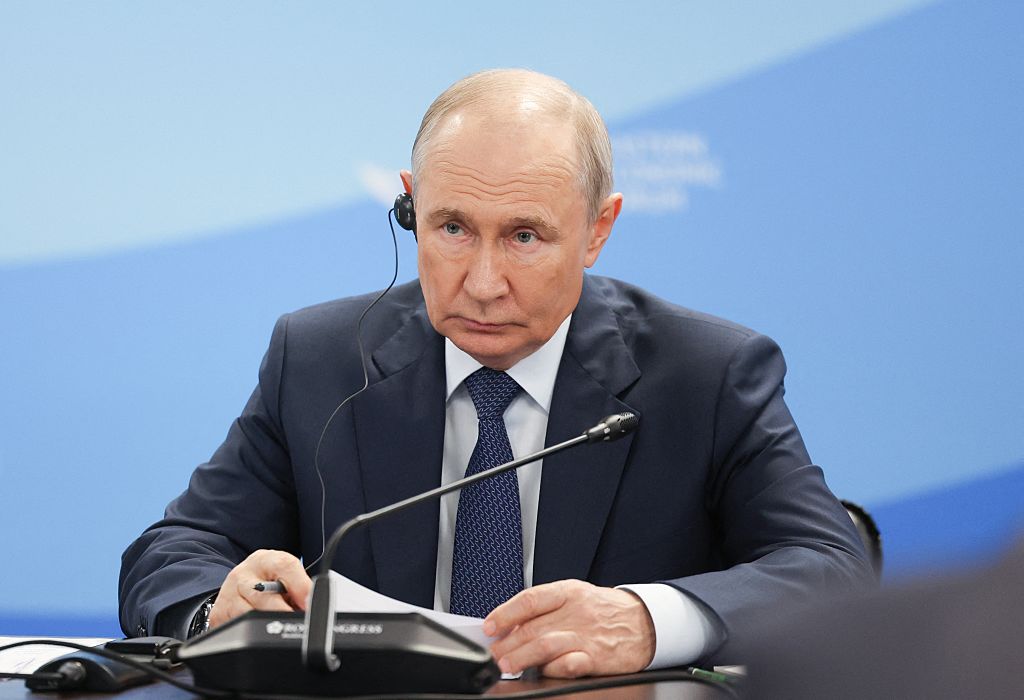
On September 3, at the Eastern Economic Forum in Vladivostok, Putin was asked about recent fuel shortages in Russia due to Ukrainian drone attacks on refineries and whether Russia needed to make its people accustomed to this situation. Putin warned the Russian people to “be prepared for everything” and told adversaries that “it’s better not to.”
For the first time, Putin admitted Kremlin’s previous “mistaken” assumption that Ukraine did not have the capability to strike refineries in the Russian heartland. Now, with Ukrainian drone strikes causing severe damage to critical Russian infrastructure, he threatened to respond more harshly.
Putin’s tough stance and inflated battlefield achievements cannot change one fact: more targets in the Russian heartland are falling within Ukraine’s long-range strike range as Ukraine’s capabilities continue to strengthen.