
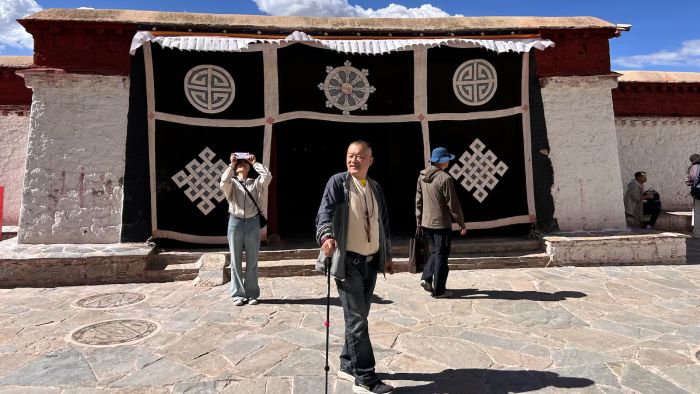
Hubei dissident Zhang Yi and his brother Zhang Xuan drove to Tibet for a tour in July. They were arrested for showing a Tibetan a photo of the Dalai Lama on a mobile phone inside the Sera Monastery. They were charged with “inciting separatism.” Zhang Yi is currently detained in Lhasa Detention Center, and authorities have refused to allow him to meet with a lawyer.
On August 28, Amnesty International issued an “Urgent Action” for the case of Zhang Yi, stating that he is a disabled person and his detention seems to be solely based on his peaceful exercise of human rights. Authorities must release him immediately.
On July 1, Zhang Yi and his brother Zhang Xuan were touring in Lhasa when Zhang Yi showed a Tibetan woman a photo of the Dalai Lama on his mobile phone inside the Sera Monastery. They had no further interaction. Later, Zhang Yi and Zhang Xuan were taken to the Chengguan Sub-bureau of Lhasa Public Security Bureau by the police. After Zhang Xuan was interrogated, he was released, but Zhang Yi was administratively detained for 15 days. His family believed it was just a brief detention.
On July 18, the family received a call from the Lhasa National Security informing them that Zhang Yi was formally placed under criminal detention. On July 30, the Lhasa National Security notified the family again that Zhang Yi had been approved for arrest by the Lhasa People’s Procuratorate on July 28, executed by the Lhasa Public Security Bureau, with the alleged crime still being “inciting separatism.”
Reliable sources reported that on August 17, a lawyer inquired with the Lhasa authorities about meeting Zhang Yi, but the authorities refused to arrange a meeting, stating that the case would soon be transferred to the procuratorial organ for review and prosecution. So far, no lawyer or family member has been allowed to visit Zhang Yi.
Amnesty International issued a statement on August 5 regarding Zhang Yi’s case. Sarah Brooks, Deputy Director for the Asia-Pacific region of the organization, expressed concerns about the arrest of Zhang Yi for showing a photo of the Dalai Lama during a temple visit, highlighting the Chinese authorities’ repression of peaceful human rights activities.
On August 28, Amnesty International again released an “Urgent Action,” emphasizing Zhang Yi’s disability and the worries about his well-being during detention. His detention appears to be solely because of his peaceful exercise of human rights. Displaying a religious leader’s photo should not be perceived as a threat to national security and therefore should not be considered a threat. Authorities must release him immediately.
On July 1, the day Zhang Yi was detained, was also the day when China’s “Law on Ethnic Unity and Progress” came into effect. This law contains broad and vague provisions that promote “ethnic unity” and a common ethnic identity, which could further restrict human rights, including the rights to religious and belief freedom and freedom of speech.
The “Urgent Action” states that before Zhang Yi is released, ensure he has regular and unrestricted access to his chosen lawyer and family, adequate healthcare without torture or mistreatment; stop using laws, policies, and administrative measures, including the “Law on Ethnic Unity and Progress”, to restrict the peaceful exercise of human rights and suppress cultural, religious, and civic expressions.
Amnesty International has repeatedly documented the Chinese authorities’ abuse of the charge of “inciting separatism” to crack down on Tibetans and others peacefully exercising their human rights. Against this backdrop, the prosecution of Zhang Yi has raised serious concerns.
Zhang Yi, a native of Wuhan, Hubei Province, is a Chinese democracy activist and human rights defender. In 1989, he was arrested for participating in the “89 Democracy Movement” and sentenced to two years in prison on the charge of “disturbing public order.” He suffered severe torture in prison, resulting in permanent deafness in one ear. After his release, due to his continued dissenting views and longstanding commemoration of the “June 4th” incident and civil rights activism, he has been closely monitored by the Wuhan authorities.