
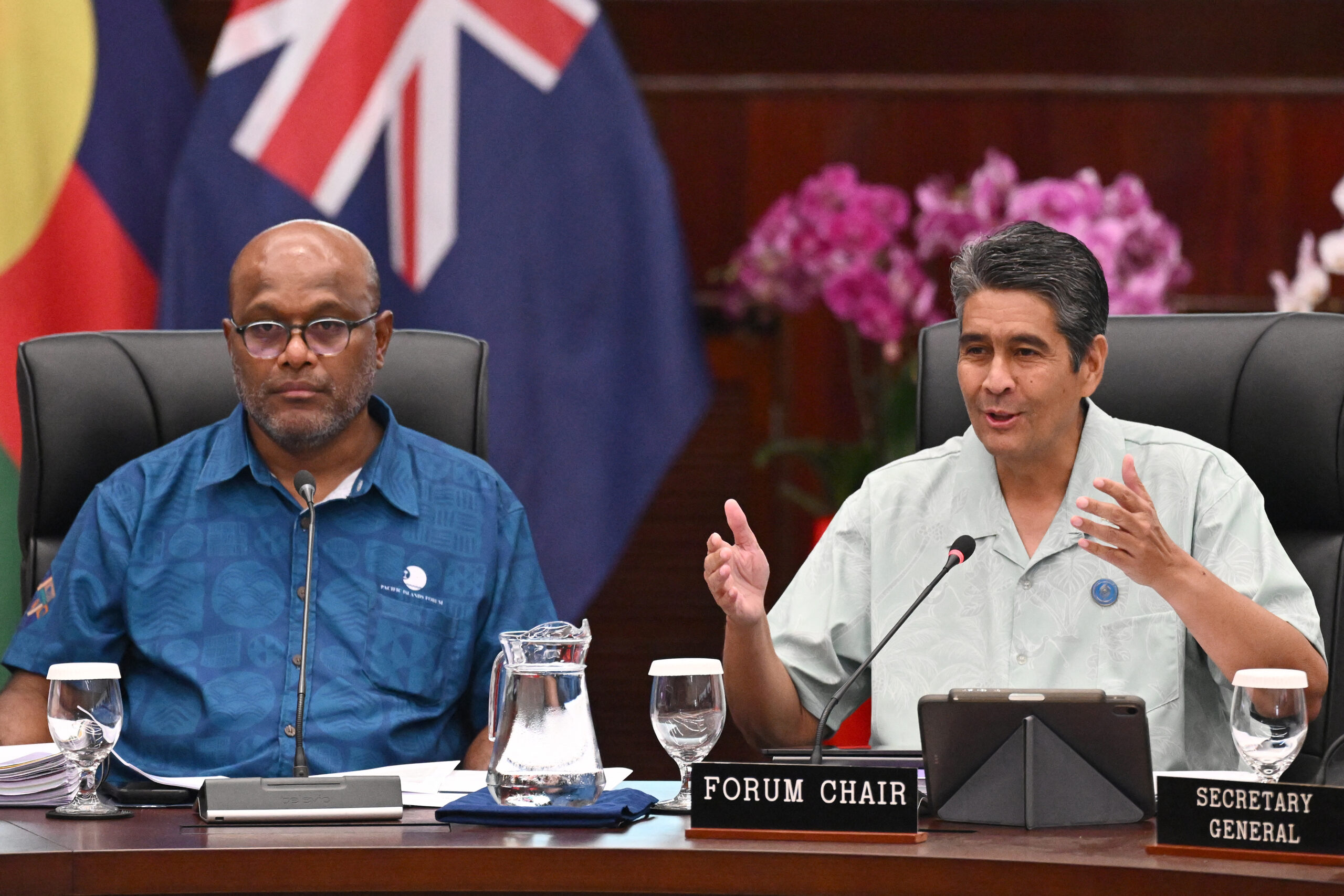
The President of Palau and Chairman of the Pacific Islands Forum, Surangel Whipps Jr., expressed on Thursday (September 3) that he hopes the 18 member countries can form a united stance on the test-firing of ballistic missiles by the Chinese Communist Party in July in the Pacific, and incorporate this issue into the final joint communique of the summit.
“This is definitely something we will discuss today,” said Whipps at a press conference. “A unified voice from the Pacific region is crucial in urging Beijing to respect sovereignty, transparency, and to be a responsible partner.”
He stated, “We do not want our backyard, our home, to be threatened, let alone be treated in such a disrespectful manner.”
The Pacific Islands Forum concluded with a leaders’ closed-door meeting on Thursday, where officials from various countries are expected to finalize the wording of the joint communique.
Whipps emphasized the importance of countries forming a common stance, saying, “We will strive for this.”
The Chinese Communist Party test-fired an intercontinental ballistic missile in July, marking the first known such launch in the Pacific since September 2024.
According to reports from Agence France-Presse (AFP), analysts believe the missile landed in a maritime area between the Solomon Islands, Nauru, and Tuvalu.
Whipps stated that Beijing’s test-firing “threatened the region and indeed showed extreme disrespect to the region.”
“They didn’t even inform us in advance about this test-firing,” Whipps said.
However, Beijing claimed that the test-firing was “a routine arrangement of China’s annual military training” and stated they “had informed relevant countries in advance.”
The test-firing occurred hours after Fiji and Australia signed a significant defense treaty. This agreement marked Fiji’s first formal alliance. Despite concerns expressed by leaders of multiple Pacific nations following the test-firing, foreign ministers failed to reach a consensus on condemning the launch during a meeting last month.
This summit also aroused Beijing’s dissatisfaction due to the issue of Taiwan’s participation. As the host country, Palau is one of the three countries in the Pacific region with formal diplomatic relations with Taiwan. Taiwan was invited to participate in the summit’s side events as a development partner.
After Taiwan’s Minister of Foreign Affairs Joseph Wu attended the opening ceremony, China’s special envoy for Pacific Island Affairs, Qian Bo, stated, “There will be consequences.” He denied that this statement was a threat but expressed that China has “serious concerns” about Taiwan’s role as a development partner of the forum.
In response, Australian Prime Minister Anthony Albanese emphasized that the Pacific Islands Forum is a “gathering of the Pacific family.” He further stressed, “Decisions regarding affairs here are made by the members of the Pacific Islands Forum, not any other country.”
Whipps also remarked, “Do not turn this place into a location for threatening others or making them feel uneasy.”
He further emphasized, “China has no right to tell us that we cannot partner with Taiwan. This is our sovereign decision, not theirs.”
Meanwhile, several Pacific country leaders did not personally attend the summit this year and instead sent lower-level officials.
Peter Peters, the Foreign Minister of New Zealand, expressed suspicions about the absence of some leaders and whether it involved foreign intervention, although he did not directly mention Beijing.
Peters said, “If you say this is not a big issue, then that goes against gravity and logic.”
The Chinese Ministry of Foreign Affairs stated that Peters’ remarks were baseless.