
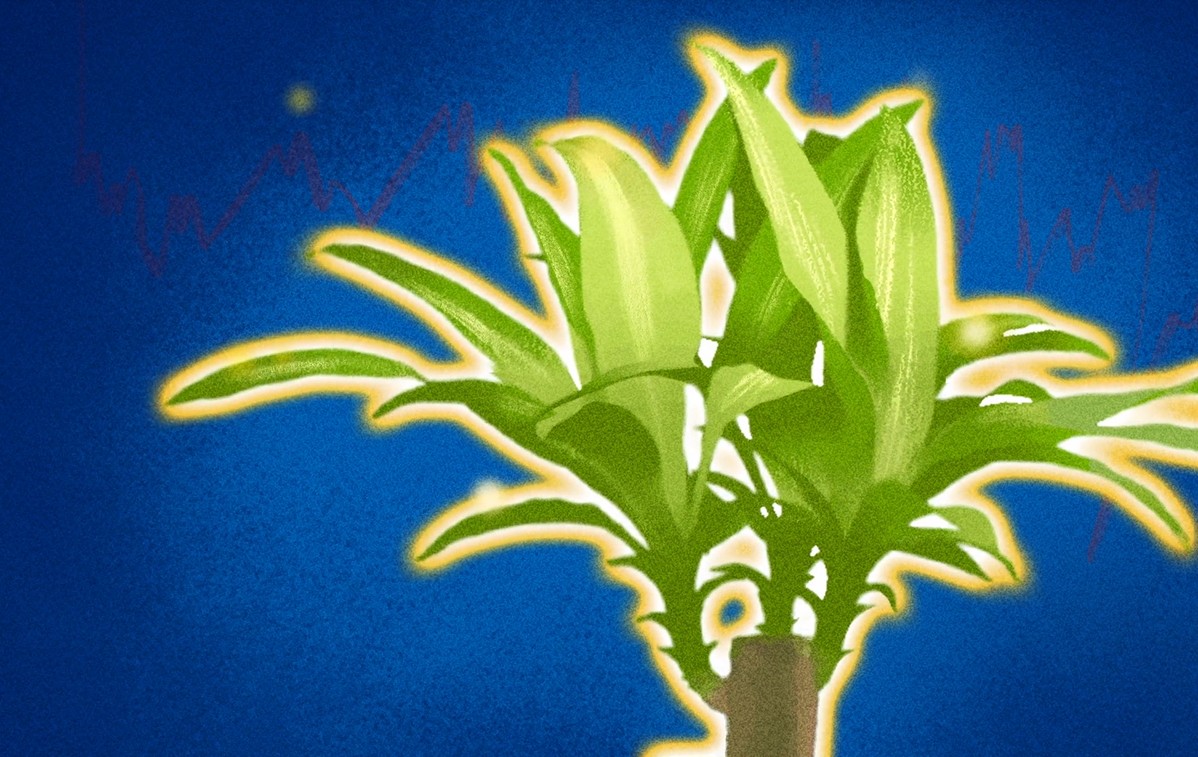
It’s common for us to see “perception” and “consciousness” as abilities possessed only by humans and animals, believed to rely on the brain and nervous system. However, the communication, memory, and environmental adaptation displayed by plants are prompting people to rethink whether this definition is too narrow.
In February 1966, polygraph expert Cleve Backster, out of curiosity, attached the electrodes of a lie detector to a plant and then watered it. The instrument immediately recorded changes in the plant’s electrical signals, with the pattern resembling human excitement responses.
Backster then thought about burning a leaf to observe the plant’s reaction. However, before he even struck a match, the lie detector needle suddenly swung significantly, depicting a curve similar to that of humans facing fear or stress.
This scene almost made him want to shout in the streets, “Plants can think!”
Backster documented these experiments in the book “Primary Perception: Biocommunication with Plants, Living Foods, and Human Cells.” He referred to the observed phenomena as “primary perception” and believed that perception may exist not only in organisms with nervous systems but possibly even at the cellular level.
However, subsequent research failed to consistently reproduce his experimental results, thus the notion that “plants have consciousness” did not gain acceptance in the mainstream scientific community. Yet, this does not mean that plants are lifeless beings with no reactions. Subsequent studies have gradually discovered that plants can indeed perceive their environment, communicate, and adjust their responses based on external changes.
Plants lack neurons but can still transmit messages in quite complex ways, including emitting danger signals.
When caterpillars feed on leaves, plants may release glutamate. Glutamate is a neurotransmitter in the human nervous system; within plants, it triggers signals related to injury, prompting undamaged parts to initiate defense mechanisms in advance.
Plants also emit warnings to the outside world. When under attack by insects, they may release volatile compounds into the air; neighboring plants detecting these chemicals will begin preparing to fend off pests.
In 1983, American zoologist David F. Rhoades suggested that plants under insect attack might communicate warnings to nearby plants through airborne chemicals. This idea faced much skepticism initially but has since been tested and replicated in over thirty plant species.
In 2023, Japanese researchers captured the process of a healthy plant receiving chemical signals released by a neighboring damaged plant. Within seconds, observable signal changes appeared within the healthy plant, transmitting alarms from its leaves to other parts.
Other experiments have shown that plants can transmit information not only through chemical substances but also through electrical signals. These findings illustrate that communication between plants is more frequent and intricate than previously understood.
The Venus flytrap does not immediately close upon first touch but waits for a second stimulus within a short period.
Inside the Venus flytrap’s carnivorous leaves are tiny trigger hairs. The first touch does not trigger leaf closure; the leaf snaps shut only if stimulated again within 15 to 20 seconds. This mechanism prevents the plant from expending energy due to unrelated stimuli like raindrops.
Even after the carnivorous leaf closes, the Venus flytrap does not immediately secrete digestive enzymes. As the insect struggles inside, it repeatedly triggers the trigger hairs; following about five stimulations, the plant initiates the digestion process.
In essence, the Venus flytrap can “remember” the number of touches in a brief time and respond differently. Without a brain, it can perform processes resembling counting and judgment.
Pea roots also make choices based on their environment. A 2016 study published in “Current Biology” split the roots of a pea plant into two pots: one continuously supplied nutrients while the other had fluctuating levels, though both pots supplied nutrients averagely.
When the stable supply was sufficient for growth, the pea plant would extend more roots towards the reliable nutrient source. Conversely, when nutrients were insufficient for sustenance, it would turn towards the unstable supplier, taking risks to ensure obtaining enough nutrients.
Researchers termed this adaptive selection based on survival conditions as “risk sensitivity.” This suggests that plants may alter their strategies when facing uncertainty according to the environment.
Plants may produce sounds inaudible to the human ear when under stress or injury.
A 2023 study found that dehydrated or injured plants emit ultrasound “clicking sounds” through the air, recordable by microphones. For instance, dehydrated tomato plants emit approximately 35 sounds per hour, while healthy plants make few sounds.
Sounds produced under different stress conditions possess recognizable features; machine learning models can differentiate whether plants are dehydrated or injured based on these sounds.
Researchers speculate that these sounds may arise from “cavitation,” the formation and collapse of bubbles in a plant’s water-conducting tissues. Though inaudible to humans, certain insects and animals might perceive them.
Preliminary evidence suggests that moths might use these sounds as cues, avoiding stressed plants and choosing healthier ones for egg-laying. Thus, what may be silent forests to human ears could be filled with sounds for other organisms.
The Mimosa pudica, known as the sensitive plant, folds its leaves when touched. In 2014, evolutionary ecologist Monica Gagliano and her team tested whether the sensitive plant could “habituate” to harmless stimuli.
Potted plants were dropped from a low height onto a cushion, causing no harm to the plant. Initially, the sensitive plant would fold its leaves each time it fell; with repetitions, the response gradually weakened until it stopped folding, seemingly recognizing the stimulus as non-threatening and no longer expending energy on defense.
Facing a different unfamiliar stimulus, the sensitive plant would still fold its leaves, indicating that the cessation of the response was not due to fatigue. When retested weeks later, it seemed to retain its original response pattern. This led the research team to suggest that certain types of learning and memory-like responses may not necessarily require a brain and neurons.
In 2016, the team referencing Pavlov’s classic conditioning experiments, used a breeze as a sign to indicate the direction light might appear. Some peas later grew towards the direction from which the wind blew, suggesting they were anticipating light.
However, research on plant associative learning remains controversial, with subsequent experiments failing to consistently reproduce results. These results are yet inconclusive in proving that plants possess learning abilities similar to animals, let alone confirming their consciousness.
Few researchers deny that plants can perceive their environment, engage in chemical communication, transmit electrical signals, and adjust their growth according to environmental changes. The real debate lies in whether these abilities can be classified as “intelligence” or “consciousness.”
In 2006, a group of researchers attempted to establish the field of “plant neurobiology,” facing strong opposition. Critics argued that as plants lack neurons or a nervous system, describing them with “neurobiology” could lead to misunderstandings. The field later continued research under a less contentious name.
Geneticist Daniel Chamovitz believes that science can only study things that can be tested and falsified; the definition of “intelligence” is too subjective, making it challenging to verify scientifically.
Plant behavior researcher Stefano Mancuso proposed a different understanding: intelligence may not necessarily reside solely in the brain. Plant roots can be viewed as a decentralized network, collectively sensing water, chemicals, gravity, and obstacles at numerous growing points, subsequently adjusting orientation to resolve survival challenges.
From this perspective, plants and humans, despite vastly different body structures, may employ similar strategies to receive information, coordinate responses, and adapt to their environments.
If consciousness is initially defined as a phenomenon produced by the brain, then stating that “organisms without brains lack consciousness” merely reiterates the original definition rather than drawing conclusions through research. The issue may not only concern whether plants possess consciousness but also how humans should understand consciousness.
Around 2,400 years ago, Aristotle did not believe that plants had consciousness akin to humans, yet he also did not view plants as passive, lifeless entities. He used the concept of a “plant soul” to describe the internal growth and survival principles within plants. This “soul” does not refer to thoughts or emotions but the capacity for self-preservation and development.
In classical Chinese thought, “nature” goes beyond the modern notion of the natural environment; its meaning aligns more with “naturally” or “unfolding from intrinsic nature.” Rooting towards water sources, orienting leaves towards sunlight does not necessitate assuming a subject that thinks like humans in the background; the ability of plants to grow and adjust based on their characteristics exemplifies in this natural unfolding process.
Contemporary discussions often leave only two options: plants are either machine-like objects or possess minds like humans. However, between these two extremes, there might exist life forms and modes of perception yet to be fully understood.
Backster believed throughout his life that plants harbored an unknown inner world. Subsequent research failed to confirm his central claims, yet the questions he raised remain unanswered: Do plants possess some form of perception unknown to humans?
Plants perhaps lack consciousness or potentially possess a form of perception entirely different from humans, currently challenging to comprehend. To date, science has not provided definitive answers.
This rewritten and translated article explores the research and debates regarding whether plants exhibit consciousness and intelligence, shedding light on the intricate and fascinating world of plant perception and behavior.