
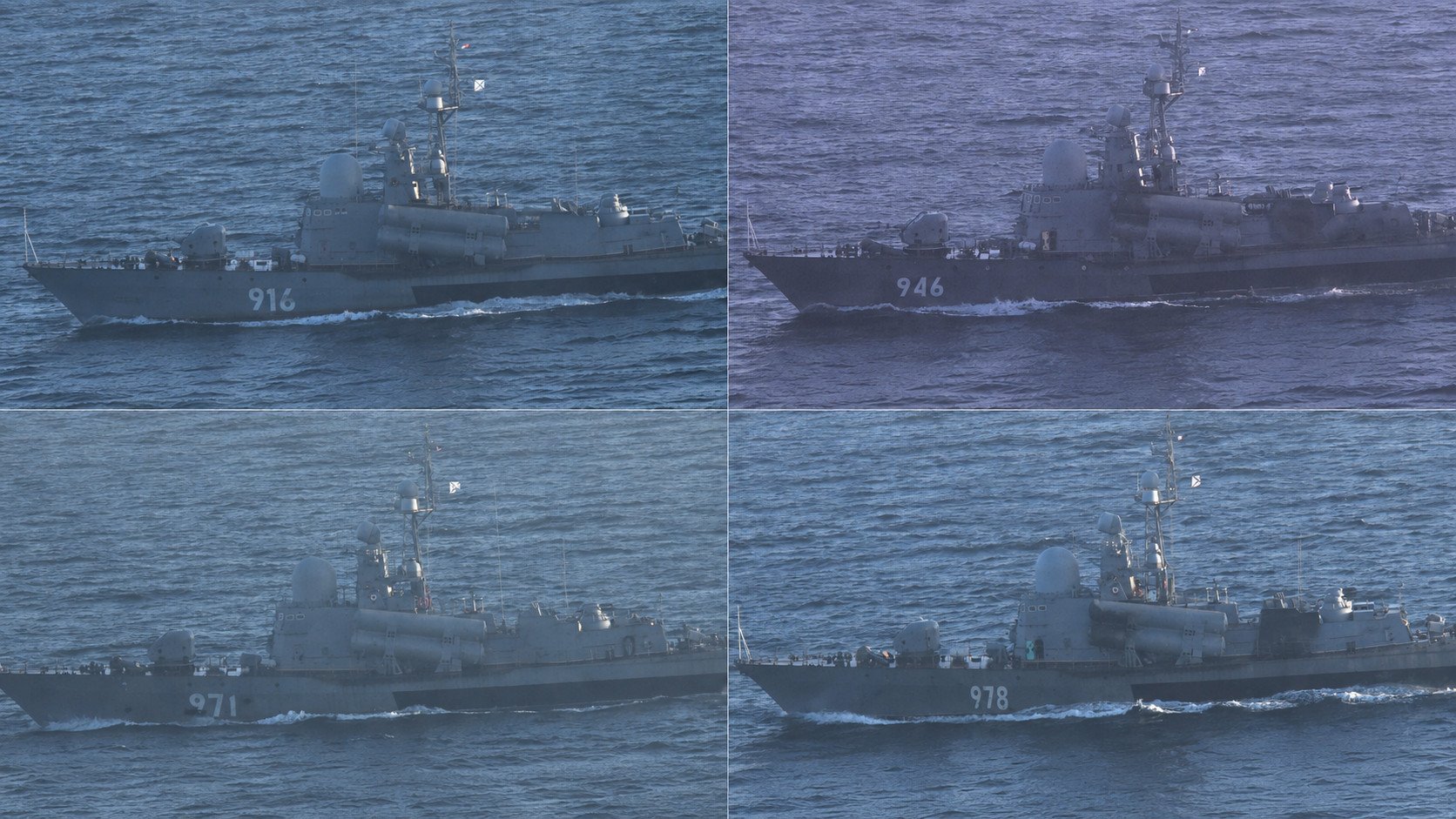
The Japanese Ministry of Defense stated that on August 14, four Russian missile boats sailed near Cape Soya in Hokkaido, Japan, with the closest distance to Hokkaido being about 40 kilometers, but they did not enter Japanese territorial waters. These warships had previously sailed in waters near Rebun Island, and Japan has lodged a protest with Russia following Russian President Putin’s visit to Iturup Island on August 13.
According to Japan’s Joint Staff of the Ministry of Defense, on August 14, four Russian 12411M “Molniya-1” class missile boats were spotted near Cape Soya in Hokkaido, with the closest point to Hokkaido being approximately 40 kilometers.
The Japan Maritime Self-Defense Force dispatched P-3C maritime patrol aircraft to track and monitor the warships, confirming that they did not enter Japanese territorial waters.
The four Russian ships bear the pennant numbers 916, 946, 971, and 978, and belong to the Russian Pacific Fleet. NATO classifies this type of vessel as the “Tarantul III” class.
According to Japanese sources, the same group of Russian warships was sighted about 70 kilometers northwest of Rebun Island on August 9. They later crossed the Soya Strait eastward and on August 14, they turned westward back. Their movements coincided with Russian President Putin’s visit to Iturup Island on August 13.
This marked the first visit of a Russian leader to Iturup Island. Japan has officially protested this, and is considering further action in response.
Iturup Island is one of the Northern Territories disputed by Japan and Russia (known as the Southern Kuril Islands by Russia). It is located at the southern end of the Kuril Islands, with the Russian Burevestnik military airfield situated on the island.
The Kuril Islands were occupied by the Soviet Union in 1945 and have since been under Russian control. Japan considers the islands, including Iturup Island, as part of its “Northern Territories”.
This longstanding territorial dispute is a major reason Japan and Russia have not yet signed a peace treaty ending World War II. The United States has reiterated its support for Japan’s sovereignty claim over the “Northern Territories”.
Russian Deputy Security Council Secretary Medvedev recently warned Japan that if Tokyo continues to assert its sovereignty over the disputed islands and protests Putin’s visit, there may be “dreadful consequences.” This highlights the escalating tensions between Russia and Japan on territorial issues.
The four Russian warships that approached Japan’s territorial waters are named R-298 (commissioned in 1990), R-19 (commissioned in 1992), R-24 (commissioned in 1994), and R-29 (commissioned in 2003).
Data on the 12411M “Molniya-1” class missile boat indicates that they were designed by the Almaz Central Marine Design Bureau in the Soviet Union. The lead ship entered service in 1981 and is primarily used for targeting surface targets in coastal and near-sea waters.
These ships have a standard displacement of 436 tons, full load displacement of 493 tons, a length of 56.1 meters, a width of 10.2 meters, equipped with 4 3M80 “Moskit” supersonic anti-ship missiles, a 76mm naval gun, 2 sets of 30mm close-in weapon systems, and “Igla-1” anti-aircraft missiles. They can reach a maximum speed of 41 knots, have a maximum endurance of up to 10 days, and accommodate around 40 crew members.