
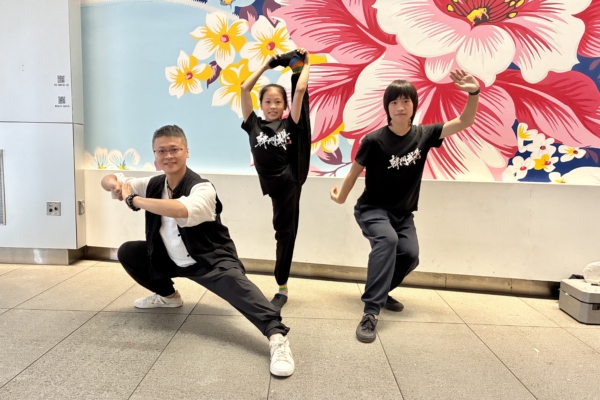
The Chinese martial arts have been passed down for generations, inheriting not only the forms and techniques but also the virtues and principles of conduct. From August 13th to 15th, the 9th “NTD World Chinese Traditional Martial Arts Competition” was held in New York. Participants included fathers with daughters and teachers with students, as they appeared together on the stage, sharing their martial arts experiences and demonstrating the respect for teachers and the inheritance of martial virtues.
Taiwanese martial artist Han Ji-xiang, who participated in the competition for the first time, has been practicing martial arts since childhood and is the third-generation heir of Han-style martial arts. He showcased the Han-style Qingping Sword at the competition. A month before coming to the U.S. to compete, Han Ji-xiang underwent a health check and was diagnosed with cancer, requiring surgery. “As a father, as a coach, can I just fall like this?” Han Ji-xiang hoped to set an example for his daughter and students, actively rehabilitating after surgery, and persisting in going abroad to compete.
“Traditional martial arts teach us that when facing adversity, we must not succumb,” Han Ji-xiang believes that winning or losing in the competition is not the focus, but rather “how to face ourselves again when we fall, and bravely stand up.”
Han Ji-xiang also pays great attention to moral education in martial arts and uses ways that children can understand to convey the essence of martial virtues. For example, he would use character analysis to explain to students what “virtue” means.
Breaking down the character for virtue, “on the left is the character for two people, and on the right from top to bottom is ‘fourteen one heart’,” Han Ji-xiang explained. Ten represents ten fingers, four represents four limbs, one represents the trunk, heart represents the inner self, “we cultivate ourselves from the outside in to improve ourselves.” The two people on the left side represent that “after we have perfected ourselves, we need to influence others more.”
As a martial arts teacher, Han Ji-xiang believes that he has an important mission in inheriting martial arts. “After the older generation passes away, the new generation of children knows less and less about this (traditional martial arts).” Therefore, he wants to be a bridge in the middle, “using ways that they can understand, comprehend, or easily accept to attract them to rediscover this thing.”
His daughter Han Ai-ni, 11 years old, performed the Han-style Tan Leg Chain in the competition. Han Ai-ni has been learning traditional martial arts since the age of three or four.
Han Ji-xiang’s teaching to his daughter is strict. Han Ai-ni recalled that when facing more difficult movements, if she couldn’t do it, “Dad might adjust the movement. If it’s already adjusted to the point where it can’t be adjusted further, (Dad) might get very angry, saying that continuous practice is necessary.”
Facing the stern father, Han Ai-ni said she understood, “I understand Dad’s feelings.” With years of martial arts practice, she can feel the changes in her body, “stronger, better physical condition, and improving concentration.”
Furthermore, she has always looked up to her father as an example, hoping to earnestly learn traditional martial arts like her father and carry on the tradition.
Fifteen-year-old Chen Yin-heng showcased the Han-style Little Tiger Swallow in the competition. Chen Yin-heng has been learning traditional martial arts for about six years. Initially, he was just learning for self-defense, but as he delved deeper into his studies, “I found that I gradually fell in love with martial arts.”
Chen Yin-heng believes that mastering the fundamentals is crucial in practicing traditional martial arts. For example, when he first started learning martial arts, he felt that doing horse stances every day seemed unnecessary. However, he discovered that the horse stance can train the lower body. When ordinary people accidentally trip over something while walking, they might fall right away, “But because I practice martial arts, practice the basics, if I get tripped, I won’t fall.”
He also summarized several stages of learning martial arts: “First memorize the movements, then slowly put in strength, and then bring out its ‘rhyme'”. After the foundational stage, Chen Yin-heng still encounters new challenges, such as practicing some movements and finding that he can’t seem to evoke the martial arts feeling. “Practice more, that is, practice often.” There are no shortcuts in practicing martial arts. Through daily practice, he slowly seeks the feeling.
In martial arts classes, Chen Yin-heng is one of the older children, “During class, I help take care of the younger children, and help the teacher with tasks.” He believes that as a student, “If the young ones don’t understand, the older ones guide them, and when they grow up, they will slowly learn how to take care, which is a crucial spirit of inheritance in the martial arts community.”
Taiwanese martial artist Liu Da-yan, a two-time champion of the NTD World Chinese Traditional Martial Arts Competition, has been teaching martial arts for ten years and has a deep understanding of martial arts inheritance. In the initial years of his martial arts practice, he always felt that he did not grasp the true essence of traditional martial arts, “Later, with the right teacher, I learned deeper, more traditional martial arts.” Therefore, Liu Da-yan emphasizes passing on the traditional essence of martial arts to his students.
“The biggest advantage of these children is their ability to endure hardship,” Liu Da-yan is very pleased with this. Traditional martial arts emphasize body movement, and every form must be performed precisely, “For example, a posture, squatting very low, squatting there for a long time.” After completing a set routine, the children will be very physically exhausted. However, through long-term training, “You can see their body movements gradually improving.”
There is a saying in the martial arts world: “Before learning art, learn etiquette; before practicing martial arts, practice virtue.” Liu Da-yan strongly agrees, “If you don’t teach them martial virtues, even if they truly master martial arts, what they will learn is violence, so martial virtue is the most important.”
Based on the students’ daily performance, Liu Da-yan guides them to respect and consider others. If students mock others’ movements, Liu Da-yan will tell them to “think of others’ feelings,” “If I did the same thing to you, how would you feel?”
Additionally, Liu Da-yan will teach the children the important essence of martial virtues – to see the good and not bully, to see evil and not fear. “When you encounter evil people, you don’t fear, but when you meet good people, we won’t bully them.” He says, “Through the process of teaching martial arts, teach them martial virtues. In the future, it will be beneficial to society in various industries.”
Eleven-year-old Wang Xuan-di is one of Liu Da-yan’s students, having studied traditional martial arts for two years. The routine she demonstrated in the competition is the Whip Staff. Wang Xuan-di, in the process of learning the Whip Staff, has a deep understanding of the basic requirements demanded by her teacher. For example, in learning traditional martial arts, no matter what form it is, in the initial stage, after each movement is done correctly, it must be maintained without moving for 9 seconds, or even longer.
This seemingly simple requirement is a significant test of the children’s physical strength. “The teacher asks us not to be tense all the time, to learn to relax within stability,” Wang Xuan-di said, “This seemingly static time actually tests the basics the most.”
After persisting for some time, Wang Xuan-di felt that her whole body became more “unobstructed.” She said that before learning martial arts, she lacked exercise at home, often feeling lethargic and lacking energy, “Practicing martial arts not only strengthens the body but also elevates the spirit.”
Also, 11-year-old competitor Li He-mei showcased the Lotus Fist in the competition and was the bronze medalist in the previous competition. She believes that the most basic aspect of learning traditional martial arts is character. For example, Teacher Liu Da-yan often instructs her: don’t casually use violence, respect others, and promote good over evil. Li He-mei also mentioned that her four-year younger brother is also learning martial arts, and if she sees her brother’s movements not up to standard, she will proactively correct him.
Compared to her performance in the previous competition, Li He-mei believes that she performed even better in this year’s competition, “Lower stances, more standard, and better body movements.”