
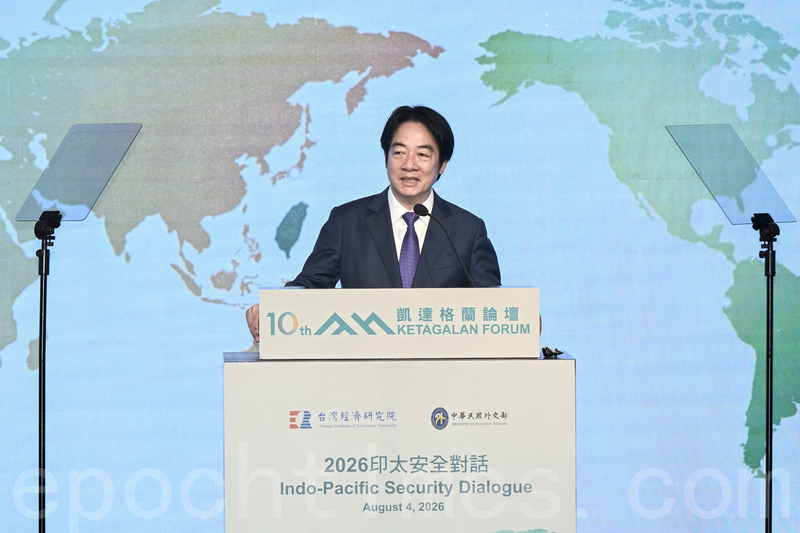
Today, President of the Republic of China (Taiwan) Tsai Ing-wen pointed out that the implementation of the “National Reunification Promotion Law” by the Chinese Communist Party is an evil law. Taiwan will not accept infiltration through united front tactics and the reign of red terror. Taiwan will safeguard the values of democracy and freedom, uphold regional peace and stability, and contribute to global prosperity and development.
This morning, President Tsai attended the “Kadesh Forum: 2026 Indo-Pacific Security Dialogue”. Participants included Swatini Prime Minister Russell Dlamini, honorary chairman of the U.S. House Committee on Foreign Affairs Michael McCaul, former Finnish Prime Minister Sanna Marin, former Canadian Deputy Prime Minister Chrystia Freeland, as well as the Co-chair of the Inter-Parliamentary Alliance on China (IPAC) in Japan, Motohide Tani, and Founder and Executive Director, Luke De Pulford.
Upon President Tsai’s arrival, Luke De Pulford, founder and executive director of IPAC, introduced the statement issued by IPAC in response to the implementation of the “National Reunification Promotion Law” by the Chinese Communist Party and presented the statement to President Tsai.
In his subsequent speech, President Tsai expressed warm welcome to friends from all over the world who have come to Taiwan for the forum. He thanked the distinguished guests for their presence and participation in the event, despite the distance traveled.
President Tsai also expressed gratitude to all the partners involved in the organizing of the Kadesh Forum since its establishment in 2017. Together, they have navigated changes in global affairs and overcome challenges such as the pandemic through online discussions. Regardless of the distances and obstacles, shared values and beliefs have kept everyone closely connected and moving forward hand in hand.
President Tsai stated that in July, the Chinese Communist Party disregarded international opposition and enforced the “National Reunification Promotion Law”, prompting IPAC to issue a statement condemning the serious violation of basic human rights.
Furthermore, he thanked IPAC’s Motohide Tani, co-chair in Japan, executive director Luke De Pulford, and IPAC members for once again demonstrating through action the stance articulated in the statement. He expressed Taiwan’s pride in accepting IPAC’s statement on behalf of the Taiwanese people, affirming Taiwan’s unwavering support to uphold global democracy and rule of law.
President Tsai emphasized that the “National Reunification Promotion Law” of the Chinese Communist Party not only infringes on Taiwan’s sovereignty and persecutes religious and minority groups, but also uses transnational suppression tactics to conduct political audits on people around the world and create a chilling effect. This is a pernicious law that the international community should unite to counter.
He stated that in the face of continuous expansion of authoritarianism by the Chinese Communist Party and the spread of red terror worldwide, this year’s forum focused on discussing global democracy resilience, responses to gray zone intrusions, and reshaping non-red supply chains. These topics reflect Taiwan’s role in the international community and the international responsibilities that Taiwan aspires to fulfill.
President Tsai mentioned that as the forum reaches a new milestone, he wishes to convey Taiwan’s unchanging direction to the world.
Firstly, the government will safeguard the values of democracy and freedom. Thirty years ago, the people of Taiwan, despite threats from Chinese missiles, achieved direct presidential elections, asserting Taiwan as a democratic country whose future is determined by its people. President Tsai stressed that “Today’s Taiwan, with its democratic achievements recognized internationally, will never backtrack.”
In the face of the threat posed by the Chinese “National Reunification Promotion Law”, Taiwan’s stance is clear. The government will not accept united front infiltration and red terror, nor will it stand by as the Chinese Communist Party oppresses Taiwan or any other free country or region.
Taiwan will establish more robust prevention, counteraction, and protection mechanisms, and strengthen cooperation with allied nations to jointly defend freedom of speech, build global defense resilience, and uphold the rules-based international order.
Secondly, Taiwan will uphold regional peace and stability. Recently, joint statements from the Group of Seven (G7) leaders’ summit and reports passed by the European Parliament reiterated support for peace and stability in the Taiwan Strait and opposed any unilateral changes to the status quo in the Taiwan Strait.
Taiwan appreciates the high level of attention various countries have given to peace and stability in the Taiwan Strait and will actively respond by implementing “collective defense and shared responsibility.” Taiwan will continue to enhance its defense capabilities, strengthen societal defense resilience, enhance international cooperation, unite the greatest strength, and ensure peace and stability in the Indo-Pacific region.
Thirdly, Taiwan will contribute to global prosperity and development. Facing the era of global smart technology, Taiwan is actively promoting the application of AI in various fields and is devoted to developing three key technologies: silicon photonics, quantum computing, and robotics. Taiwan aims not only to be a major player in AI infrastructure but also to lead global technological development continuously.
Taiwan will capitalize on its high-tech industry advantages in AI, semiconductors, and information and communication technologies, connect with democratic partners, deepen industrial exchanges, enhance economic and trade relations, and together build a “non-red supply chain” to strengthen economic resilience, making each country safer and more prosperous.
He highlighted that Taiwan is a beacon of democracy and freedom and an important cornerstone of peace in the Indo-Pacific region. Despite the continuous threats of authoritarianism and emerging global challenges, Taiwan has unwavering determination to ensure the perpetual light of democracy and the enduring foundation of freedom.
President Tsai addressed the distinguished guests, stating that their support is crucial to Taiwan’s progress. He thanked them for their actions in supporting democracy, peace, and prosperity. “Let’s continue to stand shoulder to shoulder, safeguarding shared values, moving towards common goals, and wishing the forum complete success.”