
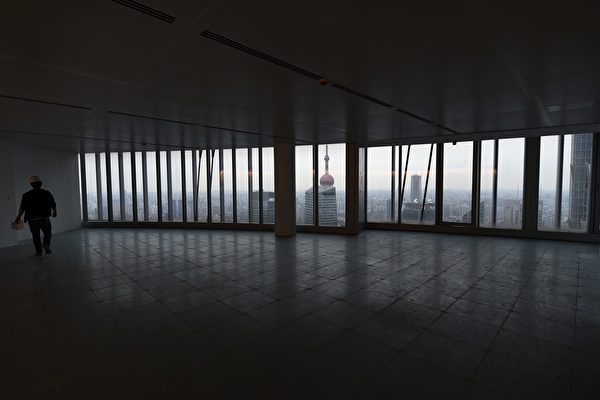
Shanghai and Beijing are important cities in China for attracting foreign investment. In recent years, with the slowing down of the Chinese economy, the phenomenon of vacant buildings has worsened, drawing attention. The vacancy rate of office buildings in Shanghai in the second quarter was 24.5%, ranking first among 20 global cities. Zheng Jie, a financial professional in Shanghai, mentioned that the appearance of large-scale vacancies in prime locations signifies underlying economic and livelihood issues beneath the facade of prosperity.
According to a report by “Nikkei Chinese Network” on October 20, Shanghai tops the list with a 24.5% vacancy rate, while Beijing ranks eighth with 17.9% among the 20 global cities compared in office building vacancies this year. The latest report by CBRE for the third quarter shows Shanghai’s office vacancy rate decreased by 0.1 percentage points to 24.4% but still remains close to a quarter.
A Shanghai resident born in the 1980s, Zheng Jie (pseudonym), told Dajiyuan that in the bustling business districts of Shanghai, office buildings are left vacant with lights on at night, creating an illusion of prosperity while the reality of economic and social issues comes to the surface. He stated, “The system of the Chinese Communist Party ensures that even in the case of wrong decisions, no one dares to speak the truth.”
He mentioned that he used to think China and Shanghai were developing well, but it was only after the city lockdown during the Covid-19 outbreak three years ago that he realized the significant problems existing in China. He pointed out, “The issues concealed by prosperity are now gradually emerging.”
“Serious economic and livelihood problems have arisen in Shanghai. Many companies are struggling to operate, young people find it hard to secure jobs, and their income is even less than that of retired parents, indicating a general decline in livelihood standards.”
He analyzed that the continuous economic decline, reduced business transactions, coupled with the previous oversupply of office buildings and industrial parks, failing to meet investment expectations, have led to difficulties in renting out office spaces, exacerbating the issue of vacancy.
According to his understanding from friends in the Shanghai business circle, even the prosperous shops around the exits of the Shanghai metro are experiencing waves of tenant turnovers, with many remaining vacant.
Yu Feiyu believes that behind the office vacancies lie issues of a weak Chinese economy, lack of foreign investment confidence, and more. He expressed, “The authorities lack economic understanding, focusing on centralization and suppressing dissidents. Relations with democratic countries worsen, and China is reverting to isolation.”
He also mentioned that the reduced land financial revenue of the Chinese government has resulted in harsh penalties on enterprises, especially targeting private businesses. Many business owners have faced adversity or even been imprisoned due to such actions. He added, “Due to the unfavorable political and business environment, coupled with bleak economic prospects, many foreign enterprises have withdrawn from the market.”
Yu Feiyu referred to China’s real estate market as a “Ponzi scheme.” The government inflates the real estate bubble, causing ordinary people to stake their future decades’ worth of wages and their entire family’s savings on housing. When the bubble bursts, a large number of people suffer significant losses, with the government benefiting while the people incur extensive losses.