
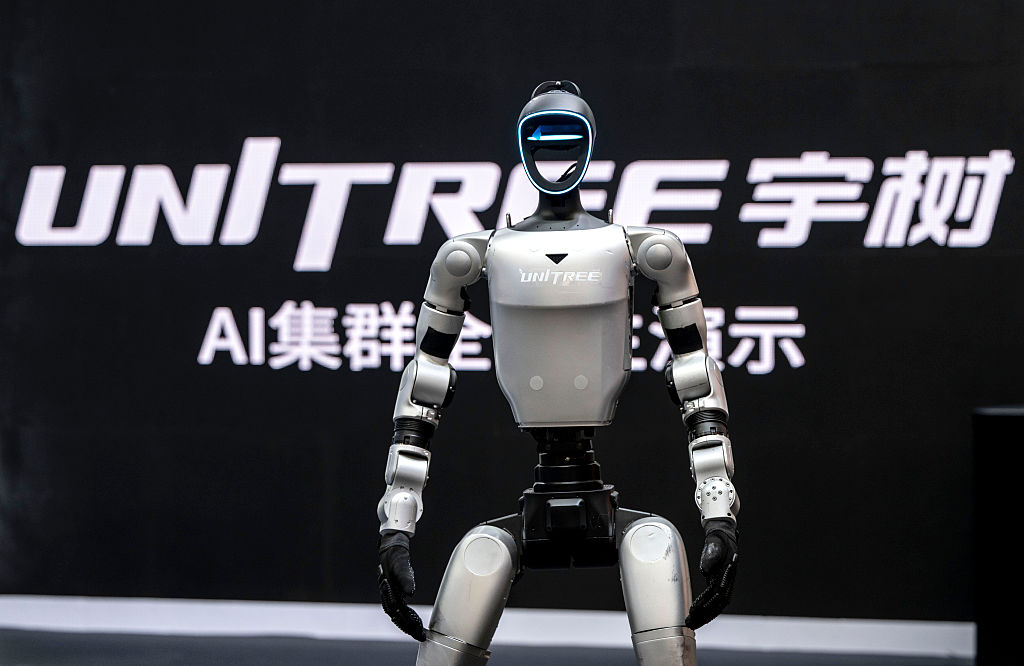
Under the policy drive of the CCP to develop advanced technology, a large number of robot companies have emerged in China, leading to a peculiar phenomenon in the industry where some are queuing up for their first public offering (IPO) while others are suffering bankruptcies and closures. Analysts believe that both the technology and capital in the robotics industry are showing signs of a bubble.
On October 21, China’s robot company Unitree Robotics released a new type of personal bodyguard robot, the “H2-X Kung Fu Legend Guardian”, positioned as personal security that can provide protection when the owner faces robbery and even lift cars to rescue trapped individuals underneath.
However, the founder and CEO of Unitree Robotics, Wang Xingxing, admitted during his attendance at the 2026 World Robotics Conference that currently robots, even though capable of performing some simple tasks, still have lower efficiency compared to human labor. Success rates can approach 100% after extensive training in fixed scenarios, but once the task involves different items or slightly alters the environment, success rates drop significantly.
Currently, China’s robotics industry is showing a split between hot and cold trends. The latest “Report on Embodied Intelligence Industry” released by the China Institute of Information and Communications states that to expand application scale and establish a stable profit model, the industry still faces many obstacles, with a noticeable gap between technical demonstrations and real-world applications.
Under the CCP’s promotion of so-called “new productive forces,” a large number of robot companies have rapidly emerged. It is reported that as of July this year, 50 robot companies have entered the listing process. Many robot companies are still queued for IPO, preparing to finance themselves by going public on stock exchanges. In the first eight months of 2026, financing in the robot field reached 124.51 billion yuan, which is double the total for the entire 2025.
Meanwhile, a number of robot companies are going bankrupt and closing down. According to public information such as court announcements, from February 2025 to September 2026, over 20 robot companies have gone under, dissolved, liquidated, or shut down their operations, covering at least 11 different sectors.
One of the most prominent cases is the complete exit from the market of Shenlan Robotics (Shanghai). The Pudong New Area People’s Court in Shanghai officially accepted the case for bankruptcy and liquidation of Shenlan Robotics, appointing a professional organization as the bankruptcy administrator.
Public records show that Shenlan Robotics had once shone brightly, launching various robot products such as commercial cleaning, intelligent delivery, epidemic prevention and disinfection, industrial collaboration, making frequent appearances at various industry exhibitions, attracting significant market attention with product demonstrations, and was once seen as a leading domestic company in robot localization and intelligence.
In addition, the Intermediate People’s Court of Shenzhen accepted the bankruptcy liquidation application filed by creditors against Yinghe Robotics, holding its first creditors’ meeting on October 19. The company was established in March 2020 with a peak valuation of 500 million dollars, and star shareholders include Meituan, ByteDance, and local state-owned capital.
Political observer Xia Yan believes that a large number of robot companies appear under policy incentives to take advantage of government subsidies and attract investments. However, many of these companies produce robots that are merely superficial, lacking real application value, hence the robotics industry in mainland China is just a bubble created by policy-induced false prosperity.
Industry venture capital media analyzing the recent wave of robot company closures believe that the two layers of bubbles in China’s robotics sector have been fully exposed – one layer being a technical bubble where companies cannot land technology, and the other being a capital bubble deliberately fabricated through false packaging.
This analysis points out that the growth of many robot companies relies on continuous financing, covering research and development, manpower, and production expenses with external capital, unable to generate positive operational cash flows. During a loose capital period, companies can expand continuously, expand their businesses, and create model projects; however, once the capital wind shifts, financing becomes difficult, and without cash flow buffers, the funding chain will quickly break. Capital is willing to foot the bill for the future, but the market will not sustain false prosperity indefinitely, leading to the unique state of differentiation in the robotics industry today.