
On Tuesday, October 13th, the American cutting-edge technology company OpenAI announced the discovery of a “sophisticated recording device” within its office premises and has handed over the matter to the Federal Bureau of Investigation (FBI) for further handling.
According to a statement released by the Department of Justice on the same day, 35-year-old OpenAI engineer and Saudi Arabian citizen Abdulrahman Alfozan was arrested last Friday (9th) on suspicion of involvement in the case. He appeared in federal court for the first time on Tuesday.
The Department of Justice alleges that Alfozan installed a hidden recording device in a senior executive meeting room of OpenAI company.
OpenAI stated that the device was installed a few days ago, and the employee responsible has been terminated.
FBI Director Kash Patel revealed in a statement that Alfozan “allegedly concealed a secret recording device in his employer’s executive conference room to covertly intercept sensitive communications about the company’s superintelligence technology (SI).”
In its statement, OpenAI said, “At present, we have no indication that this individual inappropriately accessed or stole model weights, source code, or customer data. We place great importance on safeguarding our technology, data, and employees, considering it a matter of national importance.”
This incident comes at a time when developers like OpenAI, the creator of ChatGPT, and its competitors like Anthropic are facing stringent scrutiny of their security protocols.
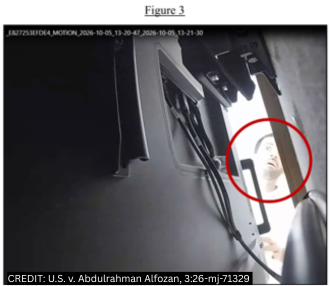
According to court documents, Alfozan began working as an engineer at OpenAI in July 2025. Around September 30, OpenAI employees discovered a hidden recording device inserted into a USB interface on the back of a television in a senior executive meeting room at their office building in San Francisco.
Upon confirmation by OpenAI, the recording device was wrapped in tissue, installed around September 28, and its contents were encrypted.
Closed-circuit television (CCTV) footage from the OpenAI office showed that Alfozan had been seen near the senior executive meeting room before the discovery of the device, even though he had no authorization to enter or participate in meetings held in that room.
According to the court documents, discussions in the executive conference room where the recording device was found often involved highly confidential technology, business, and strategic information, including proprietary research, product plans, business expansion opportunities, and non-public information about OpenAI’s technological advancements, strategic decisions, capabilities, priorities, government partnerships, and business relationships.
The court documents also indicate that before September 28, Alfozan had used office software multiple times to inquire about OpenAI’s office address, meeting rooms, their capacities and schedules, as well as the office locations of “leadership and executives” and meeting information with external partners.
Additionally, a chatbot account associated with Alfozan’s spouse (sharing the account with Alfozan’s personal chatbot account) submitted tips related to building, customizing, installing, recording, testing, obfuscating, and remotely accessing devices from September 24 to 30, including instructions on “building a continuous recording machine,” “customizing Wi-Fi connections,” “improving audio and real-time monitoring,” and “improving audio and real-time monitoring.” The chatbot account also submitted specialized tips specifically for the hidden recording device on September 27 and 28, including its custom headers and unique MAC address.
On October 5, Alfozan left an unattended bag in another room of the OpenAI building. Upon discovery and inspection by OpenAI security personnel, the bag contained Alfozan’s wallet and identification, among other items, as well as another device similar to the previously discovered hidden recording device.
If convicted, Alfozan could face up to 5 years in prison and a fine of $250,000, in addition to 3 years of supervised release.