
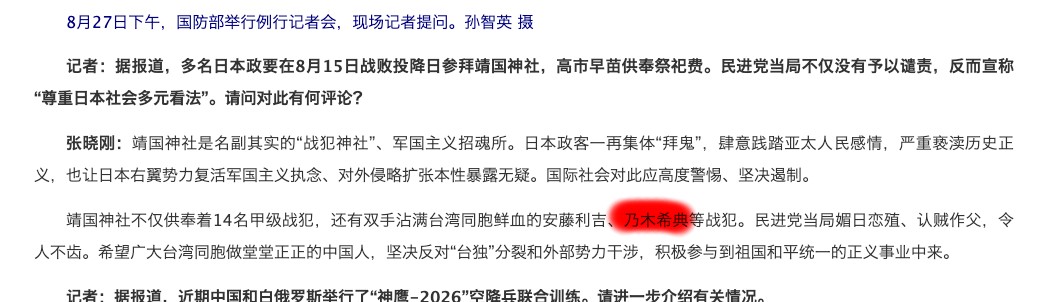
On September 7, 2026, the spokesperson of the Chinese Ministry of National Defense, Zhang Xiaogang, made remarks during a routine press conference regarding the controversial visits of Japanese politicians to the Yasukuni Shrine. He criticized the shrine for not only enshrining 14 Class-A war criminals but also figures like Akiyama Yoshifuru, creating a historical farce. This statement was promptly fact-checked and criticized by Yasutate Akihito, the executive director of a think tank in the Indo-Pacific region and a seasoned media personality.
Akihito rebuked the Chinese spokesperson for lacking basic historical accuracy and berating non-existent events during an official press conference. He highlighted the dangers of using history as a political tool to incite anti-Japanese sentiment without regard for factual accuracy, exposing ignorance and arrogance. Akihito emphasized that the history of Taiwan should be researched and evaluated by the Taiwanese people themselves.
On September 6, Akihito took to the social platform X to highlight another historical blunder made by the Chinese Ministry of National Defense. He pointed out inaccuracies in the statements made by spokesperson Zhang Xiaogang during a press conference on August 27, where the shrine visits were condemned and Taiwan was implicated, alleging that individuals such as Ando Ryoki and Nogi Maresuke – who were said to have “blood on their hands from Taiwanese compatriots” – were enshrined at Yasukuni Shrine. However, a simple check of historical records would reveal that Nogi Maresuke was not enshrined at the shrine.
Nogi Maresuke (1849-1912) was a Japanese Army General during the Sino-Japanese War and the Russo-Japanese War, who also served as the Governor-General of Taiwan from 1896 to 1898. He and his wife committed suicide following the death of Emperor Meiji in 1912. Due to the circumstances of his death not meeting the shrine’s criteria, he was not enshrined at Yasukuni Shrine. The actual shrine dedicated to Nogi and his wife is located in Akasaka, Tokyo, known as Nogi Shrine.
Akihito criticized the Chinese Ministry of National Defense for vehemently chastising a non-existent situation during an official press conference. He further articulated that while historical discussions about Nogi’s governance in Taiwan can be had, evaluations should be based on concrete historical evidence. Akihito stressed that Taiwan’s history should be researched and appraised by Taiwanese people themselves, rather than defined unilaterally by external governments.
The ludicrous aspect, according to Akihito, lies in the fact that the Chinese military spokesperson did not bother to do the basic historical research and confidently uttered false historical facts, subsequently using these falsehoods to denounce Japan and lecture Taiwan. When history is used solely as a political propaganda tool, cherry-picking Japanese military figures when needed, and fabricating a “historical memory” for the purpose of political propaganda, it disregards factual accuracy. Such practices ultimately reveal their own arrogance and ignorance.
In response to these events, an independent commentator on September 7 remarked, “Misrepresenting facts and causing laughter, the National Defense Ministry spokesperson probably only knows the history that has been distorted by the Chinese Communist Party. As for which Japanese individuals are enshrined at Yasukuni Shrine, the National Defense Ministry spokesperson simply doesn’t care! Inventing historical anecdotes out of thin air not only exposes their arrogance and absurdity but also invites ridicule from the world.”
On August 27, during the Chinese Ministry of National Defense’s routine press conference, a reporter mentioned that several Japanese politicians visited Yasukuni Shrine on August 15, the anniversary of Japan’s surrender in World War II, and made offerings. The ruling Democratic Progressive Party in Taiwan stated that it “respects the diverse views in Japanese society.”
At that time, Zhang Xiaogang responded by stating that Yasukuni Shrine enshrines 14 Class-A war criminals and also individuals like Akiyama Yoshifuru and Nogi Maresuke, who had “blood on their hands from Taiwanese compatriots.”