
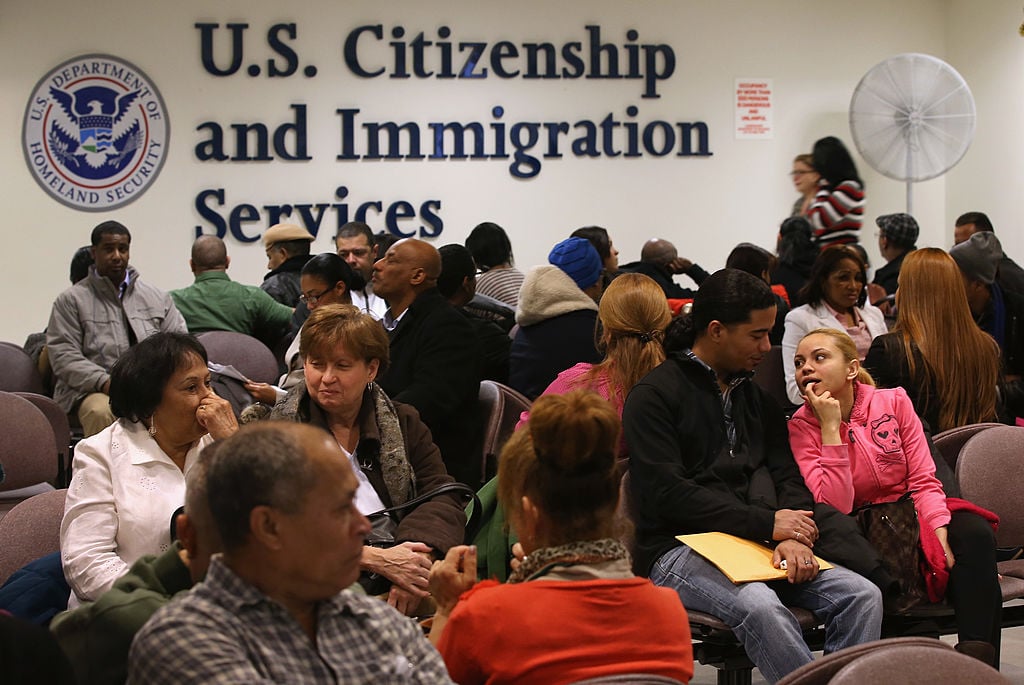
Recently, a former official of the United States Citizenship and Immigration Services (USCIS), also known as the Immigration Bureau, was arrested and charged for allegedly accepting bribes and helping others obtain immigration benefits including green cards.
The U.S. Attorney’s Office for the Northern District of Texas announced that Lukman Owolabi Ganiyu, a former senior immigration services officer at USCIS, along with his accomplice Adeniyi Akeem Somoye, were arrested on September 2nd. The federal criminal complaint filed on August 31st accuses Ganiyu of participating in a years-long immigration application corruption scheme and both are charged with “conspiracy to receive illegal gratuities by a public official.”
According to prosecutors, Ganiyu joined USCIS in November 2018 and held positions in Kansas, Texas, and North Carolina, before being promoted to a senior immigration services officer in Dallas in April 2024. The charges allege that between December 2019 and March 2026, he accepted bribes and approved applications including family sponsorship (I-130), adjustment of status/green card (I-485), removal of conditions (I-751), and naturalization (N-400) for monetary gains.
Investigators claim Ganiyu bypassed necessary interviews, supervisor reviews, jurisdictional limitations, background checks, and other standard procedures, handling applications from offices in Minneapolis, Charlotte, and Houston. Many applicants were from African countries, some allegedly not meeting legal qualifications.
The complaint states that Ganiyu personally approved Somoye’s naturalization application in December 2022, followed by approving residency applications for Somoye’s wife and children. They communicated through “a significant amount of WhatsApp messages” to make arrangements and collectively collected hundreds of thousands of dollars from numerous applicants.
Somoye acted as a “financial intermediary/moneyman,” handling around $1.7 million in transfer flows and taking a cut as compensation. Ganiyu received approximately $671,400 in electronic payments through Zelle, Cash App, and other platforms, with around $287,800 in unexplained cash deposits in bank accounts, some of which were related to immigration applications.
Between 2020 and 2025, Ganiyu received about $407,800 in salary from USCIS, without any other reported employment during that time.
Moreover, from May 2023 to January 2026, Ganiyu received around $138,400 via bank transfers from Somoye and an additional $21,900 from a company managed by Somoye.
Ganiyu resigned from USCIS in March 2026 citing “personal reasons.”
Ryan Raybould, the U.S. Attorney for the Northern District of Texas, stated in a press release, “Selling immigration benefits for cash is an overt abuse of public trust. When federal officials put a price on legal status, we intervene without delay, and we do not tolerate public corruption.”
USCIS emphasized on its website that they do not tolerate corruption, abuse of power, or violations of public trust. The investigation was conducted jointly by USCIS’s Office of Investigation, the Department of Homeland Security (DHS) Office of Inspector General, and the Federal Bureau of Investigation (FBI) Dallas Field Office.
R. Joseph Rothrock, the head of the FBI Dallas Field Office, emphasized that “manipulating immigration decisions for personal gain undermines the integrity of procedures crucial to our national security.”
If convicted, each could face up to 5 years in federal prison and a $250,000 fine. Ganiyu’s lawyer, Alfonso Cabanas, informed Newsweek that his client denies any criminal activity and disputes the government’s characterization of related financial transactions and immigration applications.
Ganiyu holds dual citizenship of the United States and Nigeria, with overseas bank accounts and property in Nigeria. The court approved Ganiyu’s bail under conditions including GPS monitoring, travel restrictions, and surrender of U.S. and Nigerian passports.
The case is currently at the complaint stage, and the final determination of responsibility awaits formal charges and trial outcome.