
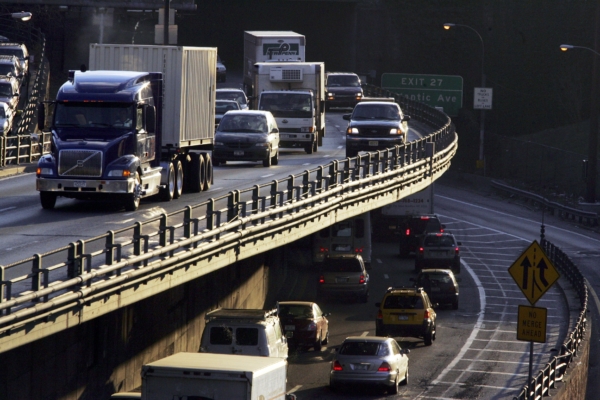
New York City Mayor Mamdani officially announced on Monday (August 24) a massive $4 billion restoration plan to thoroughly renovate a crucial section of the Brooklyn-Queens Expressway (BQE) under the jurisdiction of the city government.
In his statement on Monday, Mayor Mamdani said, “The lifespan of this infrastructure has long exceeded its original design life of 20 years, now enduring the crushing weight of up to 130,000 vehicles per day (including 13,000 heavy trucks), which is more than double the original design capacity. We cannot continue to delay any longer.”
The restoration project targets the approximately 1.5-mile long “BQE Central” section between Atlantic Avenue and Sands Street. This section is one of the busiest and most congested thoroughfares in the city, including the iconic Triple Cantilever structure and the top-level Brooklyn Heights Promenade.
To avoid tens of thousands of vehicles flooding into surrounding community roads and causing traffic disasters during construction, the city plans to construct temporary dual-lane bypass segments to maintain the existing two lanes in each direction.
Mike Flynn, Commissioner of the New York City Department of Transportation (DOT), stated, “After decades of excuses and indecision, this time we will take action with a sense of urgency, restore the city government-controlled BQE section, ensure the safety of New Yorkers, and minimize the impact of traffic diversion on the Brooklyn community as much as possible.”
According to the timetable released by the city government, the project is expected to begin in 2030, with a total duration of 10 years (expected completion by 2040).
Mamdani stated that upon completion of the restoration, it will significantly extend the structural safety life of this century-old artery of the BQE by at least 40 years (extending to 2080), thoroughly addressing the major safety hazards that the city has long faced.
The BQE, also known as Interstate 278, was constructed in segments from the 1930s to the 1960s, with some of the construction funding coming from the city of New York, some from the state government, and federal funds, resulting in fractured ownership.
Although the city government only oversees a 1.5-mile section (approximately 12% of the total length), this particular stretch includes the most complex, severely aging, and costly to repair Triple Cantilever structure. This is why for many years, discussions between the city and state governments regarding repairs often led to political blame games due to budget, responsibilities, and construction planning issues.