
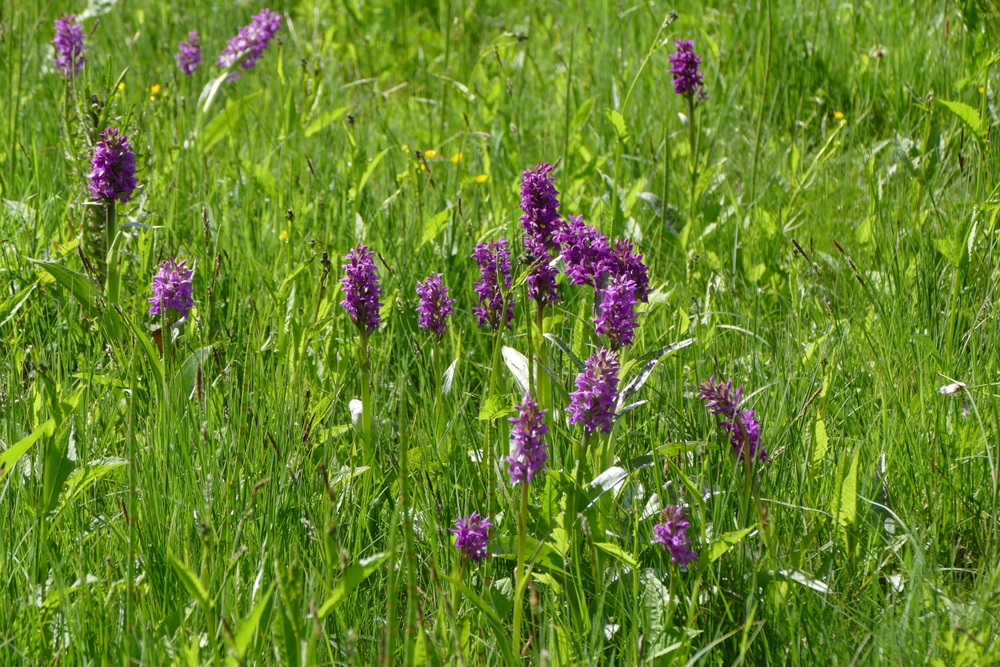
In a study conducted in the UK, a geography professor wanted to see if a piece of farmland would naturally transform into a wildflower meadow once it ceased cultivation. Despite being advised to scatter seeds, the professor chose not to do so.
Aside from annual grass cutting, the land was left untouched for over a decade. Surprisingly, the former rapeseed field did indeed evolve into a wildflower meadow, doubling the number of plant species and even naturally producing thousands of orchids.
According to ScienceDaily, this research was led by Professor Carl Sayer from the Geography Department at University College London (UCL) and the results were published in the academic journal “Restoration Ecology”.
This approximately 2-hectare plot of land is located in Bodham, northern Norfolk, England, named “Sayer’s Meadow” after the professor’s father, Derek Sayer, who is also a co-author of the paper.
After the final rapeseed harvest in 2005, the professor had the vision to restore the area to a wildflower meadow. Despite suggestions to purchase wildflower seeds for sowing, he decided to observe the land’s natural progression.
No commercial wildflower seeds were sown, no topsoil was removed, and no deep plowing was done. Apart from the traditional annual hay cutting, there was minimal human intervention.
Researchers monitored the changes in this grassland from 2011 to 2022. In 2011, there were an average of about 10 plant species per square meter; by 2022, it had increased to nearly 20. Varieties such as southern marsh orchid, greater tussock-sedge, yellow rattle, and common centaury appeared on their own. The proliferation of orchids was particularly notable.
Upon discovering the orchids initially, researchers recorded their locations using GPS. As their numbers grew rapidly, this method became impractical. Now, the meadow boasts thousands of orchids.
How did these plants thrive without intentional seeding? Researchers are still uncertain. Some species are not native to the nearest known populations, leading to speculation that seeds might have been unwittingly dispersed here by wildlife like deer.
The study revealed that abandoned farmland, with minimal human interference, can gradually evolve into diverse grasslands. This prompts a reevaluation of the necessity of conventional habitat restoration methods.
Researchers stress that not all fallow fields will naturally turn into wildflower meadows. However, in suitable conditions, allowing plants to naturally regenerate may be a simpler and cost-effective alternative to methods involving large-scale seed purchases and soil removal.