
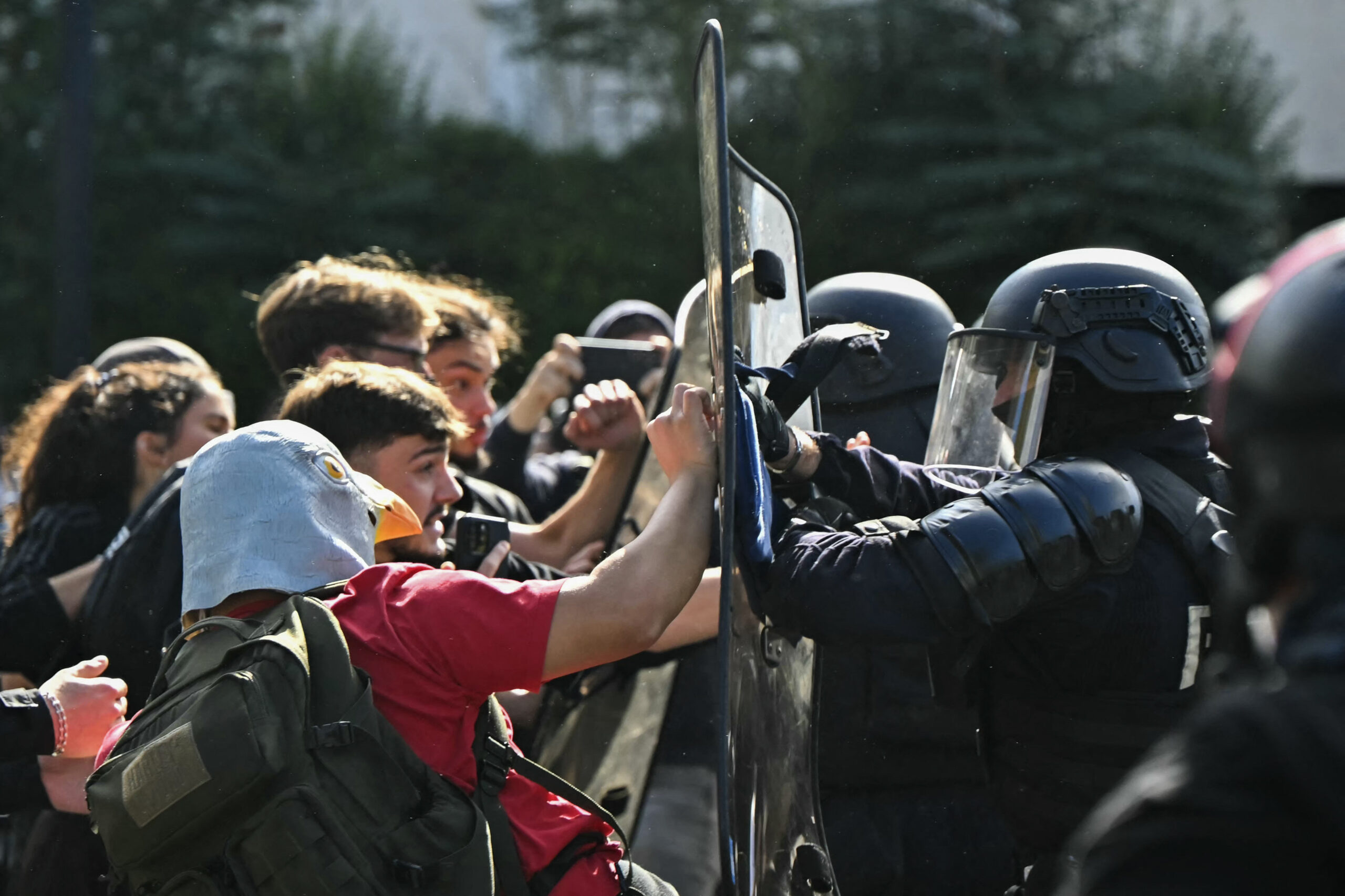
On Tuesday, October 13th, large-scale protests erupted across France, with hundreds of thousands of people taking to the streets to show support for high school students and to protest against the conditions in schools and the police enforcement methods. Additionally, this Saturday, October 17th, a nationwide protest against the rising cost of living is scheduled to take place throughout France, with plans to merge with the ongoing high school student protests.
According to Agence France-Presse (AFP), the French Ministry of Interior announced that on Tuesday, approximately 161,500 people protested nationwide, with 41,500 people in Paris alone. This number is more than double the official count of 71,500 people from last Thursday (October 8th), but lower than the 266,000 people on the previous Tuesday (October 6th, organizers claimed 450,000 participants). The student and labor union alliance organizing the Tuesday rally claimed that there were 480,000 participants nationwide.
The Ministry of Education in France reported that on Tuesday, 214 schools across France (mostly high schools) were closed, while about 94.2% of high schools remained open. Data from the French Ministry of Higher Education indicated that approximately 35% of higher education institutions were affected by closures, occupations, or administrative shutdowns. The Ministry also mentioned that since the start of the protests, about 147 education staff members were injured, with 20 of them getting injured on Monday (October 12th).
Furthermore, this Saturday (October 17th), France is set to hold a nationwide demonstration against the soaring cost of living, with labor unions and student groups planning to join forces to pressure the government of Emmanuel Macron.
Despite the government’s promise to deploy 3,000 substitute teachers to the 114 most severely affected schools after last week’s protests, students remain skeptical, believing that this is a superficial solution and that the government should come up with more fundamental resolutions.
The main issues protested by demonstrators include a lack of teaching staff in schools, dilapidated school buildings, overcrowded schedules (some schools have classes from 8 am to 6 pm), and police enforcement methods. Protesters are also calling for reforms in the higher education admission platform Parcoursup, to increase transparency, and are demanding a government investment of about 10 billion euros to improve high school education.
Many students expressed their solidarity with schools and students facing more challenging circumstances, hoping the government would listen to their voices and not resort to heavy-handed tactics. Some believe that the police used excessive force against students, resulting in injuries that drove them to participate in the protest actions.
The police response has drawn criticism, leading French authorities to suspend the use of stun grenades involved in the incidents.
While most of the protests on Tuesday proceeded peacefully, violent clashes erupted in the vicinity of one of the demonstrations in Paris.
AFP reporters witnessed several vehicles being set on fire, masked youths attempting to set up roadblocks and throw debris, while riot police dispersed protesters with tear gas. In Lyon’s demonstrations, the police also used tear gas.
Swedish climate activist Greta Thunberg, aged 23, appeared outside the Lycée Paul Éluard in Saint-Denis, a northern suburb of Paris, to show solidarity. Known for organizing climate protests and school strikes, she supported French students this time, stating that the global community is closely watching their struggle for basic rights.
Jean-Luc Mélenchon, the leader of the far-left opposition party “France Unbowed” (LFI) and presidential candidate, openly supported the students and criticized the government for the excessive use of force against young protesters.
Marine Le Pen, leader of the right-wing “National Rally,” condemned the violent actions of the protesters and demanded that those responsible for damaging school facilities (or their parents if they are minors) bear the repair costs.
President Macron urged protesters to exercise restraint, emphasizing that these issues “require time, negotiation, discussion, and mutual respect.” French Prime Minister Sebastien Lecornu has asked cabinet ministers to propose concrete solutions regarding absenteeism, school facilities, schedules, and Parcoursup.
With only about six months left before the French presidential election, Macron’s government is pushing for the passage of the 2027 fiscal budget in parliament, including spending cuts. Concerns over France’s public debt and fiscal restructuring are also increasing market scrutiny on French bonds.