
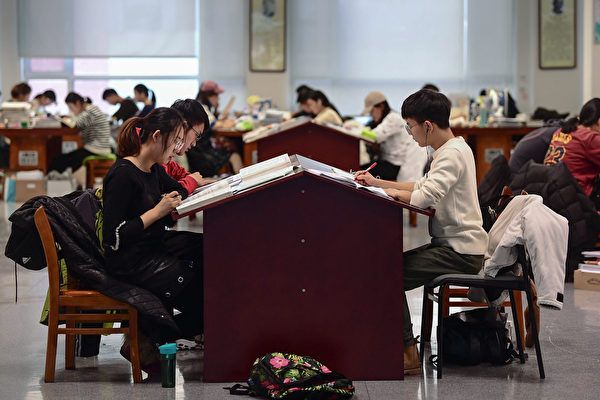
In a recent disclosure by Taiwanese students studying at a university in Nanjing, it was revealed that there are “professional students” on campus monitoring Taiwanese students. These “professional students” report any discussions on sensitive topics during classes. Similar monitoring is also targeted at Hong Kong students. Reports suggest that the Chinese national security has been stationed at universities in Hong Kong to monitor the speech of both teachers and students.
According to a report by Radio Free Asia on October 13th, a Taiwanese student, Liu Minghao (pseudonym), who is pursuing a postgraduate degree at Nanjing University of Chinese Medicine, mentioned that teachers have privately warned students not to discuss sensitive topics because there are ‘professional students’ monitoring Taiwanese students on campus and reporting to the authorities. Despite the well-intentioned reminders from teachers, it is still difficult to distinguish who these “professional students” are.
Some Taiwanese students in Shanghai and Hangzhou also informed Liu Minghao that there are cameras installed in their university classrooms. Teachers have also privately advised students to be cautious in their class discussions. Liu Minghao remarked that, unlike universities in Taiwan where students enjoy freedom of thought and speech, in China, students need to be cautious in criticizing government officials.
Liu Minghao mentioned that these “professional students” not only monitor students but also keep records of teachers’ words and actions. He highlighted that at his university, discussions on political and public issues, as well as controversial social events, are difficult to engage in, causing students to be cautious about expressing their opinions in class.
Furthermore, a Taiwanese student studying media in Beijing shared their disappointment with the classroom environment at mainland Chinese universities. They had initially expected to discuss real-world social events in journalism class but later discovered that many controversial topics were off-limits for discussion.
Expanding on the reading: Explanatory guide on the firewall monitoring system in Chinese universities exposed – expert analysis.
Public information shows that in recent years, some universities have established “International Student Management Centers,” requiring foreign students to regularly report on their accommodations, travel plans, and off-campus activities.
In May of this year, a Hong Kong student named Wang Jue (pseudonym), studying at a university in Zhejiang, disclosed to a media outlet that certain universities require class monitors to assist in monitoring the situation of international students, including religious activities and social interactions.
Wang Jue revealed to reporters that one of her teachers once privately warned her during a conversation that there are so-called “professional students” in the class. The teacher advised her not to speak recklessly and not to mention sensitive topics related to figures like Jimmy Lai from the Hong Kong newspaper Apple Daily, mentioning that there are individuals in the class specifically collecting students’ and teachers’ comments.
Wang Jue stated that these individuals are typically referred to as “public opinion information officers” in schools, specializing in documenting classroom discussions, with politically sensitive topics being reported upward.
The Chinese authorities have been closely monitoring the speech of students in universities. In recent years in China, the trend of students reporting on teachers has been prevalent, with many university professors being suspended or even losing their jobs due to their classroom remarks. According to a CIA report back in 2010, after the Tiananmen Square incident in 1989, key Chinese universities implemented a system of “student informants.” In the early 2000s, the Chinese government expanded this system to provincial-level universities. By 2005, the informant system was further extended to lower-level schools and even some high schools.
In recent years, the Chinese education system has been promoting “smart campuses” and “digital education.” Many universities have established student management platforms that not only cover academic performance and attendance but also delve into family backgrounds, political stances, psychological states, religious affiliations, and daily activities.
The campus surveillance by the Chinese government has extended beyond the mainland. Independent commentator Du Zheng revealed in an article on the Taiwanese media Up Media on October 5th that a Chinese national security officer admitted while attending a university in Hong Kong last year that their mission involved monitoring teachers and students, particularly scrutinizing remarks critical of or insulting to national leaders.
Du Zheng suggested that it is believed that there are undercover Chinese personnel in every major university in Hong Kong and even more so overseas. During Xi Jinping’s recent visit to the United States, those individuals resembling Chinese agents were seen wearing hats, masks, and sunglasses, many likely having long-term residences or work assignments in the U.S., necessitating the concealing of their true identities. They may have affiliations with certain workplaces or pose as international students.