
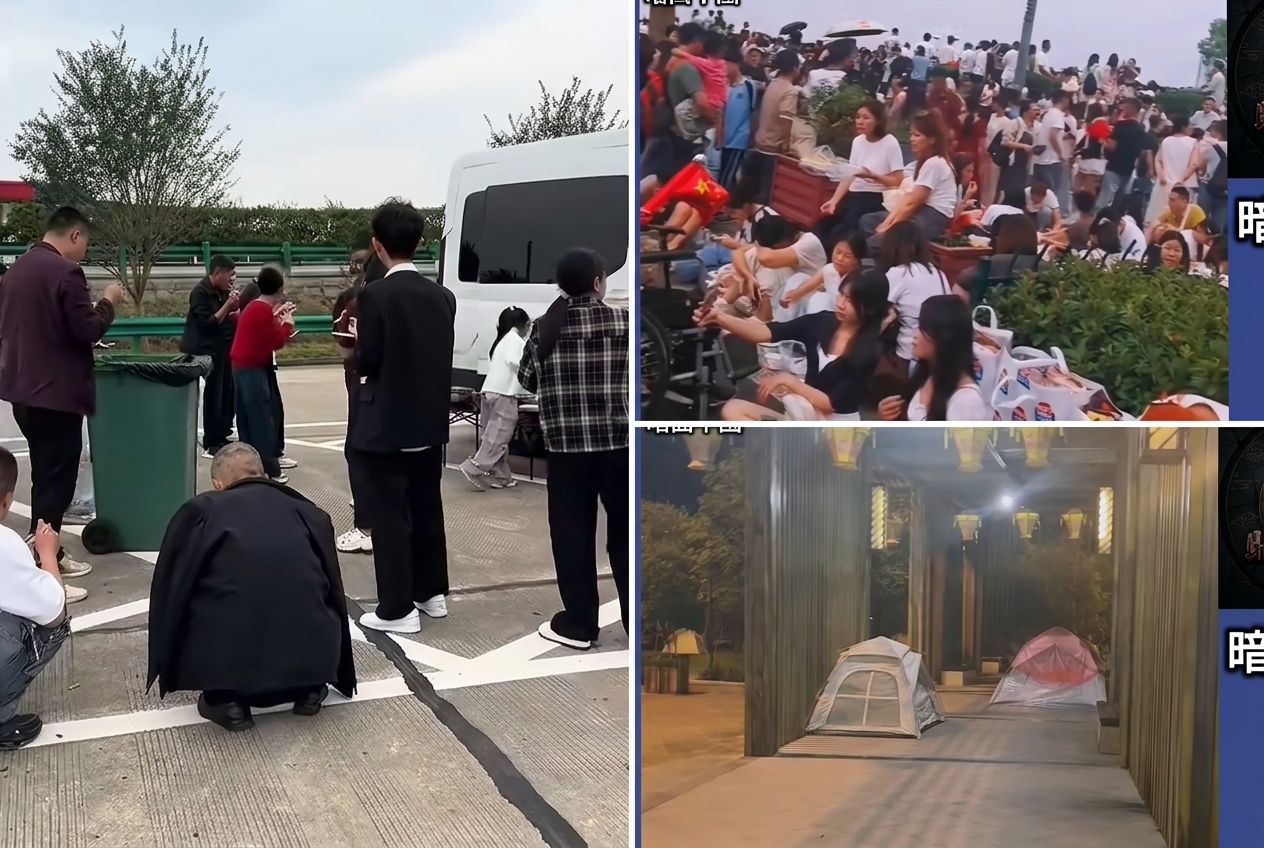
The “Eleventh” National Day holiday in China is still bustling with tourists, but the way visitors spend money is changing. Free attractions and public spaces in cities are packed with tourists, some bringing their own food, pitching tents, or even sleeping in their cars; meanwhile, some fee-charging scenic areas, hotels, and guesthouses are experiencing low visitor numbers. Many operators have stated that even with lowering accommodation prices, it is still challenging to attract overnight stays and spending from tourists.
This year, the Mid-Autumn Festival and National Day holidays are combined, allowing the public to have up to a 13-day holiday by taking just 3 days off. According to data from the Ministry of Transport, the total interregional population flow on the first day of the National Day holiday was approximately 329 million, a 1.9% decrease from the same period last year; the total for the first 4 days reached about 1.244 billion, roughly on par with last year. The Ministry of Culture and Tourism of China has yet to release the total domestic tourism numbers for this year.
Compared to popular cities, another notable change this year is the rise in “county travel.” Data from Tongcheng Travel shows that during the Mid-Autumn Festival and National Day period, bookings for county-level travel products increased by 42% annually, with tourists spending an average of 3.2 more days in county-level destinations compared to last year. Pingtan, Chun’an, Baoting, Zhongmou, and Pingyao have emerged as popular destinations. Data from Tuniu and China Mobile Wutong also indicate that the average number of days travelers spend on domestic trips is nearly 4 days, representing an increase of over 30% compared to the same period last year.
“County travel” does not equate to being economically challenged. Platform data shows that some travelers visit county towns for natural landscapes, local culture, and a slower-paced experience. Data from Tongcheng Travel also suggests that tourists are extending their stays in county-level destinations, transitioning from brief photo stops to longer stays.
Multiple videos circulating on Chinese social media platforms during the National Day holiday show crowded scenes at popular attractions. In Chongqing’s Hongyadong, crowds gather to see the free night view, with visitors reportedly only sightseeing without making purchases. In Nanchang, some tourists choose to watch free fireworks, visit free attractions, and primarily eat self-brought food or a simple bowl of noodles, self-deprecatingly referring to themselves as “poor but wanting to have fun,” hence opting for free cities and attractions.
Accommodation also faces similar challenges. During the National Day holiday, some travelers turn their private cars into temporary bedrooms or pitch tents at highway service areas and urban green spaces.
A video from the YouTube channel “Dark Side of China” shows around 30 tents clustered in a green area, with the cameraman noting that people are present but not substantial spenders, potentially leading to a similar financial loss situation as last year’s National Day holiday for businesses. Other travelers express that hotel prices are too high, choosing to sleep in their cars rather than paying inflated holiday prices.
A driver in Dali, Yunnan, mentioned in a video that a local homestay owner informed him that despite lowering room rates to 90 yuan per night, they still struggle to attract guests during the busy National Day season; whereas in previous years, room rates during the National Day holiday were at least around 300 yuan. The driver also mentioned that there were many street vendors near Erhai Lake, but most tourists only visit briefly for photos before leaving, resulting in limited spending.
Another video from the “Dark Side of China” YouTube channel showcases the emptiness in the parking lot of the Tongluo Village scenic area in Huoshan County, Lu’an City, Anhui, with only two cars present, indicating minimal visitor traffic. In the central street of Naked Heart Valley in Moganshan, Deqing, Zhejiang, some shops are closed. At the entrance of the famous Mount Putuo, a place that can accommodate thousands of people, only a scattered few tourists are visible behind the dense railing.
Wang Guochen, Deputy Researcher at the China Institute of Economic Research, mentioned in an interview with Deutsche Welle that the surge in Chinese tourism in recent years may not necessarily reflect increased consumption levels, and the phenomenon of “budget travel” is likely to continue. He believes that factors such as youth employment and a sluggish real estate market are still suppressing residents’ purchasing power.
Li Qi, a Researcher at the China Analysis Center of the Institute of Asian Social Policy, pointed out that Chinese consumers are not entirely refraining from spending money but are being more cautious about “how much to spend and where to spend it”; as long as they consider it worthwhile, they will still spend on travel, restaurants, and experiential consumption, while saving in other areas.
Last year during the National Day holiday, there were 888 million domestic trips in China, with total tourism expenditure reaching around 809 billion yuan, averaging about 911 yuan per person. The complete data on domestic tourism expenditure for this year during the National Day holiday is yet to be released. The Ministry of Culture and Tourism of China has not announced the total number of domestic tourists during this National Day holiday either, hence, at this stage, the observable factors are the differences in visitor flow and expenditure at various tourist destinations.