
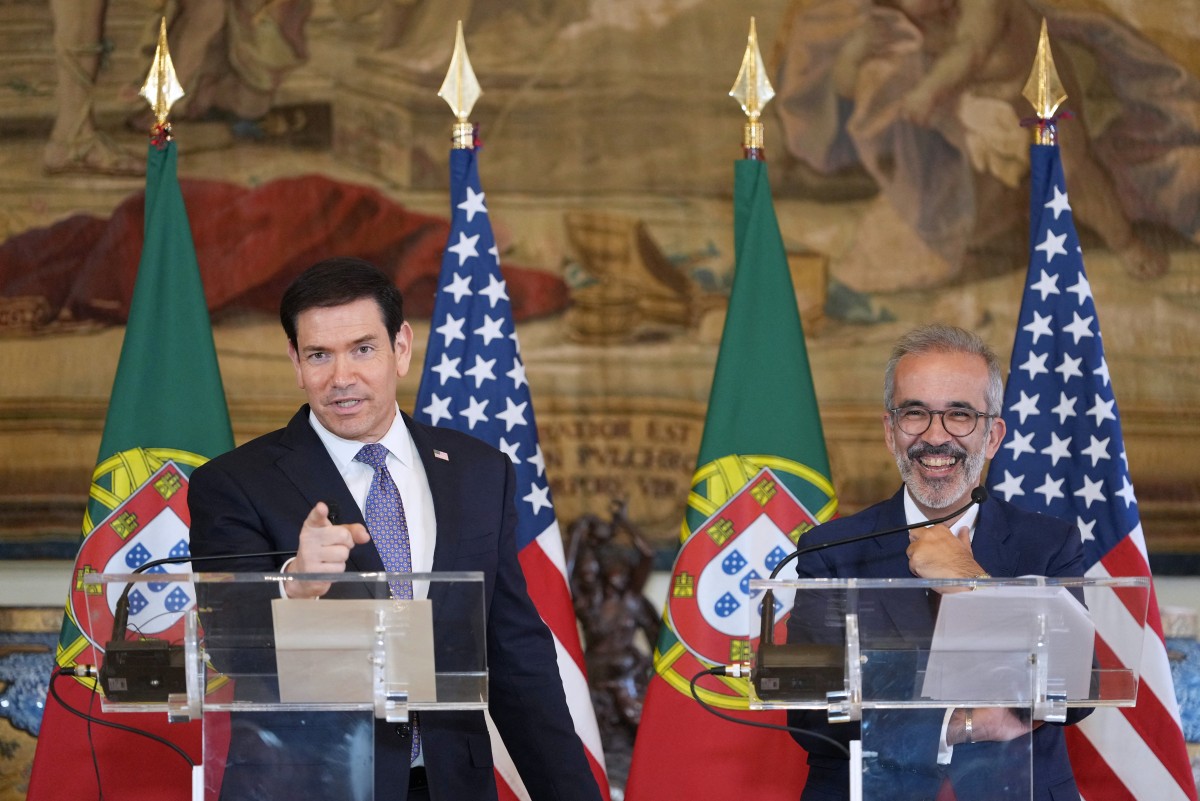
On Thursday, October 8, US Secretary of State Mike Pompeo stated that Portugal and other European countries should not rely on China or any single country for critical supplies, as the US seeks to limit Beijing’s penetration in strategic areas. The European Union is also exploring measures to reduce reliance on China.
During his visit to Iceland, Greece, and Portugal this week, Pompeo expressed concerns about Beijing’s presence in Europe during his last stop in Portugal, saying, “We believe this is not a good situation for us, Portugal, or any country in the world.”
“We believe diversity is needed,” he added during a joint press conference with Portuguese Foreign Minister Paulo Rangel in Lisbon.
Pompeo cited examples of supply chain disruptions during the COVID-19 pandemic. He argued that no country should rely up to 95% on another country in “any area,” highlighting vulnerabilities in critical minerals, core technology, and biotechnology.
Maintaining communication infrastructure remains a critical security priority, Pompeo emphasized, pointing out that foreign investments in the telecom sector could expose countries to pressure from other governments.
He described Portugal as an “ideal gateway” for US technology companies to enter Europe, mentioning advantages such as the country’s underwater infrastructure, affordable energy, mineral reserves, and data centers. However, he expressed concerns about underwater interconnect facilities, stating that undersea cables are increasingly threatened by global malicious actors attempting to disrupt them during conflicts or as a bargaining chip.
Portugal is particularly sensitive to the issue of reliance on China, as Chinese companies hold significant stakes in some of the country’s most strategically important companies. China Three Gorges owns 22.2% of utility company EDP, State Grid Corporation holds 25% of grid operator REN, and Fosun Group owns 20.45% of the country’s largest listed bank, Banco Comercial Português.
According to data from the Bank of Portugal, Beijing is one of the country’s largest foreign investors. By the end of 2024, China’s total foreign direct investment in Portugal was around €12.1 billion (approximately $13.5 billion).
Portuguese Foreign Minister Rangel described the US as a “great ally,” but also noted that Beijing’s investments in Portugal comply with current and future EU regulations.
However, the EU is exploring new rules to reduce reliance on China, including diversifying supply chains and strengthening scrutiny of Chinese investments. The EU has also proposed measures aimed at prioritizing European companies in public procurement contracts.
The US and Portugal also maintain a strong defense relationship. The US has long maintained a military presence at Lajes Field in the Azores, which is strategically located to support US and allied operations in the Atlantic region. Portugal has recently agreed in principle to allow the US to use Lajes Field to support US military operations against Iran.
Pompeo stated that the US abides by established bilateral agreements regarding the use of military facilities in Portugal and refuted allegations of US infringing on allied sovereignty in actions against Iran.
“In short, we have existing agreements to regulate our presence in the region and the use of the base; out of respect and fulfilling our obligations under agreements with NATO allies, we always abide by these regulations,” Pompeo told reporters.
During their meeting in Lisbon, Pompeo and Rangel discussed Middle East conflict issues. Portugal supports diplomatic efforts to prevent Tehran from obtaining nuclear weapons and emphasizes that the country is not a party to the conflict.
After meeting with Pompeo, Rangel stated that Portugal will decide how to replace its aging F-16 fighter jet fleet based on national interests, considering seriously the US-proposed F-35 fighter jet option and other alternatives.
Portugal has not yet initiated the formal bidding process to replace its 28 upgraded F-16M fighter jets, but competition surrounding this military procurement deal is intensifying. This deal will deepen defense relations between Portugal and European or American partners.