
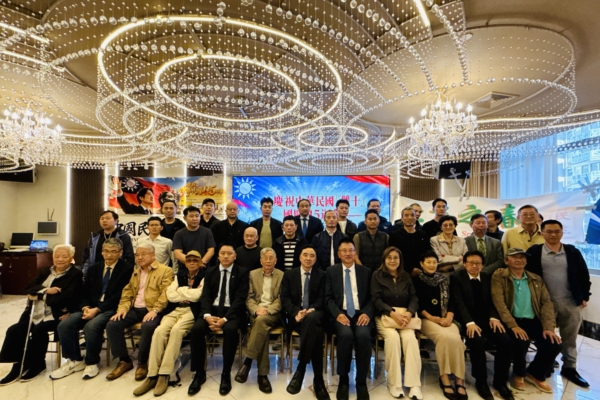
On October 6th, a pro-democracy organization in New York’s Flushing held a seminar to celebrate the 115th anniversary of the Republic of China’s Double Tenth National Day and criticize the Chinese Communist Party’s “National Unity and Progress Promotion Law”. Over 20 experts, scholars, pro-democracy leaders, and democratic figures praised Taiwan’s democratic development as an inspiration for mainland China. They pointed out that the CCP’s “National Unity and Progress Promotion Law” is actually a “National Division Law” and expressed concerns that this law could provide a pretext for the CCP to expand its cross-border repression. The seminar also discussed the future democratic transformation of mainland China.
The event was jointly organized by the “Beijing Spring” magazine, the China Democratic Unity League, and the National Committee of the China Democratic Party, chaired by the President of “Beijing Spring”, Yu Dahai, and broadcast live on the internet.
Hu Ping, the honorary editor-in-chief of “Beijing Spring”, stated that in recent years, the CCP has been restricting minority language education and cultural space, further weakening ethnic regional autonomy. He emphasized that true national unity should respect the languages, cultures, and autonomy of all ethnic groups, and that “forced assimilation” is neither humane nor likely to succeed.
Hu Ping pointed out that historically, China’s “great unification” recognized and embraced differences. The central kingdom viewed itself as the center of the world and the ruler of all under the concept of “tianxia”. Hu Ping highlighted the importance of acknowledging and accepting differences within a diverse empire, similar to federal systems in Western history.
He mentioned that some empires evolved into federations, which he saw as a display of embracing diversity. Hu Ping stressed the need to recognize and accommodate differences, stating that a federal system embodies tolerance for diversity.
Chairman of the National Committee of the China Democratic Party, Ning Xianhua, emphasized that genuine unity should be based on equality, respect, freedom, and voluntary acceptance, rather than substituting political loyalty for national dignity.
Commentator Chen Pokong stated that the so-called “National Unity Law” has generated ethnic division instead. He emphasized that minority languages and local dialects are precious cultural assets that should not be eradicated. Similarly, Rong Wei, the president of Bodeng Publishing, referred to it as a “National Division Law”, highlighting the importance of language as a carrier of culture and the risk of cultural heritage loss.
Independent media figure Zhang Jie criticized the law, stating that its passage through the legislative process does not necessarily equate to justice. He condemned the law for promoting forced assimilation under the guise of unity, labeling it as a “National Division Regression and Destruction Law”, and urged the sharing of minority ethnic stories to resist such oppressive laws.
The Chairman of the National Committee of the China Democratic Party, Wang Juntao, pointed out how Taiwan’s experience with democratization highlighted that sustaining ethnic harmony through tyranny only leads to further divisions. He emphasized that constitutional democracy and freedom of expression contribute to resolving ethnic barriers.
Huaxin Jia Cicheng, the Chinese Affairs Liaison Officer of the Tibetan Administration’s North American Office, criticized the CCP for institutionalizing forced assimilation policies under the name of “Unity Promotion Law,” weakening the languages, cultures, and identities of minority ethnic groups. He cited examples of Tibetan children in boarding schools facing difficulties in using their native language, leading to challenges in cultural preservation and communication with elderly family members.
Another focal point of the seminar was the possibility of the CCP utilizing the extraterritorial accountability clause in the “National Unity and Progress Promotion Law” to carry out cross-border repression overseas. Several speakers pointed out that vague terms such as “undermining national unity” and “creating ethnic divisions” could be used to suppress overseas discourse and human rights activities.
Hu Ping noted that such provisions threaten not only exiled Tibetans, Uighurs, and Mongolians but also exiled Han Chinese. Renowned lawyer Ye Ning highlighted that the extraterritorial accountability provision in the “National Unity and Progress Promotion Law” is not limited by nationality and may encompass overseas critics.
Ye Ning shared observations from Boston’s Chinatown, where he noted the absence of the Five-Star Red Flag, replaced by the American and Republic of China flags. Ye Ning highlighted the increasing awareness in the U.S. regarding the threats posed by cross-border CCP repression, infiltration, and criminal activities, leading to prosecutions for espionage and violations of the Foreign Agents Registration Act. However, he believed these actions were symbolic and insufficient.
Ye Ning pointed out that the CCP’s long-arm jurisdiction aims not only at specific ethnic groups but also at extending its authoritarian rule globally.
Vice Chairman of the China Democratic Union, Lu Jinghua, warned that after overseas Chinese speech falls under accountability, individuals may face arrest risks when visiting China to see family or hometowns.
Wu Shaoping, head of the Overseas Chinese Human Rights Lawyers Alliance, stressed that genuine national unity stems from respect, equality, and voluntary acceptance, urging the international community to remain vigilant against threats to overseas human rights activists and Taiwanese people posed by related regulations.
Chairman of the China Democratic Union and Vice Chairman of the National Committee of the China Democratic Party, Chen Liqun, noted that ambiguous clauses could lead to a chilling effect, where individuals may self-censor before speaking out. She called on overseas individuals not to abandon expression due to threats, emphasizing that laws may be drafted transnationally, but threats would not deter those seeking freedom.
Chen Pokong stated that the CCP’s intimidation towards Taiwan is not only about reunification or independence but also concerns the demonstration effect of Taiwan’s democracy and the continuity of the Republic of China’s historical legitimacy.
“It’s fortunate that the Republic of China still exists, and the sun and sky flag still flies high on the island of Taiwan,” he remarked. Chen Pokong highlighted how the Republic of China retained Chinese cultural elements while embracing modern democratic principles, offering a different path for political and social development for the Chinese people.
Chen Pokong believed the CCP’s intent towards Taiwan includes mobilizing nationalism against independence, diminishing Taiwan’s democratic influence on the mainland, and erasing the historical and legal challenges posed by the Republic of China.
He described Taiwan’s democracy as the “dawn of the Chinese people”, with Beijing fearing the democratic beacon’s influence on the mainland. He cited Hong Kong as an example of CCP’s promotion of “mainlandization,” reflecting its wariness towards freedom, rule of law, and democratic ideals.
Lawyer Gao Guangjun emphasized the need to differentiate between the CCP, mainland Chinese people, and Chinese culture, stressing that upholding Taiwan’s democracy does not equate to opposing mainland Chinese people or cross-strait exchanges. He suggested that the future of political parties should be built on people’s trust rather than seeking permanent power.
Pastor Shao Jun of the Rock Church urged Taiwan to remain vigilant and not blindly trust CCP promises, urging the preservation of existing freedoms and rights. Zhang Aimei, the president of the Hu Yaobang-Zhao Ziyang Foundation, viewed Taiwan as an important democratic beacon in the Chinese world, emphasizing the shared responsibility to safeguard Taiwan’s democracy.
Host Yu Dahai contrasted the systems on both sides of the strait, acknowledging the Republic of China’s practice of democratic principles in Taiwan, and looked forward to seeing these principles realized in mainland China.
In his concluding remarks, Wang Juntao stated that the Republic of China has not always followed the path of freedom, democracy, and constitutionalism. He highlighted the numerous twists and setbacks experienced, offering insights for mainland China’s future democratic transformation.
Wang Juntao noted that Taiwan experienced severe conflicts during its early transition to civilian rule, but through constitutional democracy, ethnic and provincial barriers gradually dissolved. Today, Taiwan not only differs from mainland China but also from its past.
“China only has one enemy, and that is the CCP. The political history of the Republic of China tells us that attempting to maintain ethnic harmony through tyranny only leads to greater division, but after constitutional democratization, the Republic of China truly achieved political harmony with the people,” Wang Juntao emphasized.
Independent media figure Zheng Xuguang suggested that the mainland could choose to continue the Republic of China’s republican and constitutional traditions but must do so through people’s consent and peaceful processes. Any changes to Taiwan’s current political arrangements should respect the democratic choices of the Taiwanese people.
Wu Shaoping urged the Republic of China and Chinese democracy activists to jointly promote mainland China’s democratic transformation. Xue Wei, the publisher of “Beijing Spring”, spoke of the generational inheritance within democracy movements, seeing hope in the participation of young people and encouraging activists to continue preparing for democratic transformation.
New forces within the China Democratic Party, such as Wu Pingqi, An Qiang, Hou Gaiying, Yang Ling, and Hao Fangfang, emphasized that genuine unity should be based on democracy, freedom, rule of law, and respect for differences. They stressed that criticizing the CCP does not equate to opposing China, and that peaceful assembly, interviews, and expression of political views by overseas individuals are basic rights that should not be abandoned due to Beijing’s threats.