
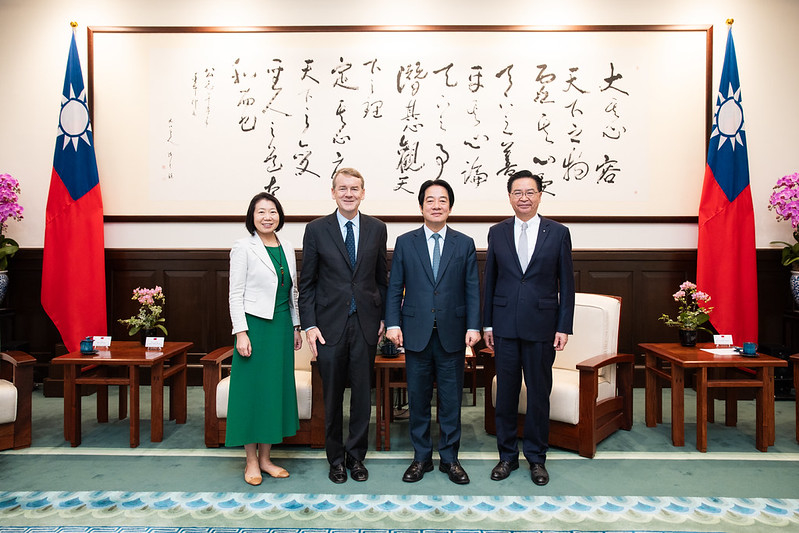
President of the Republic of China (Taiwan) Lai Ching-te expressed during a meeting with a visiting delegation of United States Senator Michael Bennet on the morning of the 8th that the peace and stability of the Taiwan Strait are crucial to the stability and development of the First Island Chain and the Indo-Pacific region. Taiwan is determined to strengthen its self-defense capabilities to defend peace with strength, and hopes to deepen defense technology cooperation between Taiwan and the United States.
President Lai Ching-te welcomed Senator Bennet and his delegation with a speech this morning, expressing a warm welcome on behalf of the Taiwanese people and extending special gratitude to Senator Bennet for his long-standing support for Taiwan. He acknowledged Senator Bennet’s unwavering support through various actions to enhance Taiwan’s self-defense capabilities and strengthen Taiwan-US partnership.
Lai Ching-te mentioned that in February of this year, Senator Bennet and other bipartisan members of Congress jointly wrote a letter supporting increased defense investment in Taiwan. In March, Senator Bennet introduced the “First Island Chain Deterrence Act”, which addresses the issue of arms sales to partners in Taiwan and the First Island Chain. In July, they advocated for the “Taiwan Assurance Act”, supporting the further institutionalization of America’s long-standing commitments to Taiwan. He expressed heartfelt gratitude on behalf of the people of Taiwan for these actions.
He emphasized that these actions convey a crucial message that the peace and stability of the Taiwan Strait are not only Taiwan’s concern but also essential to the stability and development of the entire First Island Chain and Indo-Pacific region. Senator Bennet’s visit to Taiwan on the eve of Taiwan’s National Day demonstrates concrete support for Taiwan, showcasing friendship towards Taiwan and providing significant assistance to Taiwan’s social stability.
President Lai Ching-te stated, “Taiwan is determined to strengthen its self-defense capabilities to defend peace with strength.” Taiwan’s overall defense budget has already exceeded 3% of GDP this year, reaching 3.2%; next year, the defense budget is projected to be 3.9% of GDP and account for over 20% of the central government’s total annual expenditure, aiming to reach 5% of GDP before 2030.
He mentioned, “We are increasing defense investment not just in budget terms but more importantly to transform Taiwan’s defense strategies.” Taiwan is actively incorporating artificial intelligence, unmanned vehicles, space technology, and new communication and command systems to accelerate defense technology innovation, establishing a smarter, more decentralized, and resilient defense system to achieve the goal of asymmetric warfare.
President Lai Ching-te expressed gratitude to the bipartisan support from the US Congress, both the Senate and House, and the US government for their strong backing in enhancing Taiwan’s defense capabilities. He also looks forward to Taiwan and the US jointly creating a non-red supply chain for unmanned drones and fostering more industry exchanges and cooperation.
“In addition to strengthening defense capabilities, Taiwan is actively promoting societal defense resilience,” President Lai Ching-te mentioned. “We are combining the annual Han Kuang military exercises with urban resilience exercises in society to take place simultaneously in the same scenario, aiming to achieve military-civil cooperation and national defense goals.”
President Lai Ching-te highlighted Senator Bennet’s background from Colorado, known as the “Space Technology Capital”, valuing technological innovation and advocating for the development of the space industry. The deployment of Taiwan’s first independent optical remote sensing satellite constellation “FORMOSAT-8” began last year, hoping to receive further support from Senator Bennet through deeper Taiwan-US cooperation to establish a closer partnership in the space era.
In conclusion, President Lai Ching-te once again thanked Senator Bennet for his visit and the meaningful exchange on various important Taiwan-US issues, especially on the eve of the National Day of the Republic of China (Taiwan). Taiwan will continue to walk alongside the United States, striving together to create a more peaceful, secure, and prosperous Indo-Pacific region.
During his speech, Senator Bennet first expressed appreciation for President Lai’s warm welcome and noted the good exchanges the delegation had with national security officials and legislative leaders, underscoring their support for Taiwan-US partnership. The delegation looks forward to further discussions with President Lai on future collaboration directions between the two sides and will bring back these ideas to Washington, where Taiwan enjoys bipartisan support.
Senator Bennet pointed out that Taiwan is one of the world’s most robust and dynamic democratic systems. The resilience of the Taiwanese people and their determination to establish a free and open society are central pillars in maintaining freedom and openness in the Indo-Pacific region. During his visit to Taiwan, he gained a clear understanding of the threats faced by Taiwan and saw the commitment of Taiwan’s leaders from all sectors to uphold and defend democracy, transcending political differences.
He also acknowledged the Legislative Yuan for passing a special defense procurement budget exceeding $24 billion and over $7 billion allocated for the development of unmanned aerial systems. The conflicts in Ukraine and the Middle East have demonstrated the importance of unmanned systems, and building such systems in Taiwan will effectively enhance Taiwan’s deterrence capabilities.
Senator Bennet stated that the US Congress has steadfast bipartisan support in maintaining peace and stability in the Taiwan Strait, including the sale of necessary defensive weapons to ensure Taiwan’s self-defense capability. He will continue to work with congressional colleagues to ensure the realization of authorized and funded support. He emphasized the full implementation and adherence to the Taiwan Relations Act and the “Six Assurances,” which remain the foundation and framework of US policy towards Taiwan, presenting the safest path for peace and stability in the Taiwan Strait and the entire Indo-Pacific region.
Senator Bennet expressed pleasure in seeing the closer cooperation established between Colorado, representing him, and Taiwan in fields such as space, quantum technology, optoelectronics, agriculture, and semiconductors. He will continue to promote bipartisan cooperation in the Senate to strengthen Taiwan-US space cooperation and enhance deterrence capabilities in the Indo-Pacific region.
He stressed that freedom and democracy are not taken for granted, particularly in the Indo-Pacific region. The American people and bipartisan members of Congress will stand with Taiwan to continue supporting Taiwan’s democracy, security, and prosperity. Taiwan is not alone and will never stand alone.