
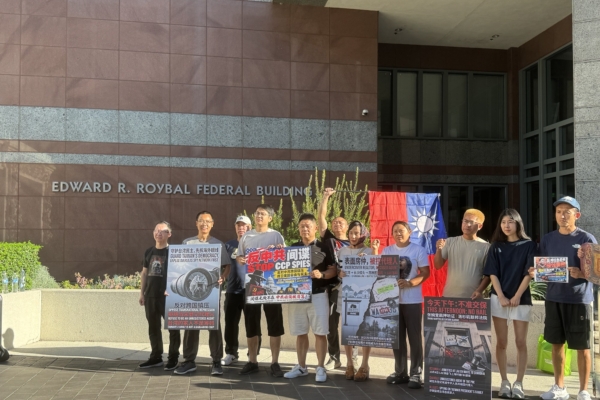
Following the visit of the Chinese leader Xi Jinping to the United States last month, the U.S. Department of Justice has recently announced a series of measures to combat overseas Chinese Communist agents. On Wednesday (October 7th), more than ten Chinese residents in Los Angeles gathered outside a federal court in the U.S. to express support for actions against the Chinese Communist Party’s transnational repression.
The gathering was organized jointly by the Chinese Democratic Party Committee, the June 4th Memorial Hall, and the Chinese Parliament Representatives. Among the attendees was Wendy Zhang, a Chinese resident in Southern California who is accused of monitoring the son of Taiwan’s President Tsai Ing-wen, who was in court that day for a hearing.
Sun Xiaolong, an executive committee member of the Chinese Democratic Party in Los Angeles, stated that the federal government’s investigations and crackdowns on foreign governments’ use of illegal agents to carry out activities such as surveillance and intimidation across borders in the U.S. are aimed at not only protecting national security but also safeguarding dissidents and other Chinese residents living normal lives in America.
Before attending the hearing for Wendy Zhang, Sun Xiaolong had recently traveled to Washington DC with friends to participate in a protest against Chinese Communist Party leader Xi Jinping. He witnessed the organized “welcoming team” of the CCP and personally saw the violent attacks by CCP forces on protesters, including his friends, which further reinforced his firsthand experience of the CCP’s transnational repression.
“Legally combating the illegal activities of foreign governments through agents is not about racial discrimination or targeting Chinese individuals, but about safeguarding America’s national security, rule of law, and the freedom of every individual, including Chinese residents,” Sun Xiaolong stated in an interview during the gathering outside the court. “Our presence here today is to clearly tell American society that we choose freedom and democracy, and we stand against the CCP’s transnational repression.”
One of the attendees, Yu Kang, expressed strong anger towards illegal Chinese agents like Wendy Zhang. “Today, the judge denied her bail, which is a relief and also demonstrates the authority of U.S. justice,” he said. “America is a land of freedom, and human rights and freedom should not be violated by foreign regimes. Those who speak the truth here should not be tracked or intimidated.”
In recent years, several instances of exposure and prosecution of Chinese Communist spies in the U.S. have garnered significant attention from society. Jiang Junliang, a member of the Chinese Democratic Party, expressed that he did not come to the event out of curiosity because such incidents happen close to home.
“The CCP has extended its influence onto American soil, treating the family members of Taiwan’s democratically elected leaders as bargaining chips,” Jiang Junliang said. “America is not a hunting ground for the CCP, and Taiwan’s democracy should not be hollowed out by CCP’s overseas agents.”
Representing the June 4th Memorial Hall, Rao Shaohai said, “Spies should not be granted bail, they need to be severely punished, and more CCP spies need to be punished to ensure the safety of Chinese residents in America and make America safer!”
In recent years, there have been numerous exposures of illegal Chinese agents in the U.S., including Chen Jun, Sun Yaoning, Wang Ailin, Wei Jinchao in Southern California, as well as Sun Wen in New York, and Li Ping in Florida, some have been charged with serious crimes and sentenced, while others have been stripped of their U.S. citizenship. Despite leading a carefree life as naturalized Chinese residents, why do they still obey the CCP’s orders and engage in activities that violate human rights and threaten America?
Mr. Zhang, a Chinese resident in California, bluntly stated in an interview that Chinese spies share a common characteristic: they have twisted values and are sophisticated selfish individuals who seek to maximize personal gains from both sides. “They all want to collaborate with the CCP to maximize their personal interests; they don’t see any problem in surveilling Tsai Ing-wen’s family or betraying American intelligence; they are not afraid of violating others, only interested in their own profit.”
These defendants often justify their actions by claiming to combat “Taiwan independence” and promote “Sino-American cooperation and exchanges.” Mr. Zhang observed that only Wei Jinchao’s mother admitted hoping her son could have a good job back in China. He noted that CCP’s recruited agents often hide their greed and absolve themselves of their crimes under the guise of patriotism and opposing division.
Due to the intricate connections overseas Chinese have with China, they are susceptible to exploitation by the CCP. Wendy Zhang, in her real estate promotion, identified herself as the “top realtor in Southern California” and boasted being in the “top three” in her agency’s performance; Mr. Zhang speculates this could be related to some kind of resource exchange between her and the authorities.
Mr. Zhang concluded by stating that without the CCP’s downfall, regardless of how strong China appears on the surface, ordinary people will only be slaves under authoritarian rule, or even minions, even if individuals like Wang Ailin become mayors, or Wendy Zhang becomes a luxurious real estate broker, as long as they act as mercenaries and cannon fodder for the CCP, they are no exception.