
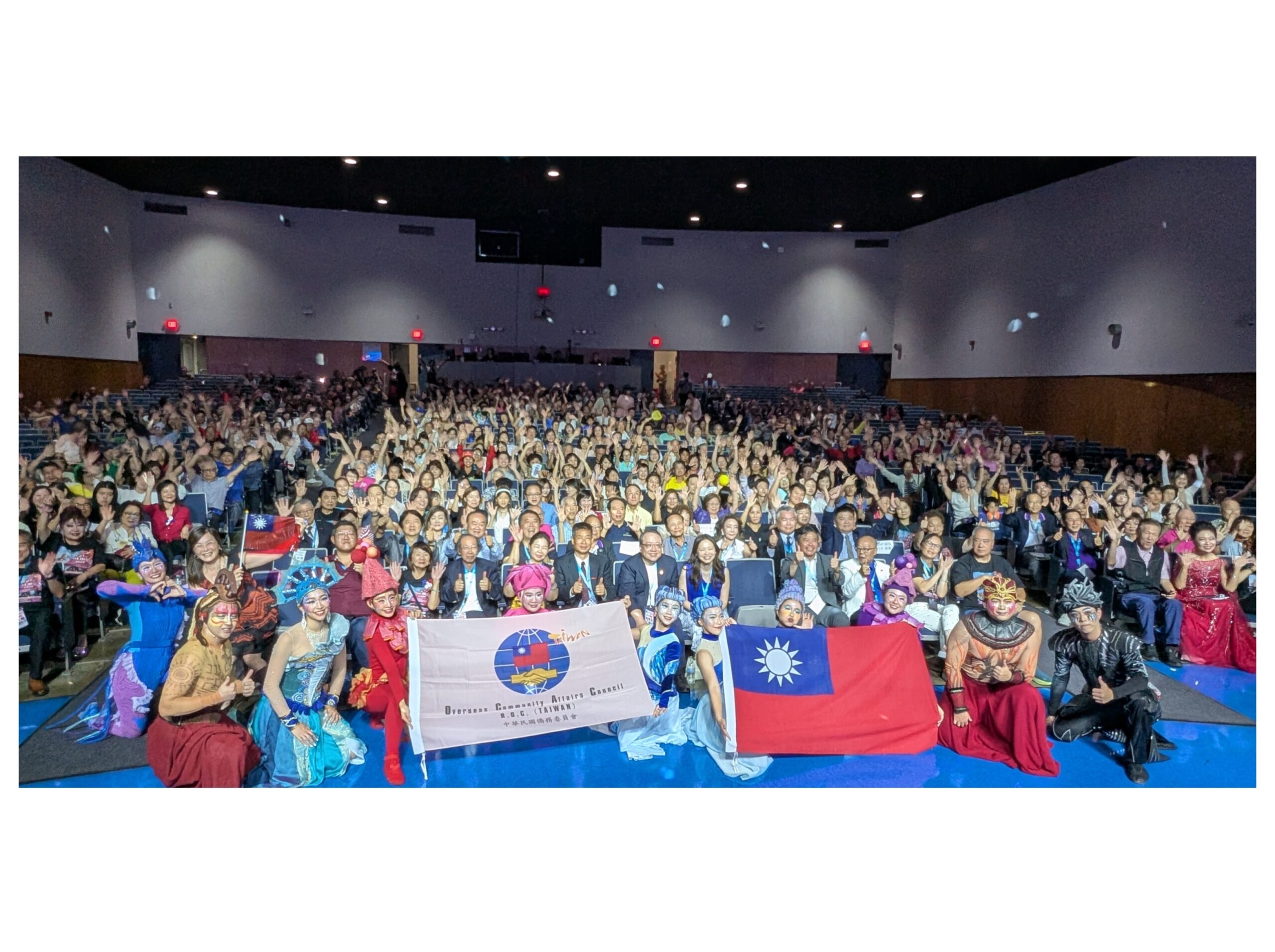
On October 7th, 2026, the Diabolo Dance Theatre, a cultural visiting group appointed by the Overseas Community Affairs Council for Taiwan’s Double Tenth National Day celebrations, performed their classic work “Light of Life” at the theater of El Monte High School in Southern California. The performance attracted nearly a thousand attendees.
This show marked the final stop of the team’s tour across the United States and Canada, where they presented a world-class performance that combined traditional diabolo spinning with modern dance, acrobatics, and audio-visual technology, offering a presentation rich in Taiwanese cultural imagery to Overseas Taiwanese and mainstream American audiences.
“Light of Life” draws inspiration from Taiwan’s landscape of surrounded by the ocean and towering mountains. It seamlessly integrates traditional diabolo spinning, modern dance, drumming, singing, acrobatics, and audio-visual effects to depict the journey of life from darkness to light. This production elevates the ancient folk art of diabolo spinning beyond mere technical display into a contemporary art form that blends storytelling and stage aesthetics.
During an interview, diabolo performer Liu Wei shared that she was introduced to diabolo spinning by her parents as a hobby, but over time, under the guidance of her teachers, she immersed herself in professional training. Starting from a school diabolo team, she eventually joined the theater group and accumulated about twenty years of learning and training experiences leading up to today.
Liu Wei’s journey mirrors the evolution of diabolo spinning from a school skill to a professional stage performance: long-term training requires not only honing technical skills but also developing coordination, rhythm mastery, and stage performance ability.
Dancer Zhang Xinzhi began dancing at around four years old, receiving more comprehensive systematic training when she entered a dance class in high school. She also participated in cultural exchanges overseas with her university dance team and joined the Diabolo Dance Theatre team for the first time on this tour.
Regarding the integration of dance and diabolo spinning, Zhang Xinzhi emphasized that diabolo spinning, being a skill-oriented art form, requires attention to body movement, coordination, and performance when combined with dance. Therefore, team cohesion and long-term training among members are crucial.
Throughout the tour that spanned several cities in the United States and Canada, Zhang Xinzhi found deep impressions left by overseas Chinese audiences. Many elder Chinese attendees showed passionate care towards the team members, treating them as if they were their own children, reflecting the Overseas Chinese community’s deep love for Taiwanese culture.
She also noted that audiences from different cultural backgrounds expressed their appreciation in varying ways. The first stop in Canada had a primarily non-Chinese audience who were more direct in their cheers and reactions, while performances with more Chinese audience members received more subdued but equally enthusiastic applause at the end of the show.
For Zhang Xinzhi, another challenge of the tour was rapidly adapting to different performance venues. Each new location brought potential differences in audio, lighting, and stage space, necessitating the team to quickly adjust technically and in their blocking within limited time. She believed that maintaining performance quality under varying conditions was one of the most challenging aspects of the entire tour.
The Los Angeles performance was divided into ten chapters, such as “Island of Ina,” “Ocean Sprite,” “Thunderous Flames,” “Song of the Blue Whale,” “The Song of Life,” “Phantom of the Dim Light,” “Enigmatic Light Spheres,” “Electric Sparks,” “Dancing in the Wind,” and “Light of Life.”
During the performance, diabolo performers showcased various spinning techniques, coupled with modern dance, acrobatics, drumming, and singing, creating light and shadow effects with glowing diabolos. High-difficulty aspects like long-distance throws challenged performers’ synchronization and spatial control, prompting occasional gasps and applause from the audience.
The show also included audience interactions, inviting children to try basic single-diabolo throws, allowing the traditional artistry to extend beyond the stage and engage with the younger generation overseas firsthand.
Established in 1986, the Diabolo Dance Theatre has long been dedicated to transforming diabolo spinning into a stage art form with international appeal, integrating Eastern and Western aesthetics, dance, music, acrobatics, and theatrical technology. Their performances have graced global stages like the Lincoln Center in New York and the Osaka World Expo in Japan.
The Los Angeles show was organized by the Los Angeles Chinese American Council and the Southern California Double Tenth National Day Cultural Visiting Committee, with guidance from the Overseas Community Affairs Council, the Los Angeles Economic and Cultural Office, and the Los Angeles Overseas Community Center. The committee, led by Chairperson Nie Zeying and Vice Chairpersons Zhu Baitian, Zhang Liqing, and Liang Guohui, with Lin Huiyi as the director, received support from various sectors of the Southern California Overseas community and businesses.
Nie Zeying stated that the Double Tenth National Day is a festival celebrated by the global Chinese and overseas Chinese communities, and after lengthy preparations, the committee aimed to present Taiwan’s top artistic groups to the Southern California audience. Seeing a full house and the passionate response from the Overseas Chinese community made all the efforts worthwhile. He hoped that through the performance, the Overseas Chinese’s emotional connection to Taiwan’s land would deepen, and the joy and brilliance from their homeland could be transmitted to the mainstream society.
Director Lin Huiyi mentioned that in order to produce a high-caliber performance, the committee had upgraded stage equipment to present not just traditional diabolo spinning but a complete theatrical art form that seamlessly integrates modern dance, acrobatics, and audio-visual technology.
Ma Boyuan, the director of the Los Angeles Economic and Cultural Office, shared that he had witnessed the Diabolo Dance Theatre’s performances during Taiwan’s national celebrations and his posting in Washington D.C. He was deeply impressed by the team’s skills and believed that commemorating the Double Tenth National Day through art was meaningful, expressing confidence that the Diabolo Dance Theatre could deliver a wonderful performance to the audience.
Several American local and federal dignitaries either attended the show or sent representatives to congratulate, affirming the role of Taiwanese cultural art in promoting international exchanges and community connections.
Congresswoman Judy Chu’s representative, Mike Eng, spoke at the event, expressing praise and presenting a certificate of commendation on behalf of Judy Chu and the U.S. Congress to the organizers and art director of the Diabolo Dance Theatre, recognizing their efforts in breaking language and regional barriers with diabolo spinning as an art form that showcases Taiwan on the international stage.