
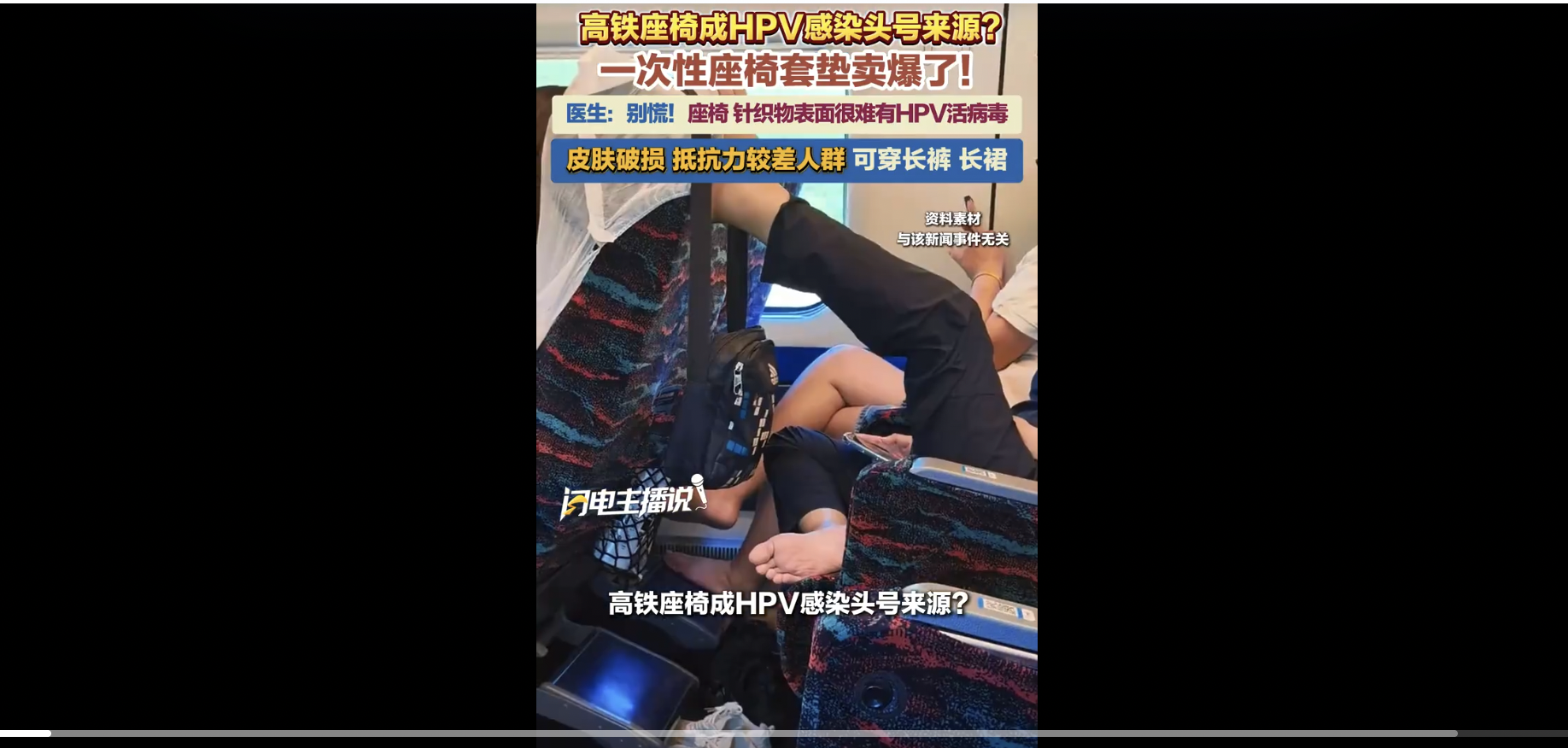
During the “Golden Week” holiday in China, the topic of “whether to use disposable seat covers on high-speed trains” has sparked heated discussions. Some passengers bring their own disposable seat covers to reduce direct contact between their skin and public seats. Meanwhile, a viral image on the internet listing “high-speed train seats” as the primary source of HPV (Human Papillomavirus) infection has further heightened public concerns about the hygiene of high-speed train seats.
On October 6, as reported by “Economic Observer Net,” more than 100,000 disposable high-speed train seat covers have been sold in e-commerce stores. The prices of these products range from just over 1 yuan to tens of yuan, mainly made of materials such as non-woven fabric and plastic.
The controversy started with a recent circulating image on the internet depicting the “sources of HPV infection.” The image identified high-speed train seats as the primary source of HPV infection, leading to concerns among some people about the hygiene of public seats. Recently, related discussions have trended on social media platforms. People have begun discussing the possibility of contracting HPV through direct skin contact with high-speed train seats over extended periods.
Dr. Li Dong, Director of the Infectious Disease Department at Beijing You’an Hospital affiliated with Capital Medical University, mentioned in an interview with Southern Metropolis Daily that the information conveyed in the viral image is unreliable, and the public should not overly panic. HPV is mainly transmitted through sexual contact or close skin-to-skin contact, with the probability of indirect transmission through the environment or objects being extremely low.
Dr. Li Dong also noted that while seats and small tables on public transportation may harbor bacteria or even fungi, HPV is relatively fragile in the environment, especially on dry surfaces, where its survival time is short. It is challenging for infectious live viruses to exist on surfaces such as seats and knitted fabrics.
Recently, the topic of “whether to bring disposable seat covers on high-speed trains” has gained popularity. During holiday travel peaks, many passengers have taken to bringing their own disposable seat covers, covering everything from headrests and backrests to seat cushions. E-commerce platform data shows that the sales volume of disposable seat covers for high-speed trains at some stores has exceeded 100,000 units, with prices ranging from over 1 yuan to over 10 yuan. In addition to complete seat protection covers, disposable table protection covers have also witnessed a surge in sales.
However, the rumor about HPV is not the sole reason for the popularity of disposable seat covers, and the phenomenon of disposable seat covers selling well is not new this year.
During the peak travel period in July 2025, Southern Metropolis Daily and “The Paper” had reported on the popularity of disposable high-speed train seat covers on e-commerce platforms.
Some netizens commented, “I’ve seen videos of people on high-speed trains taking off their shoes and stepping on seats, putting their feet on the small tables. In the summer, wearing shorts, it’s really uncomfortable to have direct skin contact with the seats, so putting on a cover is reassuring.” Many parents also expressed that since children have weaker immunity and tend to touch things indiscriminately, using disposable seat covers can reduce the chances of direct skin contact with public seats.
On September 24, a reporter from Yangtze Evening News contacted the railway customer service 12306 to inquire about the cleanliness of high-speed train seat cushions. The customer service mentioned that normal railway seat cushions are generally replaced and cleaned every 120 to 180 days; in case of damage, cleaning is also conducted. However, the specific cleaning methods could not be disclosed by the staff.
This response quickly sparked discussions. For ordinary passengers, the question remains: it is challenging for them to know when their seat cushions were last replaced and whether previous passengers engaged in behaviors like taking off their shoes and stepping on seats or putting their feet on the small tables. Some people bluntly stated that knowing seat cushions are typically replaced every 120 to 180 days does indeed make them uneasy, prompting them to prefer using their own covers.
A post by the blogger “Sellibert Books” indicated that the sudden popularity of disposable seat covers reflects a positive collision between the heightened public health awareness and the cleanliness standards of public facilities. When the response speed of safety mechanisms lags behind the increasingly refined health needs of the public, individuals will “vote with their feet” through consumer behavior. Instead of debating whether “excessive protection” is necessary, the focus should be on how to enhance the basic hygiene level of public environments. The railway department can enhance transparency regarding cleaning processes, rebuilding trust through visible details. Additionally, strengthening supervision at the institutional level is crucial to ensure that cleanliness standards are not compromised.