
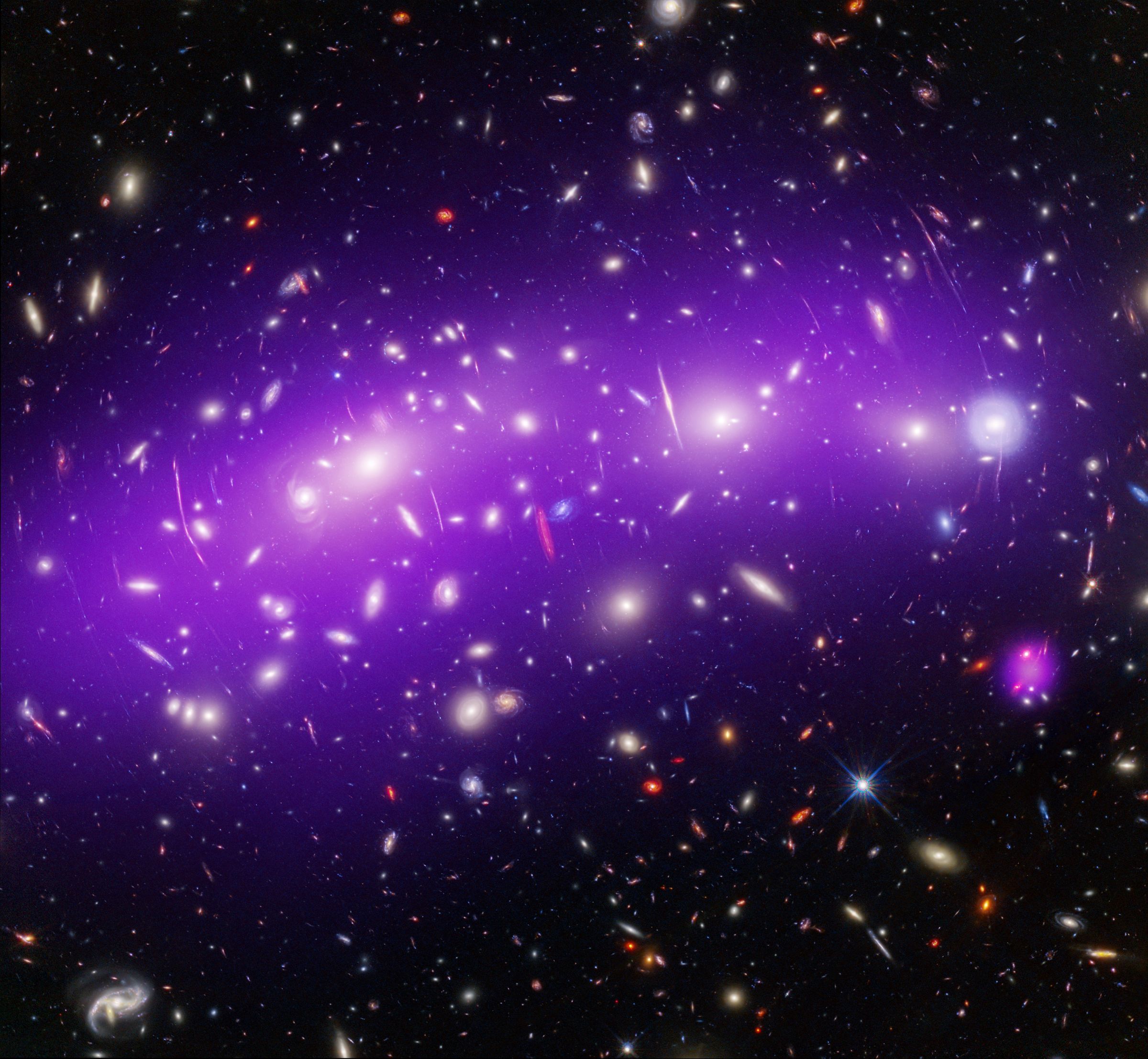
In the depths of a distant galaxy, a newly classified type of celestial body that has never been categorized before has been continuously emitting faint radiation into space. For decades, the National Aeronautics and Space Administration (NASA) telescope has been receiving these signals and storing them in a vast database. However, compared to most stars, the energy emitted by these celestial bodies is too low, causing scientists to mistakenly dismiss them as “background noise” and overlook them for a long time.
Now, a recent study published in “Nature Astronomy” confirms that these celestial bodies not only exist but may also hold the key to answering questions about how galaxies evolve and how stars are born.
The study was conducted by Professor Jimmy Irwin and Ph.D. candidate Mustafa Muhibullah from the University of Alabama, along with Rosanne Di Stefano, a lecturer at the Harvard-Smithsonian Center for Astrophysics.
Since its launch in 1999, NASA’s Chandra X-ray Observatory has been recording high-energy radiation across the entire sky. However, in processing observational data, astronomers typically set energy filters to automatically screen out signals from the lower frequency bands.
“People simply didn’t know about the existence of these celestial bodies,” Professor Irwin said. “In the past, people were used to ignoring the lowest energy bands, thinking they were just useless interference noise.”
The research team decided to thoroughly comb through the data collected by the Chandra telescope from 1999 to 2017. They identified 84 of these unclassified mysterious radiation sources in six neighboring galaxies, including the Andromeda Galaxy (M31) and the Pinwheel Galaxy (M101).
Irwin likened this process to “underwater treasure hunting”: while most of the time they only retrieve useless sediment, occasionally they can find long-lost precious gems.
After filtering out random false images and instrument noise, a new type of celestial body emerged – the team named them “Hypersoft X-ray Sources” (HSS). The term “soft” refers to X-ray photons with longer wavelengths and lower energies (typically below 1 keV), in contrast to the more penetrating “hard” X-ray photons.
Although the existence of these celestial bodies has been confirmed, their true physical identities remain shrouded in mystery. Current observational data can only estimate their approximate surface temperatures and total radiation luminosities.
Co-author Di Stefano pointed out that these celestial bodies are likely dense objects left over from late-stage stellar evolution – white dwarfs, neutron stars, or stellar-mass black holes:
• Compact objects in binary star systems (X-ray Binaries): White dwarfs, neutron stars, or black holes actively accrete material from companion stars through gravitational attraction. When the material rapidly falls into the gravitational well and forms an accretion disk, intense friction generates high temperatures, resulting in radiation in the X-ray range.
• Heterogeneous object aggregation: Irwin added that “Hypersoft X-ray Sources” may not refer to a single type of celestial body but rather a collective term for a whole class of different celestial physical systems that emit specific hypersoft photon spectra.
In the electromagnetic spectrum, X-rays typically represent extremely high-temperature, high-energy physical processes in the universe (such as black hole accretion disks). However, the most challenging feature of “Hypersoft X-ray Sources” is that the X-ray energy they emit is exceptionally weak, nearly entirely or predominantly concentrated below 0.3 keV, accompanied by intense extreme ultraviolet (EUV) radiation (often exceeding 10^38 erg/s). In interstellar space, galaxies are filled with neutral hydrogen gas, which efficiently absorbs extreme ultraviolet photons, similar to thick fog.
“If we had a telescope that is highly sensitive to extreme ultraviolet light and if there were no hydrogen gas clouds in the universe, these celestial bodies in their parent galaxies would shine remarkably bright, making them impossible to miss,” explained Irwin.
Di Stefano noted that due to severe interstellar extinction, the majority of “Hypersoft X-ray Sources” emitted light cannot escape their parent galaxies. Only a few lucky ones can overcome numerous obstacles to reach Earth and be captured by the Chandra telescope. “Each source we see represents the tip of the iceberg, hiding thousands of unseen sources within that galaxy,” she said.
Although the vast majority of “Hypersoft X-ray Sources” cannot be directly observed, these few discovered specimens provide astrophysicists with a new perspective to study galaxy evolution:
1. Gas ionization and star formation: During the evolution of galaxies, gas must cool and condense to collapse and form new stars. However, high-energy radiation can ionize gas, inhibiting its cooling.
2. Supplementing the active galactic nucleus model: Previously, scholars believed that “active galactic nuclei (AGN)” produced mainly by supermassive black holes at the center of galaxies were the source of ionizing radiation. However, in many galaxies without active galactic nuclei, widespread ionized gas similar to “Hypersoft X-ray Sources” distributed throughout the galaxies fill this theoretical gap.
This discovery shows that many important physical processes in the universe are still hidden in seemingly ordinary observational data corners. “What we see is just the tip of the iceberg,” summarized Di Stefano, “these ‘Hypersoft X-ray Sources’ will be the new key to understanding the life and death cycle of galaxies.” ◇