
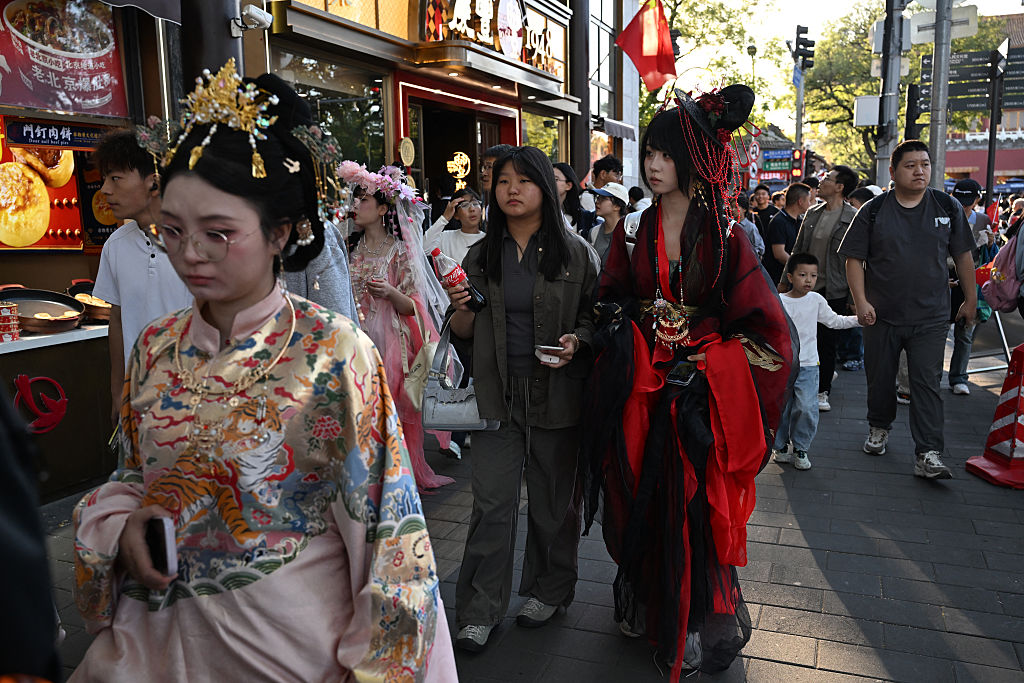
During the “National Day” holiday in mainland China, popular attractions in Beijing were crowded with people, but many young tourists tried to keep their expenses low.
According to a report from Central News Agency on October 2nd, places like Jingshan Park, the Forbidden City, and Wangfujing in Beijing were crowded with tour groups, family travelers, and young tourists.
Mr. Lian, the owner of a coffee shop in Beijing, mentioned that some visitors would check the menu and inquire about prices before comparing prices through popular review platforms. Some young people visit mainly for taking photos but only order one drink among the group.
He stated that compared to before the pandemic, customers are more price-sensitive. A cup of Americano coffee in his shop sells for about 25 yuan, while there are cafes offering coffee at 9.9 yuan in the market. Consumers even look for discounts before placing an order. Mr. Lian expressed that the shop is unwilling to continue participating in price competition, as “there is no need to go down that road further”.
A student surnamed Gao from Yichang, Hubei, arranged a three-day trip to Beijing with friends. She told the Central News Agency that they had visited places like the Summer Palace, the Old Summer Palace, and the Beijing CBD the day before, with the goal of “just seeing is enough,” and even had no time to sit down and eat.
This kind of intensive sightseeing in a short period is termed as “Special Forces-style tourism.” Gao said that young people are cautious with their spending when traveling, preferring to spend time at attractions rather than splurging on dining and other expenses.
According to a report by Reuters on September 29th, based on official data from the Chinese Communist Party, the number of domestic travelers during the 2025 “National Day” holiday increased year-on-year, but the average spending per trip decreased to 911.04 yuan, the lowest in nearly three years.
Ailsa Liao, a senior analyst at Fangde Securities, mentioned that consumers are still willing to travel but are cautious with their money. The increase in the number of tourists does not necessarily translate to a proportional increase in profits for travel companies, and there are no signs indicating a significant increase in daily spending by tourists.
Consumer spending growth in mainland China remains low. Data released by the National Bureau of Statistics of the Chinese Communist Party showed that in the first eight months of this year, the total retail sales of consumer goods increased by 1.1% year-on-year. In August, the growth rate dropped to 0.4%, with a 1.1% increase in restaurant income for that month.
On October 2nd, “Suddenly found that everyone is not staying in hotels for travel” trended on Weibo. Some netizens mentioned staying overnight in camping sites, tents, or vehicles, while others opted for free attractions to reduce accommodation and ticket expenses.
One netizen stated that chain hotels in popular tourist cities cost five to six hundred yuan per night, with higher prices for hotels with better conditions.
Another netizen commented: “Don’t talk about awakening, it’s just that we are short on money and still want to go out and have fun!”