
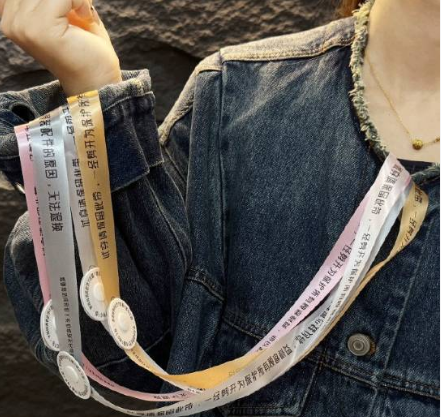
During the Mid-Autumn Festival holiday, many mainland Chinese merchants have introduced new measures to prevent buyers from returning goods after wearing them. They have started using a silk ribbon over two meters long with the words “cannot be returned or exchanged if removed” printed on it, hanging on the chest or back. Many customers have taken photos and shared them online, and the news has become a hot topic on Weibo.
The Mid-Autumn Festival holiday is a peak sales season in China, but many buyers take advantage of the 7-day no-reason return policy, wearing the clothes for a few days before returning them. This practice has increased losses for the merchants. In order to prevent buyers from exploiting this loophole, mainland Chinese businesses continue to introduce new measures to prevent returns.
According to various Chinese media outlets such as China.com, this year many merchants have added visible disposable ribbons to the neckline, shoulder seams, and zippers of clothing. The ribbons are exposed and cannot be hidden, and once cut, they are deemed as used, giving the businesses the right to refuse returns or exchanges. This physical barrier effectively blocks the loophole of “wearing and then returning”.
Many netizens have been posting photos of themselves wearing clothes with these ribbons online. The photos show that the anti-removal ribbons are clearly marked with “cannot be returned or exchanged if removed”, some ribbons are over two meters long, forming a circular band from the neckline to the sleeves, hanging on the chest or back, and cannot be hidden.
In addition, to prevent buyers from returning goods, merchants have continuously upgraded their protective measures. From just one or two anti-removal buckles per item, it has increased to over twenty protective points per item. Some even set password locks on zippers, which can only be unlocked after the buyer confirms receipt of the item. Some items also come with brick-sized tags.
Industry data revealed by China.com shows that the overall return rate for women’s clothing is 50% to 60%, and even higher for live-streaming sales channels, generally around 70% to 80%. The phenomenon of “selling ten and returning eight” has become common. A large portion of returns are not due to quality issues, but rather consumers abusing the 7-day no-reason return rule by treating online shopping as a free fitting room. Some buyers bulk purchase clothes, take photos for social media, and then return them all at once. Student groups wear new clothes to participate in sports events, return all items after they get stained, and some people wear new clothes for outings, sweat in them, and then request no-reason returns. Frequent malicious returns have led businesses to continuously bear costs such as shipping, cleaning, discounts, and inventory backlog.
Most merchants see these measures as a necessary means of self-preservation. Some industry insiders suggest that regulating the women’s clothing e-commerce market requires mutual obligations: consumers should use after-sales rights reasonably and prevent malicious behavior, while businesses need to improve quality control, accuracy in advertising, and optimize pre-sale mechanisms to truly reduce return rates and improve the online shopping environment.