
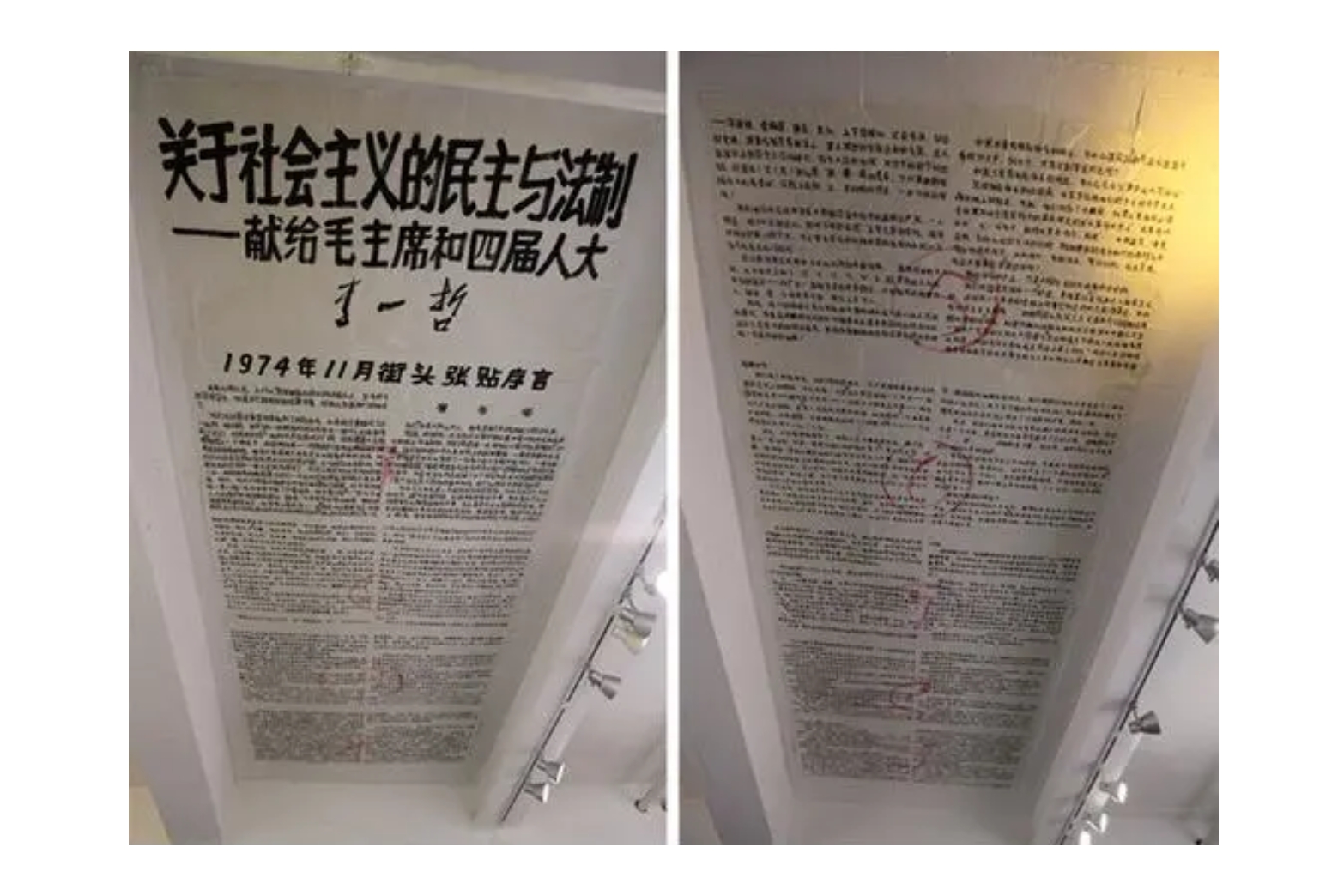
In the late period of the Cultural Revolution in China, a large-character poster of over 26,000 words appeared in Guangzhou, reflecting on the “Cultural Revolution” and openly discussing “democracy and rule of law,” triggering widespread copying and debates. One of the main authors of the large-character poster, Chen Yiyang, passed away on September 13 at the age of 79.
According to a report by Hong Kong media “Sing Tao Daily,” senior Hong Kong media figure Guan Qingning verified that in his later years, Chen Yiyang lived alone in the Panyu District of Guangzhou. His son, after not being able to reach his father by phone for several days, went to his residence and discovered that Chen Yiyang had passed away.
In November 1974, a large-character poster titled “On Democracy and Rule of Law under Socialism” appeared on the streets of Guangzhou, signed by “Li Yizhe”. This name was derived from the three main authors – Guangzhou Academy of Fine Arts student Li Zhengtian, high school student Chen Yiyang, and factory worker Wang Xizhe, each contributing one character. Guo Hongzhi, then the deputy director of the Guangdong People’s Broadcasting Radio’s technology department, also participated in the writing process, with many others joining in discussions, dissemination, and copying.
The large-character poster started by criticizing the “Lin Biao system,” further discussing issues of democracy and rule of law in the political movements after the establishment of the Communist Party in China. The original text also touched on political power, privileges, and legal constraints.
Chinese scholars living in the United States, Song Yongyi and Sun Dajin, who are also co-authors of “The Cultural Revolution and Its Heretical Thoughts,” published an article on “About Li Yizhe’s Large-Character Poster.”
The article quoted the content of the large-character poster, stating that during the Cultural Revolution, “nearly 40,000 revolutionary masses and cadres were killed in Guangdong alone, and hundreds of thousands of revolutionary cadres and masses were detained, managed, and struggled against.”
It also mentioned that these figures were from the investigation by one of the authors of the large-character poster, Li Zhengtian. The article stated that Zhao Ziyang, then the first secretary of the Guangdong Provincial Party Committee, instructed Li Zhengtian to conduct a social problem investigation to understand the impact of the Cultural Revolution in Guangdong.
After the large-character poster was posted, it attracted crowds of onlookers, causing traffic jams, and at night, people used flashlights to read it. The large-character poster was widely copied and spread to other regions of mainland China and overseas.
Hu Ping, the chief editor of “Beijing Spring” magazine, recently mentioned the large-character poster on social media, expressing that though he was far away in Chengdu at the time, he quickly learned about the poster and read a hand-copied version. After reading it, he was “extremely excited, feeling a deep resonance.” He noted the widespread circulation and positive reception of the large-character poster and felt that “the people’s hearts had truly changed.”
Hu Ping believed that the Li Yizhe large-character poster started from reflecting on the Cultural Revolution and raised questions about democracy and rule of law. He argued that the contemporary ideals of freedom and democracy in China did not just come from the introduction of Western ideas during the post-Cultural Revolution opening-up process but also emerged from the painful experiences and profound reflections of Chinese society on itself.
About a month after the large-character poster was posted, in December of the same year, the Guangdong Provincial Party Committee of the Communist Party of China classified the article as a “reactionary large-character poster” and organized province-wide criticism. Even after the fall of the Gang of Four in October 1976, the “Li Yizhe” issue was not immediately rectified. On March 2, 1977, the four members involved in writing the large-character poster, Li Zhengtian, Chen Yiyang, Wang Xizhe, and Guo Hongzhi, were arrested and later sentenced to imprisonment.
In August 1978, under the leadership of Xi Zhongxun, then the secretary of the Guangdong Provincial Party Committee, the Guangdong Provincial Party Committee reviewed the “Li Yizhe” case several times and reported to the central government. On December 29 of the same year, the Guangdong Provincial Party Committee began the rehabilitation of “Li Yizhe” and released Li Zhengtian and the other three individuals on December 30.
After Wang Xizhe was released, he was arrested again in 1981 and sentenced to 14 years in prison by the Guangzhou court in the following year on charges of “counter-revolutionary propaganda incitement,” among others. He was released on parole in early 1993.
According to another report by Central News Agency, Wang Xizhe left China in 1996 and sought asylum in the United States. Earlier this month, he traveled from the U.S. to Hong Kong and hoped to enter mainland China but was not allowed entry upon reaching Hong Kong International Airport. He later boarded a flight back to the United States.