
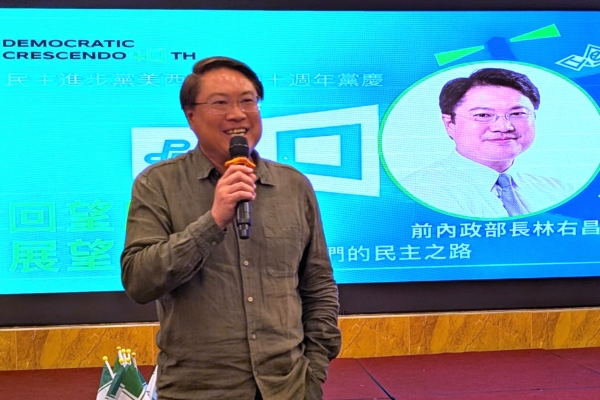
The Democratic Progressive Party (DPP) Western US Branch celebrated its 40th anniversary in Los Angeles on September 26 (Saturday) with about 120 overseas compatriots in attendance. Former Minister of the Interior Lin Yu-chang was specially invited to attend and shared his firsthand experience as a visiting scholar in the United States for six months, focusing on key Taiwan-US issues.
Lin emphasized that after six months of grassroots observation, he felt that Taiwan’s international visibility in American civil society has significantly increased. Taiwan’s security in the Taiwan Strait and economic development have officially entered the daily view of the American grassroots.
Lin Yu-chang is a representative practical political leader among the middle generation of the DPP, with multiple experiences in local governance, central administration, and international perspectives. He governed Keelung for eight years, transforming the city from a “city of sorrow” into a vibrant and aesthetic marine capital.
He later led the Ministry of the Interior, actively promoting land reform, housing justice, the institutionalization of fraud prevention laws, and improvements in road traffic safety, demonstrating high policy coordination and action. He then served as the DPP Secretary-General before resigning after the recall election.
To further deepen Taiwan-US connections and expand global perspectives, Lin Yu-chang was invited to the Institute for Indo-Pacific Security Studies (IIPS) in Washington, D.C. in April this year as a visiting scholar for six months. He focused on studying US-China competition, geopolitics, international supply chain security, defense economic security, and AI issues, elevating local governance practices to the international strategic level. He plans to return to Taiwan in November after completing his visit and engage in campaigning for local elections in various cities and counties.
Lin said that in the past, most of his visits to the US were for short-term political visits and academic exchanges, making it difficult to get a deep understanding of American society. However, this time as a visiting scholar in the US, in addition to engaging in exchanges with politicians in Washington and discussing political and security issues, he also intended to extend his reach to the daily lives of American people.
“I’m not here for leisure, but because I’m integrating into American society,” Lin shared. He noted that he often chats with people at gas stations, laundromats, convenience stores, and various restaurants. Surprisingly, whether in major cities or grassroots areas, many American people who were relatively unfamiliar with Taiwan in the past not only know about Taiwan now but also actively engage in conversations, inquiring about Taiwan’s security, economic progress, and China’s threats and pressures on Taiwan.
Lin emphasized that this “active interest from American people in Taiwan’s situation” is a sight he had never encountered before, indicating a profound change in how American civil society understands and values Taiwan.
Analyzing the roots of this change, Lin Yu-chang pointed out that Taiwan’s increased visibility is closely related to the drastic changes in the international situation in recent years. With global supply chains impacted during the pandemic, intensifying US-China competition, and the outbreak of the Russia-Ukraine war, Taiwan’s semiconductor industry’s irreplaceable role in the global supply chain has gradually made Taiwan a strategic focal point globally.
He mentioned that in the past explaining “why Taiwan is important” to American society may not have been directly understood by the public. However, with the evolving international situation, Taiwan, with a population of about 23 million, a per capita GDP close to $40,000, and its critical position in the global semiconductor supply chain, has demonstrated solid results in long-term economic transformation and industrial investment.
Lin Yu-chang believes that one of Taiwan’s biggest challenges in the future is the global competition between democracy and authoritarian systems. And US support for Taiwan is extending from Congress and policy circles to the broader society.
Regarding US-China relations and regional security, Lin suggested that various sectors should evaluate these issues within the broader context of US policies, including tariff policies, supply chain security, and security cooperation with democratic allies like Japan, Australia, and the Philippines, which better reflect the overall situational developments than individual leadership meetings.
Chairman Chen Peng-yu of the DPP Western US Branch thanked overseas compatriots for their unwavering support over the past 40 years and urged everyone to continue to unite and support Taiwan amid the challenges in both internal and external environments.
Lin Yu-chang also expressed his views on the DPP reaching its 40th anniversary. He believes that as the DPP enters its third consecutive term in office, it carries a greater responsibility than ever. In an era of highly uncertain international situations, the primary task of a democratic party is to “stabilize and instill confidence in the Taiwanese people”. Besides maintaining national security and military defense, it is essential to reduce family burdens through childcare, education, housing, and long-term care policies, and share the economic benefits of high-tech development.
Finally, Lin encouraged overseas Taiwanese, emphasizing that today’s democratic achievements in Taiwan are the result of the accumulated efforts of overseas predecessors. Faced with the challenges of a new era, overseas compatriots can continue to exert influence by engaging in cultural exchanges and interacting with local communities, helping the world better understand Taiwan and further deepening Taiwan’s international connections. ◇