
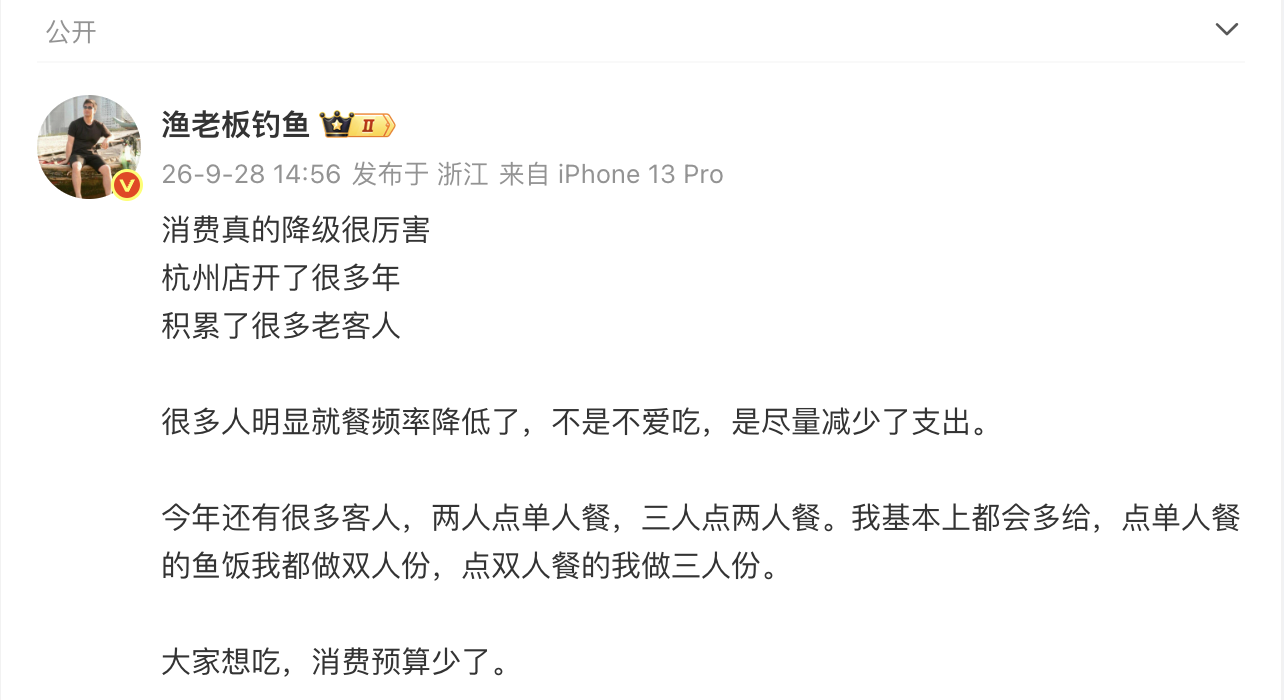
In an online post on Weibo, the owner of a fish restaurant in Hangzhou, Zhejiang Province, who has been in business for many years, described a noticeable change in dining habits this year. The owner pointed out that the frequency of visits from regular customers has significantly decreased, with some customers ordering single meals for two people or meals for two people for three individuals. This revelation quickly gained attention online and the phrase “Hangzhou owner claims significant downgrade in consumption” trended at the top of the hot search list.
With 363,000 followers and verified as “Fishing Boss Fishing” on Weibo, the owner shared on September 28th that “the downgrade in consumption is truly drastic.” He mentioned that over the years of operating his restaurant in Hangzhou, he has accumulated a loyal customer base, but their dining frequency has noticeably decreased, leading them to cut expenses wherever possible.
“This year, many customers only order single meals for two people, or meals for two for three people. I usually end up serving larger portions, making double portions for single meals and triple portions for meals for two.”
According to him, customers are not refraining from eating, but rather their spending budgets have decreased. Data from the National Bureau of Statistics of China shows that from January to August 2026, the retail sales of specialty shops, department stores, and brand stores above the quota decreased by 2.2%, 3.0%, and 10.0% respectively compared to the previous year. In the same period, convenience stores and supermarkets saw increases of 5.5% and 3.8% in retail sales, respectively.
The post by the Hangzhou restaurant owner resonated with netizens online. Weibo member “Big Soap,” with 1.175 million followers and certified as a headline article author, responded that many people have become more rational in terms of consumption. Some businesses that used to make money quickly are finding it harder to do so now, leading many merchants, especially those in business or high-end sectors, to feel the impact.
Weibo user “Nicole” commented that downgrading consumption is often a result of hesitance to spend. People are becoming more conservative in their spending habits, cutting down on luxury expenses, prioritizing savings, and focusing more on practicality rather than brand and status. Downgrading consumption is a way for ordinary people to protect themselves from uncertainties about the future, but this contraction in consumer spending can also affect employment, creating a mutually reinforcing cycle.
Weibo user “Sky of Stobor – Snowball” expressed that in recent years, the conversation around “downgrading consumption” essentially boils down to being more frugal, feeling financially constrained, and anticipating lower incomes. The most noticeable change is the shift towards “plain replacement” becoming mainstream. Previously, buying big brands may have been seen as prestigious, but now young people are more inclined to scrutinize ingredient lists and seek out manufacturers and comparable stores. Studies have shown that over 60% of surveyed young people frequently compare prices while shopping, evaluating every purchase before making a decision. The avenues for shopping have also diversified, with discount stores, clearance supermarkets, and membership stores gaining popularity.
Apart from consumption trends, job prospects and income expectations are crucial factors influencing residents’ spending habits. With 4.037 million followers, prominent V-blogger Zhang previously mentioned that during phone chats with friends who have lived in Hangzhou for years, he learned that over half of the middle-class individuals around him have experienced a steep decline in income this year. Many groups who previously earned tens or even hundreds of thousands yuan annually have seen significant income reductions, with some even facing the risk of unemployment, spanning across sectors such as e-commerce, physical stores, finance, and the Internet.
Some netizens commented: “Each year seems to be tougher than the last.” “People generally feel it’s harder to make money now.” “Both me and those around me are losing money in every investment, which leaves us no choice but to cut back on consumption.”