
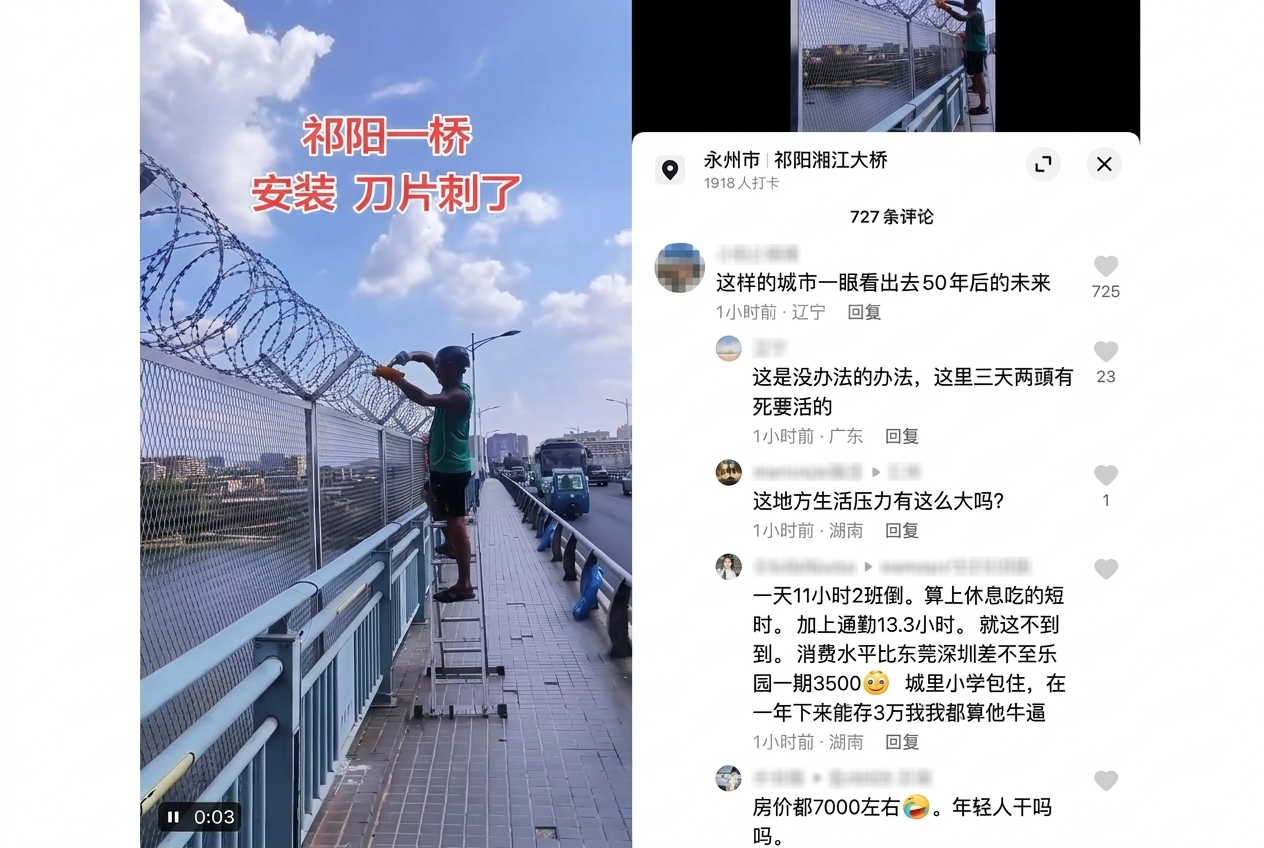
In Hunan Province, Yongzhou City, the Qiyang Xiangjiang Bridge (also known as the Qiyang Xiangjiang Great Bridge) has recently started installing “barbed wire mesh”. Comments in the online community suggest, “This is an inevitable solution, as people are frequently jumping off the bridge here.”
On September 27, a netizen shared a video showing construction workers installing protective nets and adding razor wire mesh on the Qiyang Xiangjiang Bridge in Yongzhou City, Hunan Province. After the video was released, many netizens expressed their concerns about the newly installed protective facilities on the bridge, with some revealing in the comments section that the purpose is to prevent people from jumping off the bridge, “This is an inevitable solution, as people are frequently jumping off the bridge.”
Some netizens questioned, “Is the living pressure in this place really so high?” One netizen responded, “Working two shifts for 11 hours a day, plus commuting adds up to a total of 13.3 hours a day. The monthly income is less than 5000 yuan. The cost of living is similar to Dongguan and Shenzhen.”
The Dahe Daily learned on September 28 from the Qiyang City Urban Management and Comprehensive Law Enforcement Bureau that the installation of safety protective facilities on the Xiangjiang Bridge is indeed in progress, and the project is still under construction, with an expected completion within “the next two days”.
The measures being taken at the Qiyang Xiangjiang Bridge reflect the serious issue of suicide attempts in the area and highlight the local authorities’ efforts to prevent such incidents by enhancing safety measures. It also sheds light on the challenges faced by residents in this region, such as long working hours and financial struggles, contributing to the high stress levels that may lead to such extreme actions.
The installation of the barbed wire mesh serves as a physical barrier against individuals attempting to jump off the bridge, emphasizing the importance of addressing mental health issues and providing support for those facing difficult circumstances. As the community discusses the underlying causes of such behaviors, it calls for a comprehensive approach that considers both the immediate safety concerns and the broader social and economic factors contributing to the vulnerabilities of individuals in distress.
In conclusion, while the installation of security measures like the barbed wire mesh may offer a temporary solution to prevent tragic incidents, a holistic response that addresses the root causes of mental health challenges and social inequalities is essential for fostering a safer and more supportive environment for all individuals in the community.