
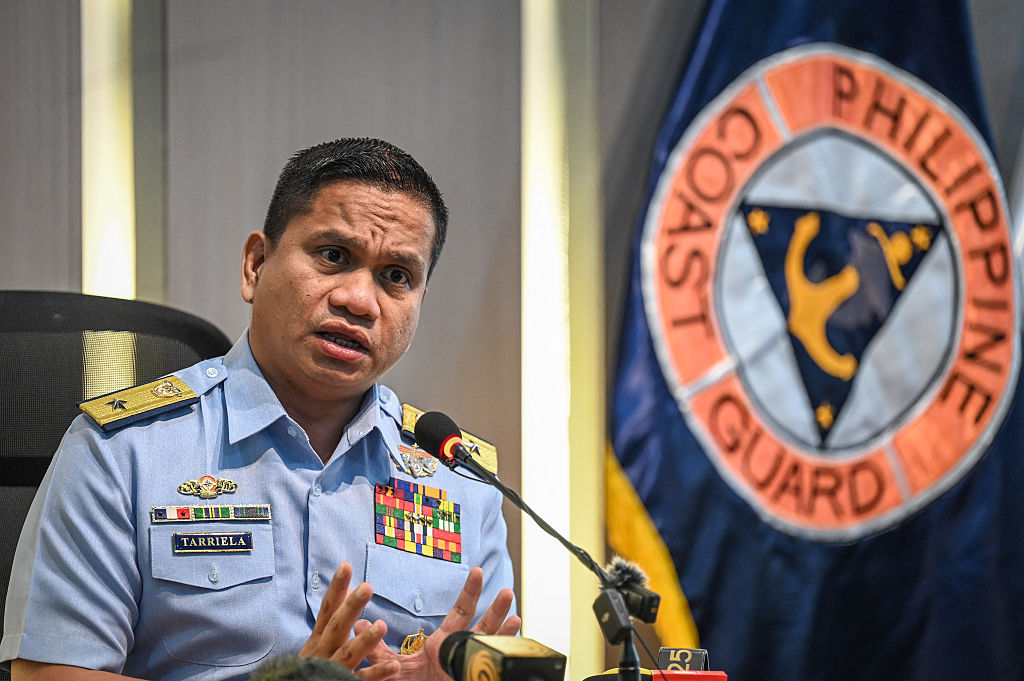
The Philippine Coast Guard (PCG) spokesperson on Monday (September 28) condemned the Chinese Ambassador to the Philippines, Jingshuan, for talking nonsense. Earlier, the two sides engaged in a war of words over the suspicious activities of the Chinese research vessel “Jia Hai Ke 7” in the northern waters of the Philippines. The Philippines accused “Jia Hai Ke 7” of lingering in its exclusive economic zone and hiding its real location, potentially threatening the security of undersea communication facilities and the information collected by the ship may be used for military purposes. The Chinese Embassy countered the accusation but was blasted by the Philippine side.
PCG spokesperson Jay Tarriela posted a statement on social media platform X on Monday confirming that the Chinese research vessel “Jia Hai Ke 7” was operating approximately 37.84 nautical miles northwest off Itbayat Island in the Batanes group of islands within the Philippine Exclusive Economic Zone (EEZ).
Tarriela stated that the behavior of “Jia Hai Ke 7” did not conform to the characteristics of a vessel transiting innocently. The ship did not maintain a steady course and speed but rather stayed in the same area. The Filipino side viewed this sailing pattern more like conducting marine scientific research (MSR) rather than a normal transit. The Philippines repeatedly radioed the ship through wireless communication to declare that the relevant area belonged to the Philippine EEZ, demanded an explanation of the ship’s intentions and to cease any unauthorized activities, but received no response.
The Philippine Coast Guard believes that “Jia Hai Ke 7” deliberately falsified Automatic Identification System (AIS) information to conceal its true sailing track. The Filipino side discovered the ship not through AIS data but by the vigilance of the Philippine Coast Guard Itbayat monitoring station.
“In accordance with the International Convention for the Safety of Life at Sea (SOLAS), ships must consistently transmit accurate AIS data; the Philippines believes that the vessel’s falsification of position information and refusal to respond to radio calls indicate that the ship does not want its activities known to the outside world,” said Tarriela.
He also mentioned that in the waters near the Batanes and Luzon Strait lie important undersea fiber optic cable routes connecting the Philippines to Northeast Asia and a broader Indo-Pacific region. By concealing its actual position and remaining stationary in this area, “Jia Hai Ke 7” raised concerns for the safety of the Philippines’ undersea communication infrastructure and the possibility of data collected by the vessel being used for military purposes.
The Philippines stated that “Jia Hai Ke 7” is China’s first privately-owned research vessel equipped with a DP-2 dynamic positioning system and low-noise electric propulsion, capable of maintaining position above the seafloor for marine geological surveys and had previously collaborated with drilling vessels. This time, the activities near Itbayat Island matched the characteristics of such operations.
The Chinese Embassy in the Philippines responded on the X platform, asserting China’s sovereignty and jurisdiction over the relevant waters and clarified that “Jia Hai Ke 7” was operating in accordance with international law including the United Nations Convention on the Law of the Sea (UNCLOS) within China’s jurisdictional waters. The Chinese Embassy urged the Philippine side to stop interfering and sensationalizing China’s normal ship operations and research activities.
In response to the Chinese Embassy’s reply, PCG spokesperson Tarriela directly questioned Chinese Ambassador Jingshuan. He said, “Ambassador Jingshuan, what kind of nonsense is this again? Just admit it, these statements are made up by you, have you really not read the United Nations Convention on the Law of the Sea?”
“‘Jia Hai Ke 7′ is only 37.84 nautical miles away from Itbayat Island in the Batanes group. According to Article 56 of the UN Convention on the Law of the Sea, the coastal country (the Philippines) has sovereign rights and jurisdiction over its Exclusive Economic Zone (EEZ), including marine scientific research activities. According to Article 246, conducting marine scientific research in our EEZ must receive the Philippines’ consent. ‘Jia Hai Ke 7’ neither had permission nor consent. China has no jurisdiction there at all,” added Tarriela.
He continued addressing Jingshuan, “Remember this: Batanes Island isn’t even within your self-proclaimed and illegally fabricated ‘Nine-Dash Line’ range – and the ‘Nine-Dash Line’ was already invalidated by the 2016 South China Sea arbitration ruling. And now, you want to extend your reach to the Luzon Strait? Don’t try to deceive us with excuses like ‘normal navigation.’ Normal vessels don’t falsify AIS positions, don’t linger above undersea cable routes, and certainly don’t ignore radio calls. Yet ‘Jia Hai Ke 7’ did all of these.”
“The Philippines is not ‘sensationalizing’ anything. You are the ones fabricating claims of jurisdiction over the Batanes Islands. Stop lying!” Tarriela concluded.