
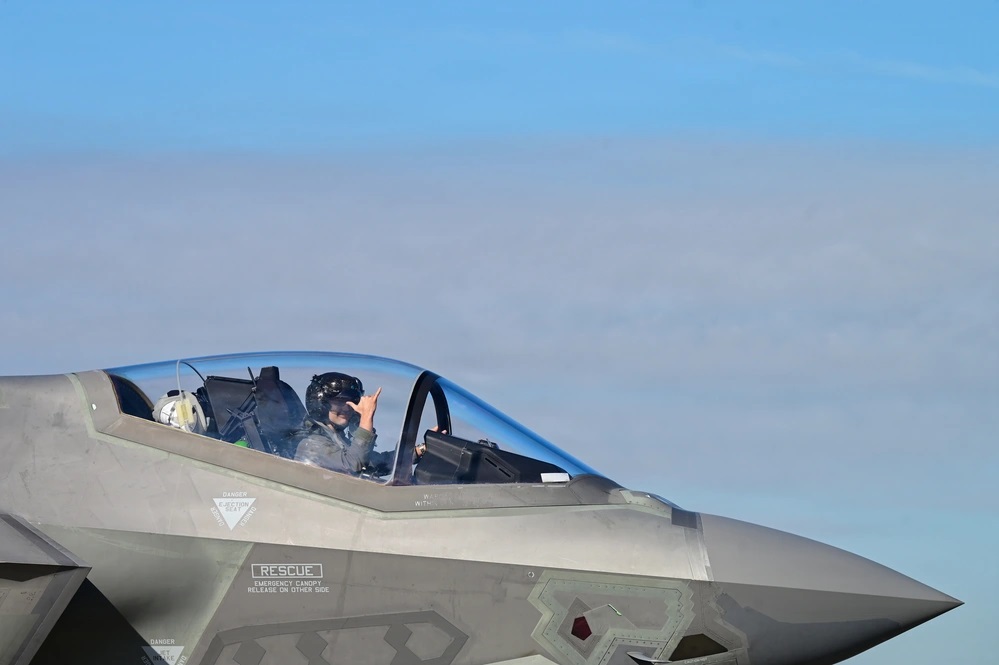
A batch of F-35 fighter jet parts being transported from Australia to the United States for maintenance ended up being diverted to Hong Kong and fell into the hands of the Chinese Communist authorities. The latest flight data shows that the carrier UPS’s Asia-to-US logistics network frequently passes through China. The US Department of Defense is investigating the incident and working to retrieve the parts, while Congress has also launched an inquiry.
The focus of the incident is on how the goods deviated from the original route and how much F-35 stealth technology information these parts might reveal. The missing parts include F-35 canopy and weapon bay doors, both coated with radar-absorbing materials. Lockheed Martin states that the related parts are no longer usable and the risk of their analysis is low; however, American lawmakers are demanding clarification on why these parts were rerouted to Hong Kong.
In a report published by Bloomberg on Friday (September 25), based on public flight data from Flightradar24, it was traced that these parts were sent from Australia to the US at the end of May, passing through Seoul, South Korea, before arriving in Hong Kong.
Data shows that in the latter half of May, UPS had a total of 4 direct flights from Sydney to Seoul, all headed to Louisville, Kentucky in the US. After leaving Seoul, 3 of these flights made a stop in Zhengzhou, China, with only one flight on May 25 going directly from Seoul to the US. There was also a flight departing on May 21 that included Hong Kong in its subsequent journey, but it cannot be confirmed if this flight carried the F-35 parts.
Bloomberg also found that within the same time frame, UPS had two flights from Seoul to Hong Kong and then to the US, overlapping with the flights arriving in Seoul from Sydney. This suggests that the goods may have been sent to Hong Kong after a layover in Seoul, but public data still cannot confirm the actual transport routes.
It is currently unclear whether the parts were rerouted due to a logistical error or deliberately transferred. After the Chinese side obtained these parts, they have not been returned thus far.
The missing parts include cockpit canopy and weapon bay doors. According to Bloomberg, sources said that both were coated with radar-absorbing materials to enhance the stealth capabilities of the F-35.
CBS News points out that if the missing parts are indeed these two types, they do not contain advanced aircraft electronic equipment that could provide a significant advantage to adversaries once obtained. However, the canopy itself is part of the stealth system, and the radar-absorbing materials on the surface may provide information about F-35 stealth technology.
Lockheed Martin stated that these parts “are no longer usable and have been deemed low risk for exploitation.”
The company also noted that logistics decisions are not unilaterally made by the company; the US government designates approved transportation schemes, which are then selected by the company from compliant carriers.
The incident has caught the attention of bipartisan lawmakers in the US. At least two congressional committees are investigating how the parts ended up in Beijing’s possession.
Mark Warner, Vice Chairman of the Senate Intelligence Committee and Democratic Senator, remarked, “I am seeking a complete briefing on the course of events, which is extremely concerning.”
He expects to receive the briefing by the end of the week.
Senator Kevin Cramer, Chairman of the subcommittee under the Senate Armed Services Committee investigating the incident, asked, “Is this an error by the transportation company? An error by our allies? Or did the Chinese plan to intercept these from the start?”
Cramer expressed his hope to retrieve the parts and believes that China will certainly do everything possible to study what information can be gleaned from these parts.
The Pentagon has confirmed that it is investigating the shipping event. A US defense official stated, “We are actively cooperating with relevant US authorities and industry partners to recover these components, investigate the incident, and take preventive measures to avoid similar situations in the future.”
The Chinese Ministry of Foreign Affairs stated on Thursday that they “are not aware of the situation.” Currently, it is still unclear why these goods were rerouted from Seoul to Hong Kong and whether this transfer was due to a logistical error or other reasons.