
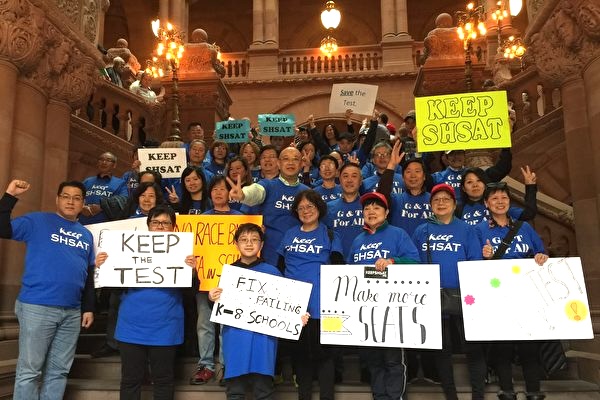
New York, September 26, 2026 – A Chinese-American parent in New York is taking legal action after her son scored a 558 on the Specialized High Schools Admissions Test (SHSAT) but was not admitted to his top choice, Stuyvesant High School. On September 25, the parent brought the dispute to the United States Supreme Court, seeking intervention in New York City’s specialized high school admissions policy.
This case has once again brought to the national forefront the controversy surrounding whether the “Discovery Program” has altered the longstanding admissions system based on test scores and whether this change unfairly impacts Asian-American students.
According to the plaintiff and her legal representatives at the Pacific Legal Foundation (PLF), Yi Fang Chen, a Chinese mother, revealed that her son scored 558 on the SHSAT in 2025. The admissions cutoff for Stuyvesant for the 2026-2027 school year was 561, leaving him just 3 points short of the regular SHSAT admission quota.
The statement pointed out that at the time, only 54 students scored between 558 and 560 on the SHSAT and listed Stuyvesant as their first choice, but the admissions reform reserved about 20% of the spots at Stuyvesant – around 160 seats – for students in the “Discovery Program.” Without this reform, Chen’s son’s score of 558 would have placed him among these 160 students, securing his admission to Stuyvesant.
The new school year started on September 10, and Chen’s son had to settle for his second choice school, Brooklyn Tech High School, missing out on his top pick.
The “Discovery Program” was initially designed to provide opportunities for students from economically disadvantaged backgrounds who scored slightly below the admission cutoff through summer programs. Prior to 2019, these students accounted for only 1% to 3%; however, starting in 2019, New York City expanded this program to 20%. Eligible students must come from middle schools with an Economic Need Index (ENI) of 60% or higher and earn scores below the regular admission cutoff on the SHSAT.
Ms. Chen stated through the lawsuit, “Race is the driving force behind this reform.”
Citing an analysis by the New York City Department of Education, the Pacific Legal Foundation indicated that based on 2019 SHSAT data, the 20% reserved quota resulted in Stuyvesant raising its SHSAT admission threshold by around 10 points.
Ms. Chen filed a lawsuit against the city government on April 23, 2026, arguing that the expanded “Discovery Program” had disadvantaged her son and sought immediate relief, requesting the government to allow her son to attend Stuyvesant. However, the district court promptly denied Ms. Chen’s motion for a preliminary injunction.
Previously, a federal district court ruled in favor of the city, stating that the data provided by the plaintiff was insufficient to prove that Asian-American students were significantly disadvantaged, and thus did not further determine whether the reform had a discriminatory purpose.
The Chinese American Citizens Alliance of Greater New York (CACAGNY) raised similar legal challenges as early as 2018, questioning the expansion of the “Discovery Program” for potential racial bias. The case has been in federal court proceedings for several years.
Wai Wah Chin, founding president of CACAGNY, has consistently advocated for maintaining the SHSAT as an objective admissions criterion. In a recent opinion piece, she reiterated that the solution to the problem lies in “increasing seats at specialized high schools rather than eliminating entrance exams.”
Chin criticized the “Specialized High Schools: Excellence and Inclusion Initiative” put forth by New York City council members Lincoln Restler and Nantasha Williams, particularly the reforms to the “Discovery Program,” which would limit the program to the poorest 15 districts, with few Asian-American students among them.
“A better approach is to explore why certain groups outperform others on the SHSAT exam,” wrote Chin, citing a report from the Brookings Institution that found Asian students spend nearly double the time on homework compared to white students and almost four times that of black students.
The outcome of Ms. Chen’s request to the Supreme Court and how it will be handled remain uncertain at this point.