
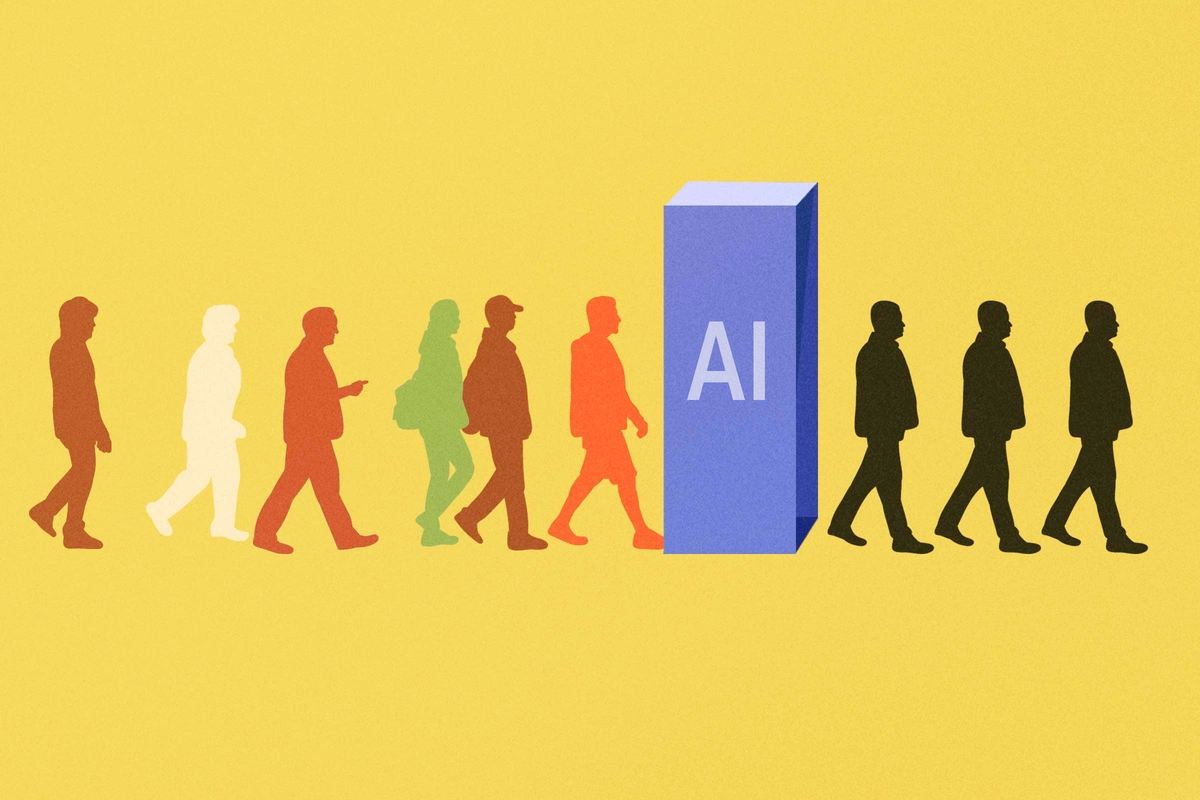
When artificial intelligence (AI) becomes the starting point for writing and decision-making, it is reshaping the way we understand perspectives, trust our own judgment, and evaluate the value of our work.
Before generative artificial intelligence emerged, Amazon had already embedded deep thinking directly into its workflow.
In 2017, Amazon founder Jeff Bezos described a meeting culture built around slow, written reasoning: no PowerPoint presentations, no bullet points, just a usually six-page narrative that took a week to write from start to finish, detailing a product or project.
In the meeting room, everyone from junior staff to senior leaders had to sit quietly and read for 20 to 30 minutes before speaking.
Bezos stated that the purpose of this was to keep thinking clear through writing and reading. Weak reasoning would immediately show, and flaws could not hide behind bullet points or fancy slides. Thinking takes time, and that’s the core of it.
The danger of generative artificial intelligence is that it subverts this logic with a simple prompt – making you feel like your own thinking is redundant.
However, today, throughout the American business sector (including some departments at Amazon), employees are increasingly facing pressure to use AI tools to draft memos, proposals, reports, and even code. The incentives are clear: higher productivity, lower costs, and faster output.
But with speed comes a cost.
Jobs that used to hone thinking skills in the process are now being offloaded to AI, resulting in a loss of autonomy.
Using prompts makes you think the writing is your own. However, most of the structure – frameworks, options, and even logic – is already set by AI systems. While users can guide, it’s within boundaries they haven’t defined, inadvertently transferring their autonomy to the AI model.
“You think you have autonomy through prompts,” computer scientist Zhivar Sourati, who studies large language models (LLMs) at the University of Southern California, told The Epoch Times, “but compared to two years ago, you have much less autonomy now.”
Two years ago, AI was just a tool that required you to input prompts; today, it’s become a tool that sends prompts back to you in reverse, undermining your confidence in your own ideas.
Psychologist Michael Inzlicht of the University of Toronto primarily studies how technology changes motivation, self-control, and effort. He stated in an email to The Epoch Times, “When AI takes over work, our sense of agency in the output diminishes. The work doesn’t belong to us anymore, and we know it.”
Compliance with AI in the workplace is intensifying. A study by Carnegie Mellon University and Microsoft found that knowledge workers who trust AI outputs often don’t carefully review them – a tendency known as automation bias.
This compliance carries risks because while AI often provides seemingly persuasive answers, these answers may be incorrect, incomplete, or stripped of crucial context.
Some lawyers painfully learned this lesson after submitting court briefs citing fictitious cases generated by AI.
When the content output by AI itself starts becoming homogeneous, reliance on AI tools comes under questioning inherently.
A group of colleagues may input the same prompt into the same AI system and receive draft proposals that are structurally similar, linguistically clear, neutral, and normative. Thoughts may begin to converge – often before independent judgments are fully formed. Agreement starts to feel more like a natural occurrence, even if it’s not heartfelt.
“People are just talking to AI now and getting ideas.” Sourati said.
In practice, AI compresses the early stages of thought. A manager drafting a strategic memo may end up with an initial set of recommendations no different from those generated by others using the same tool. A doctoral student who used to manually comb through research gaps can now have the model instantly fill in those gaps – and so can others in the field.
This influence has transcended technical work. AI tools are increasingly being employed for personal writing – breakup letters, wedding vows, even autobiographies, writing forms that were once intimately connected to personal experiences and voices. On a scale of billions of users every week, even minor shifts in how ideas are generated can quickly lead to homogenization.
The pressure for linguistic and cognitive compliance is longstanding, not a creation of AI. What AI changes is where this phenomenon of convergence occurs in the process – it’s no longer happening at the end of thinking but increasingly at the beginning.
In an article published in Trends in Cognitive Sciences, Sourati pointed out its significance because people bring their unique writing and reasoning styles to work.
“When these differences are filtered through the same large language model,” he told The Epoch Times, “their unique language styles, perspectives, and reasoning strategies become homogenized.”
What AI does isn’t just making us sound similar; the worrying part is that it might narrow the boundaries of acceptable debate. When language is flattened, options are repeatedly framed in the same manner, dissent or differing voices appear less supported than they actually are.
Over time, repeated framing can create an “illusion of consensus,” where people get the misconception that they’re independently arriving at similar conclusions or problem-solving approaches when, in reality, different ideas, perspectives, or even critical stances have been polished by the same machine-generated patterns into a more uniform façade than reality.
Even Sourati noticed this impact in his own writing. AI’s polishing made everything more standardized – also diminishing his uniqueness.
“I suddenly realized…it’s not me anymore,” he said.
When consistency emerges from a common starting point, it feels more natural than it actually is. In this sense, AI reverses the goals that systems like Amazon memos were designed to achieve – where writing and careful reading helped people develop their perspectives before encountering others’ viewpoints, thus earned agreement required effort.
What’s changing isn’t just people’s ideas, but also how AI subtly shapes the ways they arrive at those ideas.
The increasing reliance on AI – and the associated sense of identity – is not unfounded. It’s amplified by a more imperceptible phenomenon: people often believe they understand more than they actually do.
When people use AI, they often mistake the tool’s quick, fluent responses for their own understanding.
An experiment by AI safety and research company Anthropic helps explain why. Participants who relied on AI assistance scored about 17% lower in an understanding test covering material they had processed a few minutes earlier. The task was completed, but understanding lagged behind.
“Deep understanding might require friction – going through some struggles to really get things straight. AI completely bypasses that ‘struggle,’ so what you end up with is a shiny finished product, but the user doesn’t really grasp the content,” Inzlicht said.
For Inzlicht, the problem starts when friction disappears. Thinking entails the start of errors, uncertainties, and the slow construction of ideas. He and his co-authors pointed out in an article published in Communications Psychology that the mental effort involved in this process aids people in learning and skill development.
“When we work hard to understand something, we’re forced to connect it to what we already know; it’s these connections that get it etched in our minds.”
Recall high school math. Figuring out a problem on your own, no matter how painful the process, teaches you more than simply seeing the answer and reverse-engineering it. The struggle with a challenging problem itself is the crux.
Depending on how it’s used, AI may short-circuit this process, encouraging cognitive offloading. Over time, this could weaken people’s resilience, making them more likely to give up in the face of challenges once AI is removed.
Studies find that even just 15 minutes of using AI can make people feel less focused, unable to persist in difficult tasks relying on their own efforts.
In this way, AI is changing the relationship between effort and knowledge: what was once merely convenient eventually becomes necessary.
Effort isn’t just about building understanding – it also builds meaning. When people labor through a task, they often value the end result more.
“When AI helps us produce work, our assessment of the value of that work diminishes,” Inzlicht said, “it feels less meaningful, less ours, and less worth it.”
He pointed to AI-generated art pieces and videos, saying, “We’re even willing to pay less for them. That’s where the issue lies. To some extent, we realize that what AI creates isn’t truly made by us.”
The benefits of resistance aren’t infinite; too much resistance can feel unbearable.
The real risk isn’t AI itself, but losing the efforts that shape our achievements and the various endeavors that make us who we are.
Original Title: What We Are Giving Away to AI
Published in the English edition of The Epoch Times.