
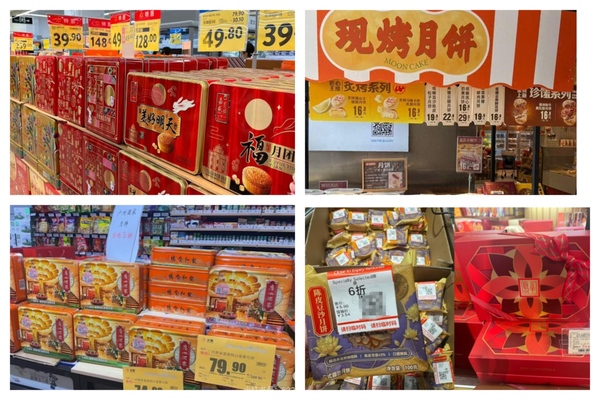
China’s economy is facing a downturn, leading to a cautious approach in consumer spending, particularly evident in the Mid-Autumn Festival mooncake market this year, which has encountered an unusual “cold wave.” Demand for high-priced gift boxes has significantly decreased, with gift boxes priced above 200 yuan (RMB) facing sluggish sales. In a shift, consumers are less inclined to “give gifts” and are now more likely to see mooncakes as a personal consumption item rather than for gifting purposes. Wholesale merchants have noted that “this year’s mooncake market is relatively sluggish overall, with consumers generally reducing their spending.”
According to various reports from mainland China, this year’s mooncake sales promotion started earlier than in previous years. High-end brands such as Maxim’s and Peninsula, considered industry bellwethers, have already begun discounting their gift boxes, with some products seeing price reductions of more than 30%. Mooncakes from five-star hotels have also been significantly discounted, with the Shangri-La custard mooncake gift box, originally priced at 338 yuan, now selling for only 88 yuan on second-hand trading platforms. Even upscale boutique supermarkets are offering mooncake gift boxes priced mostly between 200 and 400 yuan, with gift boxes priced above five to six hundred yuan becoming increasingly rare.
At the same time, the market share of affordable gift boxes ranging from 68 to 200 yuan has risen to over 60%, becoming the dominant force in the mooncake market. Price points such as 79 yuan, 99 yuan, and 139 yuan are the most popular, while sales of bulk and individually packaged mooncakes continue to rise. Sales of simple mooncakes priced below 80 yuan now constitute 78% of total sales.
In a top ten sales ranking on a certain e-commerce platform, gift boxes priced below 30 yuan account for over half of the sales, with a mooncake gift box priced at 29.9 yuan selling over two million units.
On September 24th, reporters visited several supermarkets and wholesale markets in Wuhan and found that discounted mooncake gift boxes were prevalent on shelves. While high-priced gift boxes were not doing well, sales of affordable, low-sugar, and short-shelf-life mooncakes showed noticeably better performance.
A mooncake wholesaler revealed that profit margins on mooncake gift boxes have become very thin, at around 10%. Even if they are selling at a loss, they must offer discounts as “otherwise the mooncakes will be left unsold after the fifteenth of August.” Reporters found that many offline supermarkets had already begun their mooncake sales promotions, with discounts ranging from 6% to 9%, even though Mid-Autumn Festival was still four to five days away.
On social media platforms, many mooncake distributors lamented the difficulty in selling mooncakes, with some mooncake factories choosing to scale back production temporarily. Certain netizens pointed out that there were more sellers than buyers at local mooncake fairs. Several mooncake wholesalers and convenience store owners informed reporters that their sales had dropped by 5 to 7% compared to the previous year. Some shop owners anticipated sales pressure, leading them to reduce their inventory purchase by 90%; yet, despite this, they still had unsold stock.
According to data from a fast-moving consumer goods monitoring website, in the lead-up to Mid-Autumn Festival this year, sales of mooncakes at major stores decreased by 45.17% compared to the previous year, with a 40.67% drop in sales volume. The sales volume of gift boxes also fell by 49.04%, marking the second consecutive year of decline. The market share of gift boxes priced above 500 yuan in traditional channels fell to less than 2%, with sales of high-end gift boxes priced above a thousand yuan plummeting by 76% compared to the previous year.
Another aspect reflecting the rationalization of mooncake consumption is the rising popularity of “DIY mooncake gift boxes” through online platforms as a cost-saving measure.
Reported by Guangming Net, some consumers are no longer purchasing pre-made gift boxes but buying empty gift boxes and loose mooncakes to assemble their own “high-end” gift boxes. On procurement platforms, some empty mooncake gift boxes are priced at just over one yuan, with cumulative sales nearing 100,000 units.
Recently, a video showcasing a man purchasing empty boxes online and creating a high-end mooncake gift box garnered attention online. In the video, the man bought empty gift boxes, loose mooncakes, and packaging materials to assemble the gift box himself. He calculated that the empty gift box cost 17 yuan, and with the mooncakes and packaging materials added, the total cost was less than 25 yuan, with the finished product looking similar to a gift box priced around a hundred yuan.
This “buy your own mooncakes and assemble your own gift box” trend has sparked discussions among netizens. Some believe in the concept of “spending little to achieve much,” while others argue that in traditional high-priced gift boxes, the cost to consumers largely stems from the packaging.
From the waning interest in high-priced finished gift boxes to consumers buying empty boxes to assemble, the mooncake market’s shifts reflect an increased sensitivity among consumers towards the premium on gift boxes. The “food” aspect of mooncakes is now being reconsidered, with the perceived value of luxury packaging diminishing. Many consumers express that while in the past mooncake purchases emphasized packaging and presentation, the focus has now shifted towards health benefits and practicality.
Research from Analysys found that 55.9% of consumers purchase mooncakes to “share with family,” 50.4% for personal consumption, and 42.5% for gifting purposes, marking the first time that mooncakes for personal consumption have surpassed those for gifting.
“The mooncake market is undergoing the most profound transformation yet: shifting from a gift economy back to a food economy, from prioritizing ‘exclusivity’ to focusing on ‘substance’,” a veteran food industry insider in Ningbo stated. The tide is turning against paying for luxury packaging.
Mainland financial commentator Jiang Han remarked in his column that in the past, high-priced mooncakes served a function in business gifting and relationship maintenance. However, as consumers shift towards personal consumption, they are more concerned about price, ingredients, and actual taste, becoming less willing to pay a premium for luxury packaging and branding.