
Hello, viewers! Welcome to “Century Truths.”
Today, we are going to discuss a segment of history that the Chinese Communist Party textbooks have never dared to address directly.
In the official narrative of the CCP, the Northern Expedition was portrayed as a glorious period where the Kuomintang and the Communist Party “worked hand in hand, fighting together,” with the Communist Party being the “driving force” and “contributor” of the Northern Expedition.
However, as we unearth the true documents buried in history, a completely different historical picture emerges.
What role did the Communist Party play in the Northern Expedition? Let’s start from the beginning.
To understand why the Communist Party hindered the Northern Expedition, we must go back to the start of the “united front with Russia and tolerance of the Communists” in 1924.
After experiencing multiple failed revolutions, Sun Yat-sen, in order to gain military and financial assistance from the Soviet Union, reluctantly accepted the conditions set by the Soviet representative Adolf Joffe, allowing Communist Party members to join the Kuomintang as individuals, known as the historical “tolerance of Communists.”
However, did the Communist Party join the Kuomintang truly to “assist in the nationalist revolution”?
Historical documents provide a negative answer.
At that time, the CCP, as the “Chinese branch” of the Comintern, completely obeyed Moscow’s commands. The highest strategic command given to the CCP by the Comintern was very clear: parasitize, grow, and eventually seize the leadership of the Kuomintang.
Executing this strategy was Mikhail Borodin, the Comintern’s full authority representative in Guangzhou.
The memoirs of Kuomintang elder Hu Hanmin hit the nail on the head. He said that Borodin’s strategy instructed to the Communist Party members was crucial: to divide the Kuomintang into left and right factions to instigate internal division for the Communists to monopolize party affairs.
Against this backdrop, in January 1926, the Kuomintang’s “Second National Congress” convened in Guangzhou. While it appeared to be a routine party meeting, it was actually a long-planned organizational power seizure. Of the 256 delegates present, three-fifths were Communist Party members!
At that time, Chiang Kai-shek’s ambition was to inherit Sun Yat-sen’s legacy, marching north to unify all of China and end the chaotic warlord era. However, the Communist Party vehemently opposed this. In their view, a successful Northern Expedition would elevate Chiang Kai-shek’s military prestige to its peak, spreading the Kuomintang’s power nationwide, greatly restricting the Communist Party’s survival and power usurpation space.
Therefore, starting from the end of 1925, a conspiracy against Chiang Kai-shek and aimed at sabotaging the Northern Expedition began secretly in Guangzhou.
At that time, the senior military adviser of the Soviet Union stationed in Guangzhou was Kissanka. This individual held a strong disdain for Chiang Kai-shek’s Northern Expedition proposal.
According to the recollections of the first graduates of the Whampoa Military Academy and Chiang Kai-shek’s documented “Soviet Union in China,” Kissanka, during numerous gatherings in Guangzhou, cynically remarked in front of many Whampoa military officers:
“The Guangdong Revolutionary Government only has a few tens of thousands of troops, a severe financial deficit, relying entirely on Soviet aid for weapons and ammunition. Meanwhile, in the north, Wu Peifu, Sun Chuanfang, and Zhang Zuolin have a combined force of 700,000 troops. Chiang Kai-shek’s ambition for the Northern Expedition is tantamount to hitting a rock with an egg, an overestimation of his capabilities and a reckless venture!”
Kissanka not only disparaged publicly but also engaged in blatant sabotage in practical actions. Chiang Kai-shek repeatedly requested weapons, funds, and vehicles necessary for the Northern Expedition from the Soviet military advisers, but Kissanka adopted a “delaying tactic,” even outright refusing to provide support. He privately remarked to others that he could not supply Chiang Kai-shek with ample armaments, or else he could not “control this lion.”
Even more despicably, the Soviet advisers collaborated with the Communist Party members in Guangzhou, spreading anti-Chiang sentiments within the military. They fostered the “Youth Army Officers Union” within the Whampoa Military Academy to counter the pro-Kuomintang “Sun Yat-sen Doctrine Association,” fueling bloody conflicts.
In early 1926, Chiang Kai-shek bitterly wrote in his journal:
“The Communist Party, along with Borodin and Kissanka, limit my actions, hinder my grand plans. Whenever I aim east, they insist on going west. The Northern Expedition, in their eyes, is a sin. The path of the revolution is so difficult!”
This obstruction reached its peak during the “Zhongshan Ship Incident” on March 20, 1926.
The CCP and Soviet advisers even attempted to utilize Li Zhilong, the Chief of the Naval Bureau and a Communist Party member, to deploy the Zhongshan Ship to Huangpu, scheming to forcibly abduct Chiang Kai-shek onto a Soviet warship and transport him to Vladivostok. Chiang Kai-shek made a decisive move, declaring martial law, arresting Li Zhilong, and confiscating weapons from the Worker’s Picket teams, effectively crushing the coup. This confrontation within the party was later referred to as “Chiang Chung-Cheng Saves the Party.”
After the Zhongshan Ship Incident, Stalin didn’t want an immediate rupture and adopted a more restrained approach. He had no choice but to recall the arrogant Kissanka back to the Soviet Union and send a more tactful senior adviser, Borodin. However, Borodin’s arrival did not change the fundamental policy of the Communist Party’s obstruction to the Northern Expedition but made their methods more covert and politically driven.
On July 9, 1926, Chiang Kai-shek officially assumed the position of Supreme Commander of the National Revolutionary Army and convened a swearing-in ceremony in Guangzhou, marking the official commencement of the Northern Expedition.
With 100,000 Northern Expedition forces confronting the armies of Wu Peifu, Sun Chuanfang, and Zhang Zuolin, totaling over 700,000 armed forces, the disparity in military strengths made the victory seem almost impossible.
However, as the Northern Expedition forces swiftly advanced, achieving one victory after another, behind the scenes, the interference in the rear quietly ignited. Stalin’s orders were issued on the first day of the Northern Expedition, instructing the exploitation of military vulnerabilities in the rear to continue causing unrest.
Following the Northern Expedition’s capture of Changsha in July 1926, a peasant movement in Hunan began to unfold. The Communist Party-led Farmers’ Association rapidly expanded in various counties of Hunan, reaching its peak by the end of 1926 and early 1927. Mao Zedong went to Hunan in January and February 1927 to personally investigate, writing the famous “Hunan Peasant Movement Investigation Report.”
In other words, wherever the Northern Expedition forces triumphed, the Farmers’ Association expanded behind them, seizing control of rural areas by exploiting power vacuums, a genuine portrayal of the Communist Party’s “encircle the cities from the countryside” strategy.
The Farmers’ Association formed by the CCP in Hunan promoted the slogan “all landowners are oppressors, all scholars are villains,” claiming all landowners were oppressors and any scholar dressed in long robes was a villain. Under the association’s influence, hooligans and rogues escalated their actions, invading the homes of gentry to steal food, brutally killing pigs, executing in public, and even exhuming graves.
Mao Zedong, in his “Hunan Peasant Movement Investigation Report,” detailed these actions without criticism, instead praising them as the “vanguard of the revolution” and “very good.”
In the Northern Expedition forces, eighty to ninety percent of junior officers came from small landowner families, those targeted by the peasant movement were the relatives of these officers. General He Jian’s father was paraded through the streets, tied up, and publicly humiliated. General Li Zongren of the Seventh Army later wrote in his memoir that soldiers and officers from the Two Lakes region witnessed such humiliation of their family members, leading to imminent eruption of anger. The rage of the Northern Expedition forces was directed not only towards warlords but increasingly towards the hidden hands causing disturbances from behind.
As the Northern Expedition forces achieved victories on the frontlines, significant troubles brewed in the rear. Stalin’s directive on the expedition’s commencement aimed to trigger a comprehensive war between Britain, the United States, Japan, and Chiang Kai-shek’s forces. The idea was that with foreign intervention, the military might of the Northern Expedition forces would be decimated. With direct military assistance from the Soviet Union, the Communist Party could then take advantage of the power vacuum and establish a Soviet Red Revolution in China.
This was the Communist Party’s tactic of “killing with a borrowed knife”!
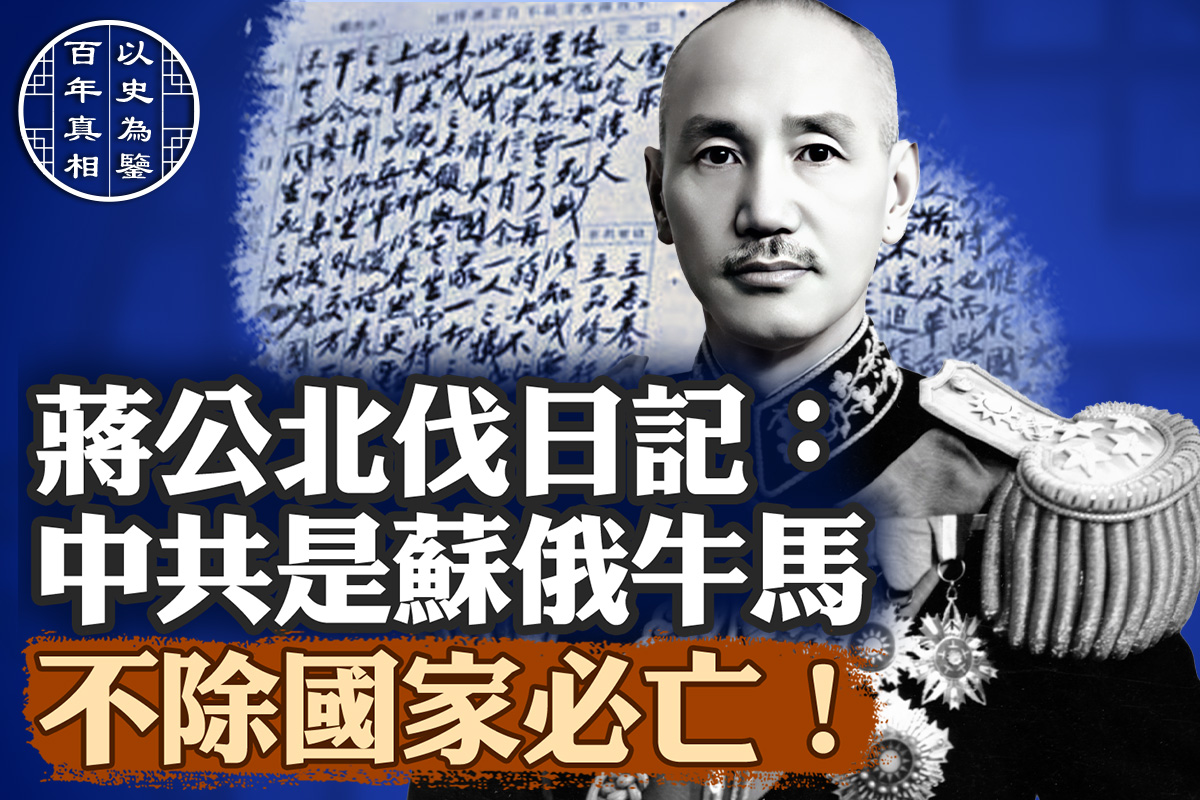
After the Nanjing Incident, Chiang Kai-shek fully realized the Communist Party’s malevolent intentions. He angrily wrote in his diary, “Without removing the Communist Party, the country will perish! They are not the revolutionaries of China but the cattle and horses of Soviet Russia. Betraying the country, harming compatriots, nothing is more despicable than this!”
In such a situation with no retreat and no tolerance, to preserve the achievements of the Northern Expedition and prevent China from becoming a Soviet colony, Chiang Kai-shek, together with the capitalists of Jiangsu and Zhejiang, Kuomintang elders, and military leaders, decisively launched the “purge of the party” on April 12, 1927, to thoroughly eliminate the Communist parasites and subversives hidden within the Kuomintang.
After the purge, Borodin repeated his tactics, manipulating a “pro-Communist anti-Chiang campaign” led by Wang Jingwei’s Wuhan government. The “Ning-Han Stand-off” came into existence, and the Northern Expedition project once again faced a crisis.
However, just over a month later, on May 31, 1927, a top-secret message from the Comintern caused a significant uproar, ultimately leading to a rupture between Wang Jingwei’s Wuhan government, the Communist Party, and the Comintern.
This unexpected incident caused by a telegram from the Comintern to re-engineer the Wuhan government, initiate land reforms, and implement comprehensive Communism. To combat Chiang Kai-shek and the Northern warlords, they demanded the mobilization and organization of a 500,000-strong revolutionary army in Hubei and Hunan through the Communist Party.
But unexpectedly, to seek Wang Jingwei’s support, this order was personally delivered by the Comintern’s representative Luo Yi to Wang Jingwei. Enraged by its contents, Wang Jingwei dismissed all Communist Party members from the government positions and expelled over 140 Soviet advisers, including Borodin and Galen.
Many years later, Mao Zedong, recalling this incident, still harbored resentment, stating that Luo Yi was a big fool.
Thus, the Communist Party’s parasitism within the Kuomintang, attempting to subvert the Northern Expedition, was utterly bankrupt in China.
The Ning-Han conflict drove the Northern Expedition into a standstill. In August 1927, the same month the Communist Party launched the Nanchang Uprising, Sun Chuanfang launched a counterattack, advancing his troops directly towards Nanjing. Chiang Kai-shek chose to resign and go into exile to facilitate the Ning-Han merger and restore the Northern Expedition.
His decision was correct. Everyone, from rivals Wang Jingwei to allies Li Zongren and Bai Chongxi, ultimately admitted that leadership of the Northern Expedition belonged only to Chiang Kai-shek.
On January 5, 1928, Chiang Kai-shek made a comeback, resumed his position as Supreme Commander, and ordered the Northern Expedition. By then, the Communist Party’s interference and troubles had been predominantly eliminated. Chiang Kai-shek reorganized his forces, rejuvenated morale, and recommenced the expedition. In June of the same year, Chiang Kai-shek, together with Feng Yuxiang, Yan Xishan, and Li Zongren, successfully captured Beijing. In December, Zhang Xueliang declared the Northeast be handed over, marking the successful conclusion of the Northern Expedition, effectively unifying the various provinces south of the Yangtze River. Formally, the Republic of China completed national unification.
Looking back on this history, a profound paradox emerges: the ultimate success of the Northern Expedition was largely achieved only after the “elimination of Communist Party interference.”
The Zhongshan Ship Incident removed the Red infiltration from Whampoa, the “party organization case” ousted the Communist Party members from the core of the First Army, and the purge eliminated the hidden saboteurs in the rear. It was through a series of swift actions that Chiang Kai-shek maintained the cohesive spirit and combat effectiveness of the revolutionary army, pulling the Northern Expedition back from the brink.
Yet, the CCP’s version of history narrates this episode in reverse: claiming the Communist Party “propelled” the Northern Expedition and that Chiang Kai-shek was the “revolutionary traitor.”
However, the evidence is clear—Borodin’s confession, Luo Yi’s secret telegram, the public exhibitions of the “Soviet Conspiracy Evidence Compilation,” and the Communist Party Central Committee’s resolution against the unification of the Northern Expedition—all reveal the truth, proving that while lies may dominate textbooks, historical facts cannot be concealed.
That’s all for today’s program. Thank you for watching. Don’t forget to like, subscribe, and share our show if you enjoyed it. See you next time.
Production Team of “Century Truths”