
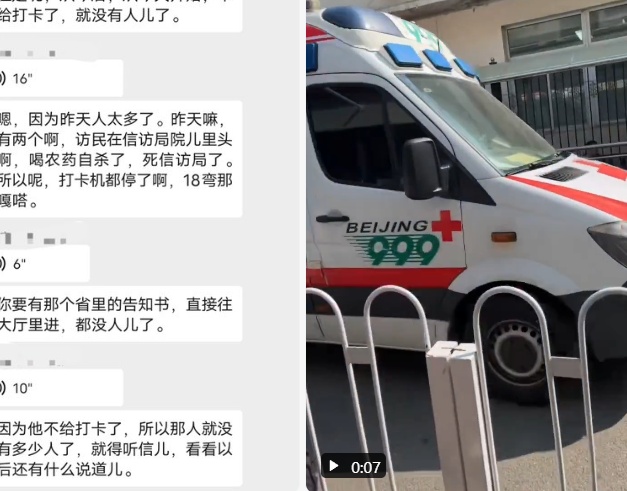
After the implementation of the new petition regulations by the Chinese Communist Party on July 1st, petitioners from various regions are restricted from going to Beijing, causing widespread discontent. According to petitioners at the Beijing petition office, on the morning of September 16th, there was a sudden increase in the number of petitioners outside the office, and two people attempted suicide by drinking poison. On the 17th, the Beijing petition office closed its doors and stopped registration.
In the morning of September 16th, petitioner Bai Yu, who was queuing outside the petition office to register, told Epoch Times that she saw ambulances coming in and out. “At that time, when I reached the position of the National People’s Congress (reception office), I first saw an ambulance coming out. After two hours, a man lay straight on the stretcher cart and was taken out by them. At that time, I was wondering why that person didn’t get into the ambulance? I didn’t even know if he survived or not.”
On the morning of the 17th, Bai Yu was getting ready to go to the petition office to join the queue, when another petitioner told her that the two petitioners who drank poison had died, and the office had stopped registration for the day. “A woman told me that something big happened at the national petition office, don’t go there. Two people died, and they are not allowing anyone to register.”
Journalists tried to contact the petition reception department of the Beijing petition office but were unable to get through.
Bai Yu, who temporarily resides in Beijing, said that the new petition regulations have been in effect for over two months. She used to go to register almost every day and noticed significantly fewer petitioners outside the office. However, on the morning of the 16th, the number of petitioners suddenly increased.
The new regulations require petitioners to obtain a certificate from their home province allowing them to petition in Beijing. However, according to petitioners, the majority of them are unable to obtain this certificate, preventing them from going to Beijing to petition.
“If the province doesn’t issue the certificate, there’s no way. So, these people all came to Beijing. If the local authorities don’t provide anything, and Beijing doesn’t accept or allow entry, these people must feel very desperate, and some may see no other way out.”
Petitioner Gao Liang told Epoch Times that news of petitioners committing suicide spread rapidly. He mentioned that entering the petition compound requires passing through three security checkpoints, and the final one only allows bringing in documents, making it unlikely that poison could be ingested in the petition hall.
Gao Liang said that before the implementation of the new regulations, petitioners used to gather outside the petition office. After the regulations took effect, petitioners are now dispersed to Tiananmen Square, the Communist Party State Council office, Zhongnanhai, and other important locations, resulting in a higher concentration of people.
“Beijing is in chaos now. Previously, whether it was Zhongnanhai or Tiananmen, there were few people visiting, around a hundred. Now, seven to eight hundred people show up every day. There are also six to seven hundred people near the State Council office. Each day, there are five to six vans transporting petitioners to Jiujingzhuang, compared to only two vans previously.”
Gao Liang believes that by freezing the contradictions between officials and civilians, not resolving old cases, and piling up new cases, the social contradictions are intensifying, leading to frequent extreme incidents.
“Driven to desperation, resorting to suicide, and now incidents similar to the ‘Xianzhong Rebellion’ are occurring more frequently nationwide. The conflicts and clashes between officials and the public are becoming more severe and widespread, leading to more acts of retaliation in society.”
(The interviewees are referred to by pseudonyms)